
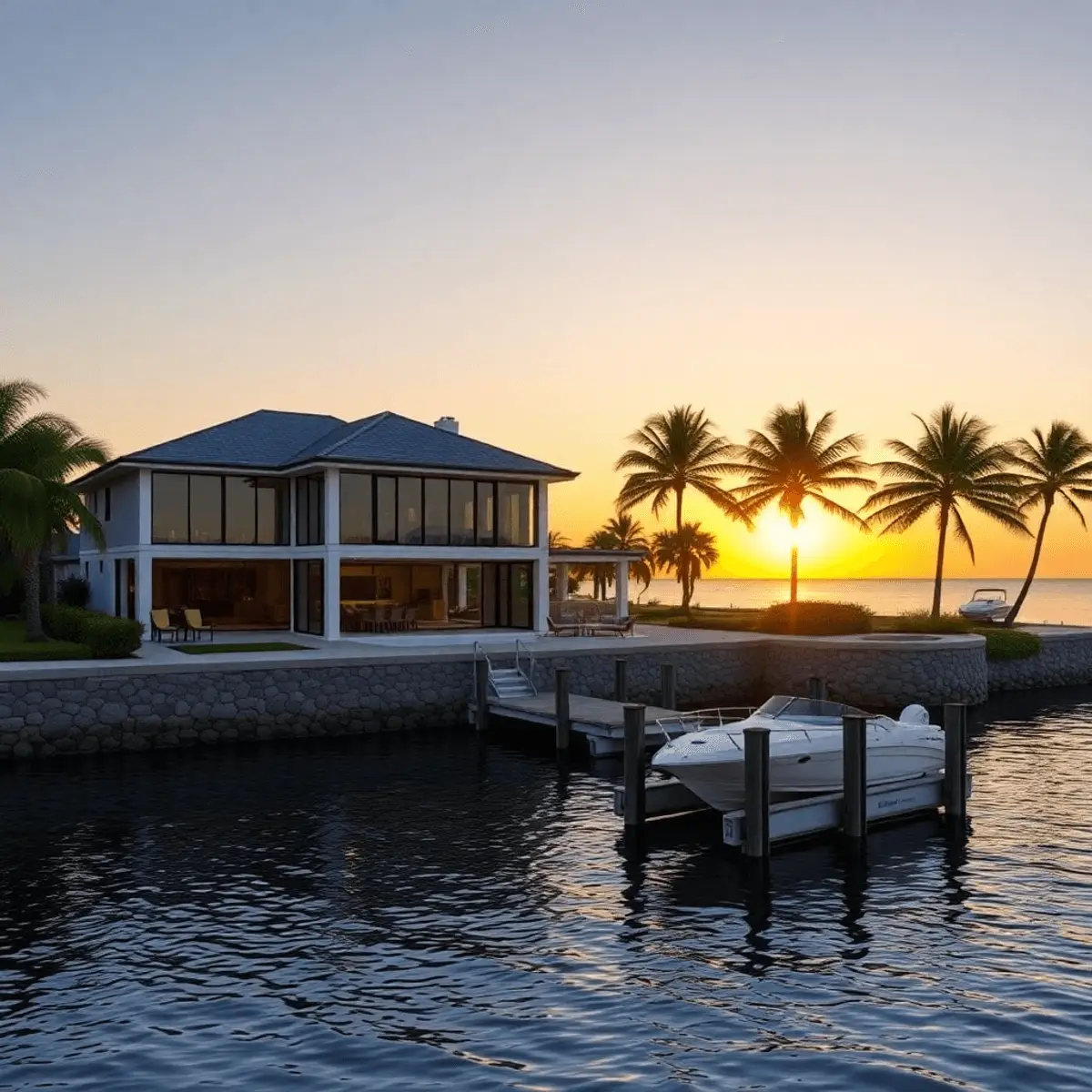
Flood zone requirements decide more about a Broward County waterfront home than any design decision that follows. Before the architecture, before the finishes, the parcel’s flood zone and base flood elevation set how high the living space must sit, what may exist below it, how the foundation is engineered, and what the home will cost to insure for its entire life. Owners who learn these rules early design beautiful homes around them; owners who learn them late redesign under pressure.
What are flood zones, and why do they govern the project?
Flood zones are FEMA’s mapped classifications of flood risk, published on Flood Insurance Rate Maps and adopted into local floodplain ordinances. They are not advisory: the zone and its base flood elevation become enforceable flood zone requirements through the permit, and they follow the property permanently through insurance and resale.
Every parcel’s designation is looked up at the FEMA Flood Map Service Center, and the state’s floodplain management program explains how communities adopt and enforce those maps through the Florida Division of Emergency Management.
Which flood zones appear across Broward County?
Three dominate the luxury corridor: AE zones, inland and along canals, where flooding is expected but wave action is not; VE zones, the coastal high-hazard areas exposed to waves, carrying the strictest rules; and X zones, outside the mapped high-risk areas, where flood insurance is optional but flooding is still possible. The letter changes the engineering, the cost, and the paperwork.
The zone-by-zone comparison is expanded in AE, VE and X flood zones in Broward County, with the coastal-high-hazard specifics in V-zone construction requirements.
What is base flood elevation and why does every number matter?
Base flood elevation is the height floodwater is expected to reach during the base flood event, and it is the datum every flood zone requirement references. The lowest floor must sit at or above it, plus whatever freeboard the local ordinance adds, and the finished elevation is documented on a FEMA Elevation Certificate that follows the home through insurance and resale forever.
The luxury design implications are covered in base flood elevation requirements versus luxury lifestyle, and the documentation in FEMA elevation certificates.
What do flood zone requirements demand of new construction?
Elevation of the lowest floor above BFE plus freeboard; foundations engineered for the zone, piles or columns in VE, compliant walls with flood openings in AE; flood-damage-resistant materials anywhere below the flood level; elevated or protected mechanical, electrical, and plumbing systems; and enclosed space below the elevated floor limited to parking, access, and storage only.
FEMA’s technical bulletins on flood-damage-resistant materials and flood openings are the working references; the foundation strategies are detailed in elevated foundation and coastal home design.
What extra rules apply to waterfront parcels?
The marine scope brings its own reviewers: seawalls, docks, and any work over water answer to state and sometimes federal agencies alongside the county, and oceanfront parcels add the state’s Coastal Construction Control Line. Those approvals run on their own timelines, which is why waterfront projects open the slowest track first rather than last.
The CCCL program belongs to the Florida Department of Environmental Protection; the full waterfront sequence is in waterfront home construction in South Florida.
How does permitting handle flood compliance?
Through documentation at three moments: the permit application establishes the design elevation and foundation approach; construction inspections verify the work; and an Elevation Certificate records the as-built elevations before the certificate of occupancy. Miss any of the three and the project stalls where it is most expensive to stall.
Broward’s building authorities publish the local requirements through Broward County Building, and the approvals strategy is covered in the South Florida luxury home permitting process and building codes across the three counties.
How do flood zone requirements affect budget?
Through five drivers: foundation type and depth, the structural cost of elevating the living level, flood-resistant materials and detailing below the flood line, elevated or relocated mechanical systems, and site work and drainage. None is optional, all are engineerable, and every one of them is cheaper decided in design than discovered at inspection.
Where these land among the other budget categories is shown in the luxury construction cost breakdown, with the insurance side in how flood zones impact insurance premiums.
Which flood zone requirements do owners get wrong most often?
Four repeat offenders: buying a lot without confirming its zone and BFE; designing the home before the elevation strategy; treating the space below the elevated floor as usable living area; and deferring the Elevation Certificate until closing. Renovations add a fifth, crossing the substantial-improvement threshold unaware, which pulls the entire home into current compliance.
The renovation trigger is explained in retrofitting existing homes for flood zone regulations.
How does Kass Construction & Development handle flood compliance?
By underwriting it before design: Kass Construction & Development, a state-licensed (CGC1529472) boutique luxury builder led by Mitch Kass, a licensed general contractor and attorney, with 100+ luxury residences delivered by Mitchell Kass and the firms he has led across Broward, Palm Beach, and Miami-Dade, confirms zone, BFE, and freeboard at the lot stage, then designs the elevation strategy as architecture rather than compliance.
A custom build often runs 18 to 36 months and a high-end renovation 6 to 12 months; flood decisions belong at the front of both, during pre-construction planning. Contact Kass Construction & Development or call 954-607-4335.
What does each Broward County flood zone require of a new luxury home?
The flood zone letter sets the foundation, the lowest floor, and what may exist below it; the table below is the practical translation.
Key takeaways
- What does each Broward County flood zone require of a new luxury home?
The flood zone letter sets the foundation, the lowest floor, and what may exist below it; the table below is the practical translation. - How do you find and confirm a Broward County parcel's flood zone?
Broward County's own floodplain and environmental resources are at broward.org, and the elevation certificate is explained in FEMA elevation certificates for buyers and builders. - How do flood zone requirements shape the design of a luxury waterfront home?
The required elevation is a design input, and the best South Florida houses use it. - What is the substantial improvement rule, and how does it change a Broward renovation?
In any mapped flood zone, once improvement costs reach 50 percent of the building's market value, the entire structure must be brought into compliance with current flood zone requirements, which usually means elevating.
| Flood zone | What it means | Construction consequence |
|---|---|---|
| X (unshaded) | Minimal flood hazard | No federal elevation mandate; local freeboard and drainage still apply |
| X (shaded) / 0.2 percent | Moderate hazard | Elevation recommended; insurers price it |
| AE | 1 percent annual chance flooding with a base flood elevation | Lowest floor at or above BFE plus freeboard; enclosures below limited to parking, storage, access with flood vents |
| AH / AO | Shallow ponding or sheet flow | Elevation above the stated depth; drainage design |
| VE | Coastal high hazard with wave action | Open pile or column foundation, lowest horizontal member above BFE, breakaway walls only below, no fill for structural support |
Definitions come from FEMA; the VE rules are detailed in V-zone construction requirements.
How do you find and confirm a Broward County parcel’s flood zone?
- Look the address up on the FEMA Flood Map Service Center and note the zone, the base flood elevation, and the map panel date.
- Check the municipality’s floodplain ordinance for local freeboard above the federal minimum; many South Florida jurisdictions add a foot or more.
- Order an elevation certificate from a licensed surveyor to learn where the existing grade and any existing structure actually sit.
- Ask the floodplain administrator for a written flood zone determination if the parcel straddles a boundary.
- Record the numbers in the design brief before the architect draws a floor.
Broward County’s own floodplain and environmental resources are at broward.org, and the elevation certificate is explained in FEMA elevation certificates for buyers and builders.
How do flood zone requirements shape the design of a luxury waterfront home?
The required elevation is a design input, and the best South Florida houses use it.
- Arrival. Stairs and an elevator become part of the entry sequence; a porte-cochere and covered parking occupy the level below the living floor.
- Views and breeze. An elevated main level sees over the seawall and catches the easterly breeze; terraces and balconies extend it.
- Below the living level. Parking, storage, and access only, built with flood-damage-resistant materials and flood vents (AE) or breakaway walls (VE).
- Systems. Air handlers, electrical panels, water heaters, and generators above the design flood elevation; pool equipment elevated or flood-rated.
- Site. Grading and drainage that move water away from the structure without loading the neighbor’s lot.
The architecture of that height is the subject of creative elevated design solutions; the foundation choices are compared in elevated foundation coastal home design.
What is the substantial improvement rule, and how does it change a Broward renovation?
In any mapped flood zone, once improvement costs reach 50 percent of the building’s market value, the entire structure must be brought into compliance with current flood zone requirements, which usually means elevating. The practical consequences:
- Cumulative rules: some jurisdictions count improvements over a period of years, so two smaller projects can add up to one substantial improvement.
- Value is the building only, not the land; an appraisal or the tax assessor’s building value is the usual benchmark.
- Repairs after storm damage are counted the same way as improvements.
- The determination is made by the local floodplain administrator at permit application.
FEMA’s definition is at fema.gov; how the rule drives the renovate-or-rebuild decision is worked through in teardown vs renovation in South Florida, and the insurance consequences in flood insurance requirements for elevated luxury homes.
Frequently Asked Questions
How do I find my property’s flood zone in Broward County?
Look the parcel up at FEMA’s Flood Map Service Center and confirm with the local building department, since communities can adopt stricter requirements than the federal minimum. Do it before making an offer, not after.
What is freeboard, and does Broward require it?
Freeboard is additional height required above base flood elevation by local ordinance. Requirements vary by community within the county, which is why local verification matters as much as the FEMA map.
Can I build living space below the elevated floor?
No. Enclosed area below the flood elevation is limited to parking, building access, and storage, and in AE zones it must have compliant flood openings. Finished living space below the line violates flood zone requirements and voids insurance assumptions.
Do flood zone requirements apply to renovations?
They apply fully once a renovation crosses the substantial-improvement threshold, at which point the entire home must meet current flood standards. Below the threshold, requirements attach to the work itself.
What is an Elevation Certificate and when is it needed?
It is the surveyed record of the building’s elevations relative to base flood elevation, required to close out permitting and used by insurers to rate the policy. Buyers should request the existing certificate during diligence.
Does a higher elevation lower flood insurance?
Generally yes: rating reflects how the lowest floor sits relative to base flood elevation, so building above the minimum is one of the few permanent levers an owner controls. The premium effect compounds over the life of the home.
How early should flood analysis happen?
Before the lot purchase closes. Flood zone requirements, BFE, freeboard, and the resulting elevation strategy shape the entire design and budget, and they are the cheapest facts to confirm and the most expensive to discover late.
What is the base flood elevation (BFE)?
The minimum height a home must be built above to reduce flood risk.
Do I have to elevate my home in Broward County?
Yes—if located in a flood zone, elevation is required for new construction.
Are new flood maps affecting Broward County?
Yes—updated FEMA maps became effective in 2024 and impact building requirements
Does elevation reduce insurance costs?
Yes—higher elevation typically results in lower flood insurance premiums.