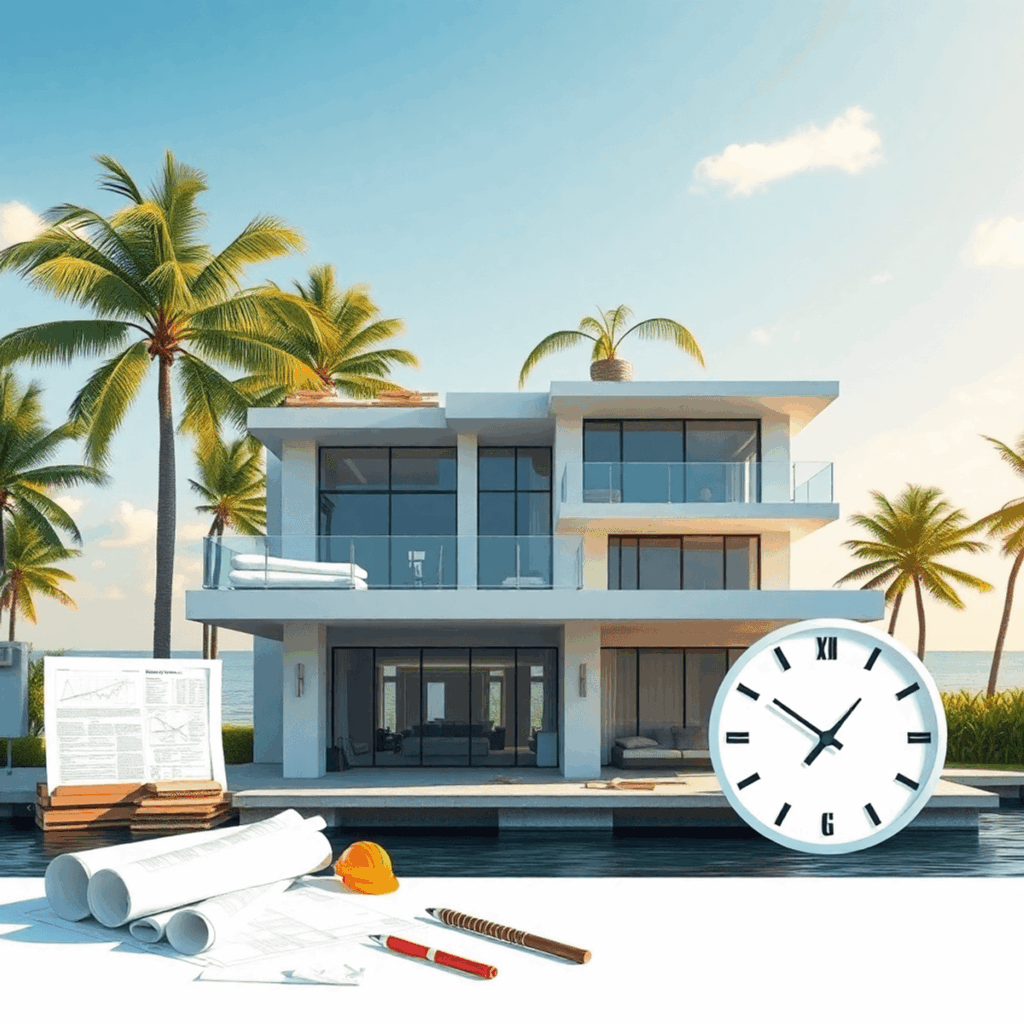
Building a luxury custom home in South Florida is an exciting endeavor. However, the permitting process can quietly add weeks or even months to your timeline if not handled with discipline from the start. High-end homes, particularly waterfront estates, trigger more reviews, involve more departments, and require more coordination than a typical single-family build. This isn’t inherently problematic, but it becomes an issue when teams treat permitting as a mere formality rather than a project phase that requires serious management.
In Broward, Palm Beach, and Miami-Dade, the permitting process varies by municipality. Two homes with similar designs can follow very different review paths depending on whether the property is located in Fort Lauderdale, Hollywood, Boca Raton, Delray Beach, Miami Beach, Coral Gables, or an unincorporated area. Some cities route plans through multiple internal divisions while others require external sign-offs before starting certain reviews. Understanding these local differences early on can significantly alter your planning timeline and submittal strategy.
In reality, a “permit delay” seldom manifests as one dramatic denial. Instead, it usually presents itself as repeated comment cycles, missing approvals, plan revisions, resubmittals, and scheduling bottlenecks that accumulate over time. The goal of this guide is straightforward: to highlight the most common delay points for luxury homes in South Florida and provide strategies to prevent them before they cost you valuable months.
To mitigate these delays, it’s crucial to adopt a proactive approach towards luxury home renovations and remodeling. This involves thorough research and understanding of local regulations and requirements for luxury custom home building in South Florida, which can greatly streamline the permitting process.
Moreover, when it comes to luxury home architecture and design, working closely with experienced professionals who understand the unique challenges of building in this region will help ensure that your project stays on track and within budget.
Why luxury home permits get delayed more often in South Florida
Luxury homes tend to be custom by definition. That customization increases the number of details that must be coordinated across architectural, structural, civil, and MEP (mechanical, electrical, plumbing) drawings. Add waterfront conditions, floodplain requirements, coastal construction considerations, and higher wind design pressures, and it is easy to see why reviewers look closer.
The good news is that most “surprise” delays are preventable. Prevention is about doing the right work earlier, coordinating the right people, and submitting complete packages that make a reviewer’s job easy.
1) Incomplete or inconsistent plan sets (the #1 avoidable delay)
The most common scenario is also the most frustrating: the architectural plans, structural drawings, MEP sheets, and civil/site plans do not fully align. A reviewer flags conflicts, the team revises, and the project gets pushed into another cycle.
High-end features add real complexity here, including:
- Large-span openings and big sliders that affect headers, shear walls, and anchorage
- Custom staircases and floating treads that require clear structural detailing
- Elevators that trigger specific shaft, electrical, and life safety requirements
- Smart home systems, low-voltage infrastructure, and equipment space planning
- Specialty glazing, oversized doors, and unique façade systems
- Generator tie-ins, transfer switches, and fuel source coordination
Typical comments that force resubmittals include missing details, conflicting dimensions, unclear code references, incomplete product approvals, and plans that do not clearly show how the building is anchored, ventilated, drained, and powered.
How to prevent it
To avoid these common pitfalls in luxury home construction in South Florida it’s essential to run a coordinated pre-submittal plan review with architect, engineers, and builder in the same room (or same call) looking at the same set. This approach ensures everyone is on the same page and can address any potential issues before submission.
Moreover maintaining one “source of truth” drawing set with a clear version-control process can significantly reduce confusion. Assigning a responsibility matrix makes it obvious who owns each sheet and each supporting document.
Finally, submitting complete supporting documents the first time—such as energy forms, product approvals, shop drawing notes—can save a lot of time. For more insights on navigating these complexities in luxury home construction in South Florida you can refer to Kass Construction’s insights page.

For further resources related to luxury home construction such as templates or checklists you can visit Kass Construction’s resources.
2) Zoning and land-use conflicts discovered late
Zoning issues are a common trigger for luxury homes, especially in South Florida where luxury real estate trends often push the edges of what is allowed. The biggest culprits include setbacks, lot coverage, height limits, floor-area ratio, accessory structures, privacy walls, and guest houses or detached structures.
Waterfront properties add another layer of complexity. Seawalls, docks, boat lifts, and riparian rights can involve separate agencies and require separate approvals. Even when a dock permit is not required for the building permit itself, the site planning often needs to account for waterfront constraints that shape grading, drainage, and access.
Late discovery of zoning issues usually happens when design advances before confirming zoning constraints or the likelihood of obtaining a variance. By the time someone checks, the home is already “designed,” and now the project must either shrink, shift, or enter a variance process with its own timeline and public hearing requirements.
How to prevent it
- Start with an early zoning analysis and, when appropriate, a pre-application meeting.
- Confirm survey accuracy before design is far along.
- Design to zoning from day one, not after the fact.
- If a variance is likely, build a real variance strategy that includes timeline planning, neighbor outreach, and strong documentation.
3) Survey, elevation, and floodplain documentation issues
South Florida’s sensitivity to elevation data is well-founded. Flood zones, base flood elevation (BFE), required freeboard, finished floor elevations, and drainage planning are all interconnected. If the documentation is outdated or inconsistent, reviewers will halt the process until clarification is provided.
Common delay causes include outdated surveys, missing benchmarks, inconsistent elevations between civil and architectural plans, and floodplain manager questions that necessitate revisions and re-stamping.
Waterfront estates receive even more scrutiny because drainage, stormwater management, and finished grade transitions must be meticulously resolved to ensure site performance during heavy rain and king tide conditions.
How to prevent it
- Order a current boundary and topographic survey with clear benchmarks.
- Verify flood zone information early and confirm which FEMA map panel applies.
- Align civil and architectural elevations before submittal to avoid complications during comments.
- Document assumptions clearly including datum references and finished floor targets.

4) Product approvals and specialty materials not ready at submittal
Florida’s product approval environment is strict, and luxury selections can slow permits when decisions are left open. Impact-rated windows and doors, roofing assemblies, exterior cladding systems, and balcony or guard assemblies often require Florida Product Approval and, in many cases, Miami-Dade NOAs as well.
The most common issues are “TBD” specifications, substitutions mid-review, missing approval numbers, and incomplete engineering for custom systems. Even when deferred submittals are allowed, they must be properly structured and approved by the design team so the building department is comfortable issuing the permit.
How to prevent it
- Lock key exterior envelope decisions early: windows, doors, roofing, waterproofing approach, and exterior cladding.
- Maintain a product approvals log that lists approval numbers, limits, and installation requirements.
- Preselect alternates so procurement issues do not force late swaps.
- Coordinate structural engineer sign-offs for deferred submittals where allowed, and document the deferral clearly.
5) Historic district, HOA, or design review board approvals overlooked
Many luxury neighborhoods have layered approvals outside the building department. HOA architectural review committees, community guidelines, historic preservation boards, and neighborhood overlays can all be in play.
This derails schedules when a city will not issue the permit until external approvals are documented, or when a board requests redesign after the permit review is already underway. Meeting schedules alone can add weeks if you miss a submission deadline and get pushed to the next cycle.
How to prevent it
- Request governing documents early and read the architectural standards carefully.
- Map every required approval and the meeting dates well in advance.
- Present realistic renderings and material boards so boards can evaluate what you actually plan to build.
- Keep a buffer for board cycles, revisions, and re-presentations.
6) Underestimating MEP complexity in high-end homes
Luxury homes have more MEP scrutiny because the systems are bigger, denser, and more integrated. Multiple HVAC systems, ERVs, dehumidification, smart lighting panels, whole-home audio, security, generators, elevators, and pools or spas create coordination challenges that do not show up on simpler builds.
Common causes of delay include missing load calculations, panel schedules that do not match the plans, unclear equipment locations, ventilation conflicts, and communications pathways that are not shown. Reviewers need to see that the home will be safe, code-compliant, serviceable, and realistically buildable.
How to prevent it
- Engage MEP engineers early, not after the floor plan is “final.”
- Produce coordinated equipment plans and riser diagrams that match architectural layouts.
- Confirm utility requirements early, including service size and any constraints.
- Pre-plan generator placement and noise setback implications.
- Align low-voltage scope with electrical so pathways, racks, and power needs are clear.

7) Contractor licensing, paperwork, and permit submission errors
Administrative issues can still cause major delays, even on very sophisticated projects. Common problems include incorrect contractor of record, expired licenses or insurance, missing notarizations, owner-builder confusion, and permits filed under the wrong type.
South Florida also has real-world friction points: municipal portals, document naming rules, digital signature requirements, and threshold building requirements where applicable. A technically excellent plan set can still stall if the submission is not compliant with the city’s process.
How to prevent it
- Assign a single permitting lead who owns the checklist and the portal process.
- Use a compliance checklist for every submission and resubmission.
- Verify contractor and qualifier information before filing, not after rejection.
- Confirm whether the project triggers threshold requirements and prepare accordingly.
- Ensure affidavits, notarizations, and recorded documents are ready and correctly executed.
8) City review backlogs and inspection scheduling bottlenecks
Some delays are outside any homeowner’s control. Reviewer workloads, staffing, peak seasons, and the sequencing across departments can extend timelines.
What still helps is what reviewers consistently reward: a clean first submittal, fast and complete resubmittals, proactive communication, and an understanding of how routing works (zoning, building, fire, engineering, public works, and sometimes outside agencies).
How to prevent time loss
- Build a realistic permit timeline and assume at least one comment cycle on custom work.
- Track cycles and due dates so responses do not sit idle.
- Schedule pre-inspections or preconstruction meetings when available.
- Keep trades aligned so inspections do not fail for avoidable reasons like missing access, incomplete paperwork on site, or uncoordinated sequencing.
9) Late changes by the owner or design team
Luxury projects are especially prone to change. It is normal to refine finishes, adjust layouts, enlarge openings, revise kitchens and baths, or add AV and security upgrades. The problem is timing. Changes during permit review can create ripple effects: revised engineering, recalculations, updated energy forms, updated product approvals, and re-review fees.
Even “small” changes can be big in permitting terms if they touch structure, egress, glazing, mechanical loads, or electrical service.
How to prevent it
- Set decision deadlines and treat them as real project milestones.
- Freeze a true “permit set” and manage later preferences as alternates or post-permit selections when feasible.
- Use formal change-control that clearly states the time and cost impact before the change is approved.
A practical prevention plan: how to keep your permit moving from day one
If you want a simple workflow that reduces surprises, this is a strong starting point:
- Due diligence: confirm property constraints, utilities, and any overlays (HOA, historic, coastal).
- Zoning and survey: order a current survey, confirm zoning limits, and verify flood zone and elevation requirements.
- Concept set: develop a concept that is already designed to zoning and site realities.
- Coordinated engineering: bring structural, civil, and MEP into the process early so systems fit the architecture.
- Pre-submittal review: hold a coordination review and complete a document checklist before uploading anything.
- Complete submittal package: submit plans and supporting documents together, with product approvals strategy defined.
- Comment response cadence: respond quickly, clearly, and completely, with a single point person tracking every comment and every revision.
Create a simple “permitting binder” (digital is fine) that includes surveys, zoning notes, an approvals log, product approvals, contacts by department, and a decision tracker. For luxury custom homes, the permitting phase goes smoother when the team is integrated: builder, architect, engineers, and permitting lead working off one coordinated plan.
Timeline mindset matters too. Even with excellent preparation, plan for review cycles and build buffers around board meetings, coastal reviews, and specialty approvals. A realistic schedule is not pessimism. It is how you protect your construction start date.
How Kass Construction & Development helps prevent permit delays in Fort Lauderdale and beyond
Kass Construction & Development is a boutique, state-licensed luxury custom home builder based in East Fort Lauderdale, serving Broward, Palm Beach, and Miami-Dade. The focus is precision, transparency, and long-term value, especially for architect-driven custom homes, waterfront estates, and high-end renovations.
Permitting delays are often a coordination problem. To address this, Kass takes an integrated approach that connects permitting and project management with architect and design partnerships, owner’s representation, and construction risk mitigation. When needed, Kass also coordinates with real estate attorneys and other professionals so the project is protected from the early feasibility stage through final construction.
In practice, that looks like:
- Early feasibility and zoning review before design gets locked in
- Coordinated plan set management across architect, engineers, and consultants
- Product approvals tracking so envelope decisions do not stall issuance
- Disciplined comment-response turnaround to keep cycles moving
If you are planning a custom home or a high-end renovation in Fort Lauderdale or anywhere in Broward, Palm Beach, or Miami-Dade, the best time to discuss permitting is before the design is finalized. A short conversation early can prevent months of avoidable delays later.
FAQs (Frequently Asked Questions)
Why does the permitting process for luxury custom homes in South Florida often take longer than typical single-family builds?
Luxury custom homes, especially waterfront estates in South Florida, involve more detailed reviews, multiple departments, and require extensive coordination. These complexities, combined with local municipal variations in Broward, Palm Beach, and Miami-Dade counties, mean that permitting is a multi-phase project requiring disciplined management to avoid significant timeline extensions.
How can incomplete or inconsistent plan sets delay luxury home permits in South Florida?
Incomplete or inconsistent architectural, structural, MEP (mechanical, electrical, plumbing), and civil plans are the leading cause of permit delays. Conflicts such as missing details, conflicting dimensions, unclear code references, and incomplete product approvals force repeated resubmissions and prolong the review process.
What strategies can help prevent permit delays caused by plan inconsistencies during luxury home construction?
Conducting a coordinated pre-submittal plan review with architects, engineers, and builders ensures alignment on all drawings. Maintaining one ‘source of truth’ drawing set with strict version control and assigning clear responsibility matrices for each document sheet significantly reduces confusion. Additionally, submitting complete supporting documents like energy forms and product approvals upfront streamlines approval.
How do zoning and land-use conflicts impact luxury home permitting in South Florida?
Zoning and land-use conflicts are common hurdles for luxury homes due to unique local regulations and trends pushing development boundaries. Discovering these conflicts late in the permitting process can cause substantial delays as revisions or variances may be required to comply with municipal codes.
Why is understanding local municipal differences important when building a luxury custom home in South Florida?
Permitting processes vary widely across municipalities like Fort Lauderdale, Boca Raton, Miami Beach, and unincorporated areas. Some require multiple internal reviews while others need external sign-offs before certain reviews begin. Early comprehension of these differences allows for better planning timelines and submission strategies tailored to each location’s requirements.
How does working with experienced professionals benefit luxury home architecture and design projects in South Florida?
Experienced architects and builders familiar with South Florida’s unique coastal conditions, floodplain requirements, wind design pressures, and permitting nuances can proactively address potential challenges. Their expertise helps keep projects on schedule and within budget by preventing common pitfalls that cause permit delays.