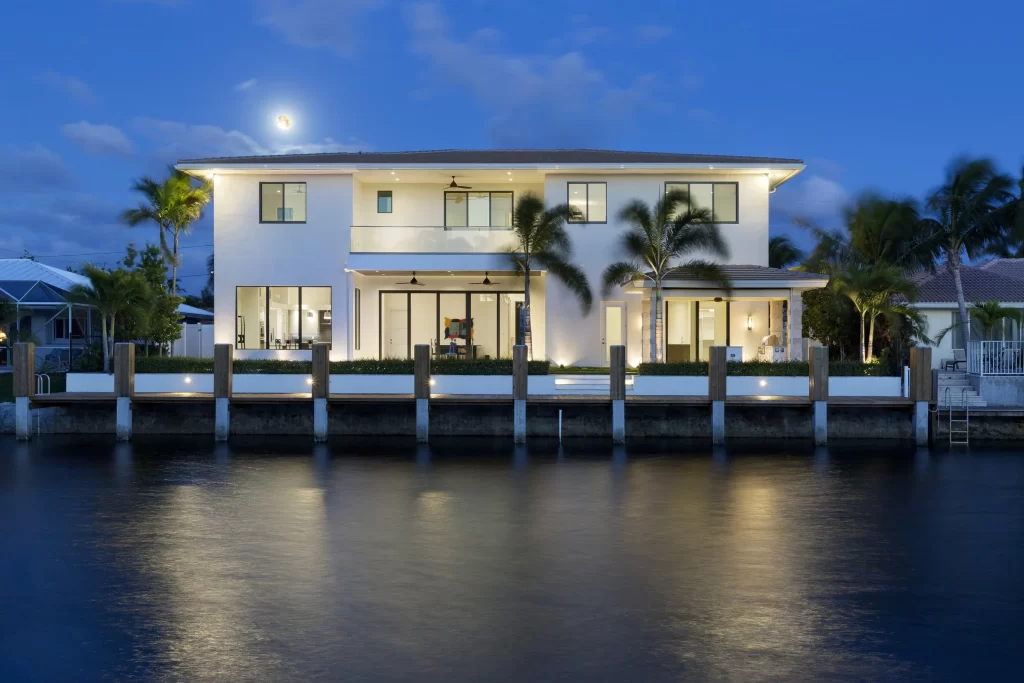
Luxury homes are not merely “bigger versions” of standard builds. In South Florida, they represent complex, permit-heavy projects that involve specialty trades, long lead times, waterfront variables, and large deposits that move swiftly once the deal is finalized.
The catch is that many high-net-worth buyers often find themselves handed a “standard” construction contract that was never designed for an architect-driven custom home or a waterfront estate. This is where the potential pitfalls lie. Most expensive disputes do not start with a dramatic blowup; rather, they often begin with vague language, missing exhibits, and misaligned expectations. These issues quietly evolve into change orders, delays, and finish-level disappointment.
The goal of this guide is straightforward: to help you spot contract red flags early so you can protect your budget, timeline, design intent, and long-term resale value.

Why high-net-worth buyers get burned by “standard” construction contracts
South Florida luxury projects carry risk for reasons that have nothing to do with the quality of the contractors involved. You are often dealing with:
- Complex permitting and inspections, especially for waterfront, flood zones, coastal construction, historic overlays, or strict municipal review.
- Specialty trades and high coordination demands, like elevator installers, generator vendors, home automation integrators, custom millwork shops, and high-performance glazing teams.
- Long-lead procurement, including windows and doors, stone slabs, appliances, switchgear, and bespoke fixtures.
- Large upfront cash flow, where deposits and early draws can get out in front of verifiable progress.
Where things typically go wrong is usually in the paperwork: a contract that is light on scope detail and standards but heavy on vague promises like “we’ll figure it out later.” Unfortunately, “later” is often when the money leaks and the schedule slips.
Understanding these intricacies can significantly improve your experience in luxury custom home building in South Florida, [luxury home architecture design](https://f9productions.com/steps-for-planning-and-executing-a-successful-home-build/), or luxury home renovations remodeling projects. However, it’s essential to recognize that there are several challenges associated with building a custom home. To better prepare yourself for this journey into luxury custom home construction, understanding these challenges can significantly enhance your overall experience.
Before you sign: the three documents you should insist on seeing
If the builder cannot attach these documents, you are not looking at a complete agreement. You are looking at a framework for future disagreements.
1) A complete scope exhibit
At minimum, this should include:
- Drawings and relevant details
- Specifications and performance requirements
- Finish schedules (floors, tile, stone, paint systems, hardware, plumbing, lighting)
- Allowance list (if any) with assumptions
- A clear list of owner-supplied items (and who installs, warrants, and coordinates them)
2) A realistic project schedule with milestones
You want a schedule that acknowledges the reality of:
- Permitting and re-submittals
- Long-lead procurement (windows/doors, generator, elevator, stone)
- Dry-in timing, inspections, and trade sequencing
3) A payment schedule mapped to verified progress
Progress should be tied to measurable milestones, not calendar dates. For example:
- Permit issuance
- Foundation inspection passed
- Rough framing complete
- Rough MEP (mechanical, electrical, plumbing) complete and inspected
- Dry-in achieved (roof, windows/doors installed, waterproofing milestones)
If the builder wants payment “on the 1st of every month” regardless of what is complete, that is a leverage problem.

Red flag #1: Vague scope language that lets the builder charge you twice
Watch for phrases that sound harmless but create loopholes:
- “As needed”
- “Builder standard”
- “Or equivalent”
- “Per code” (without defining the product and performance standard)
Vague scope is how a contract quietly becomes a change order machine. In luxury homes, the biggest surprises often show up in:
- Trim profiles, reveal details, and millwork grade
- Soundproofing assemblies between rooms and floors
- Waterproofing details in showers, balconies, and exterior transitions
- Smart home wiring, rack locations, and prewire scope
- Exterior hardscape, drainage, and landscape boundaries
- Dock/seawall coordination, utilities, and specialty permitting on waterfront projects
What to request in writing:
- A clear inclusions and exclusions list
- Attached specs and a finish schedule with brand, series, and performance notes
- Model numbers where possible (appliances, plumbing fixtures, lighting systems)
- Mock-up expectations for high-end work (tile, stucco, stain, paint level)
If something matters to you visually or acoustically for long-term durability it must be defined.
For more insights into navigating construction contracts effectively while avoiding potential pitfalls like vague scope language or unrealistic timelines check out these insights from Kass Construction which provide valuable information on how to handle such situations. Additionally their resources page offers further reading material to equip you with the knowledge needed when dealing with construction agreements.
Red flag #2: Allowances that are unrealistic for luxury finishes
Allowances are not automatically bad. The problem is unrealistic allowances that make a bid look competitive while guaranteeing overruns later.
In high-end South Florida builds, common allowance categories include:
- Custom cabinetry and built-ins
- Appliances (especially integrated and panel-ready packages)
- Stone slabs and fabrication
- Plumbing fixtures and trim packages
- Decorative lighting and controls
- AV and smart home systems
- Landscaping, irrigation, and outdoor lighting
- Pool finishes, tile, and equipment upgrades
How to sanity-check allowances:
- Compare the allowance numbers to your architect/designer selections.
- Ask what pricing level the builder assumed for the neighborhood and comparable builds.
- Require an allowance worksheet that includes unit counts and assumptions (for example: how many recessed lights, how many plumbing fixtures, linear feet of cabinets).
Protective language to add:
- Allowance overruns require written owner approval before purchase.
- Any builder fee or markup on allowances must be clearly disclosed.
- Substitutions must meet defined performance standards, not just “or equivalent.”
Red flag #3: Payment terms that expose you to leverage loss (or lien risk)
High-net-worth buyers can afford the home, but that is exactly why contract terms can drift in the builder’s favor. You want a structure that protects leverage and reduces lien exposure.
Watch for large upfront deposits
If a deposit is not tied to real mobilization costs, early permitting work, or clearly defined preconstruction services, it is a risk.
Avoid pay-on-date clauses
A draw schedule should be tied to completion milestones, inspections, and visible progress. Paying on a date invites disputes when progress is subjective.
Be careful paying for uninstalled materials
Sometimes it is appropriate for long-lead items, but only if the contract requires:
- Secure storage
- Proof of insurance
- Clear ownership language
- Documentation (invoices, serial numbers where applicable)
- Verification that the materials are actually ordered and received
Control lien exposure
Require lien waivers with every draw:
- Contractor waiver
- Subcontractor and supplier releases
For larger renovations or complex new builds, many high-net-worth buyers also use escrow controls or third-party draw verification through an owner’s representative.
Red flag #4: One-sided change order clauses that guarantee budget creep
Changes are normal in custom construction. The danger is a contract that lets changes happen without clear pricing, documentation, and schedule accountability.
Problem clauses include:
- Verbal approvals
- The builder can proceed “at owner’s expense”
- No defined pricing method
- Excessive markup on changes
- No requirement to disclose schedule impact
A fair change order process should require:
- Written request (owner, architect, designer, or builder-initiated)
- Priced proposal with labor and material breakdown
- Schedule impact disclosed in writing
- Owner signature required before work starts
Also clarify, in writing, who pays for:
- Design errors or missing details
- Coordination gaps between trades
- Code-driven revisions discovered late due to sequencing or permit issues
If the contract treats every gap as an “owner change,” you should renegotiate before signing.
Red flag #5: No clear standard for quality, mockups, and “substantial completion”
Luxury buyers do not just care that the house is finished. They care that it is finished to a defined standard.
If the contract does not define quality, you end up arguing opinions.
Define quality standards and inspection points
Consider adding references to:
- Finish level expectations (paint level, drywall finish, millwork grade)
- Alignment, lippage, grout joints, and acceptable tolerances
- Hardware, door swing, and reveal consistency
- Waterproofing and exterior envelope standards
Require mockups where failures are expensive
Mockups help avoid costly rework and disappointment. Common ones:
- Tile layout and grout color mockups
- Stucco texture samples
- Paint samples in real lighting conditions
- Millwork stain and sheen samples
- Waterproofing details at showers, balconies, and transitions
Define substantial completion vs final completion
Substantial completion should mean the home is safe and usable, with essential systems operational. Final completion should mean:
- Punch list completed
- Closeout documents delivered
- Final inspections and CO (if applicable)
- Retainage released only after completion criteria are met
On high-value projects, third-party inspections can protect long-term value, especially for waterproofing, building envelope, and HVAC commissioning.
Red flag #6: Warranty language that sounds good but is hard to use
Many warranties look fine until you try to make a claim.
Watch for:
- Short warranty windows that expire before seasonal issues show up
- Unclear coverage exclusions
- Notice requirements that make claims impractical
In South Florida, clarify coverage for:
- Water intrusion and building envelope performance
- Cracking (and what is considered normal vs defective)
- Roofing systems and flashing details
- Windows and doors installation (not just manufacturer defects)
- HVAC and humidity control performance
- Pool equipment and finishes
- Smart home, AV, and networking systems
Add practical terms:
- Response times (acknowledgment and site visit windows)
- Escalation steps if the first response fails
- Who coordinates warranty trades after move-in
Also require that all manufacturer warranties are transferred and that closeout includes manuals, serial numbers, and as-built documentation.
Red flag #7: Missing insurance, licensing, and indemnity details
This is not paperwork trivia. This is how you protect yourself if something goes wrong on site.
Confirm:
- The builder is state-licensed, and the contract lists the license number.
- The contract names the correct legal entity you are hiring.
Require current certificates for:
- General liability
- Workers’ compensation
- Builder’s risk (and clarity on who insures the structure during construction)
For waterfront and high-value properties, confirm:
- Higher policy limits that match the project
- Additional insured language where appropriate
Indemnity should be balanced. Be cautious of clauses that push all risk to the homeowner for site conditions, third-party claims, or unforeseeable issues without a fair process.
Red flag #8: Schedule promises with no accountability (especially in South Florida)
South Florida schedules are affected by realities you cannot ignore, including permitting timelines and municipal responsiveness, inspection availability, hurricane season planning, supply chain volatility, and HOA and neighborhood restrictions.
A red flag is an “estimated” schedule with:
- No milestones
- No required notice of delays
- Broad force majeure language that excuses everything
Add accountability with:
- Milestone dates tied to stages (permit, foundation, framing, rough-in, dry-in, finishes)
- Required weekly updates
- A procurement log for long-lead items
- Delay notice requirements (how fast the builder must notify you and what documentation is required)
- Clarity on who owns permitting tasks and how re-submittals are handled
A luxury project should feel managed, not guessed.
Red flag #9: Termination clauses that trap you (or make switching builders impossible)
Most buyers never plan to terminate. But if your project goes off the rails, the contract should not make an exit financially devastating or operationally impossible.
Problem areas include:
- Termination for convenience that only favors the builder
- Excessive cure periods that allow delays to compound
- Unclear handover of plans, permits, subcontracts, and long-lead orders
Require a clean transition plan that includes:
- A deliverables list (as-builts, vendor contacts, warranties, procurement records)
- Site security and safety responsibilities
- Clear material ownership language
- A defined method for valuing work-in-place
If the contract makes it hard to retrieve permits, access records, or take ownership of materials you paid for, renegotiate.
For luxury contracts in South Florida’s real estate market, a construction-savvy attorney is not optional. It is a cost of risk management.
Red flag #10: Dispute resolution that’s expensive, slow, or biased
Disputes are rare when contracts are clear, but the clause still matters.
In practical terms:
- Mediation is a guided settlement process. It can be a helpful way to resolve disputes without escalating to more formal proceedings. Here’s a guide to civil mediation for more insight.
- Arbitration is private, often faster than court, but can be expensive and limits appeal.
- Litigation is public and slower, but sometimes necessary depending on the facts and remedies needed.
Watch for:
- Mandatory far-away venues
- One-sided attorney fee provisions
- Waivers of key remedies that remove your leverage
A better approach is stepped and time-bound:
- Executive meeting (owner and builder leadership)
- Mediation
- Arbitration or litigation
Also require documentation rules that reduce “he said, she said” later: written change orders, site photos, meeting minutes, and written approvals.
How to de-risk your build with the right team structure
Contracts matter, but execution is where risk shows up. The best outcomes happen when the team is structured for alignment from day one.
For high-net-worth buyers, that often means:
- Builder, architect, and designer aligned on scope and standards before pricing is finalized
- Permitting and procurement managed proactively, not reactively
- Independent oversight through an owner’s representative who verifies draws, tracks schedule, and documents quality
Boutique, precision-focused builders often deliver more transparency because they run fewer projects at a time and rely on repeatable systems, clean documentation, and tight accountability.
Kass Construction & Development is a Fort Lauderdale-based, state-licensed luxury builder serving Broward, Palm Beach, and Miami-Dade. Their model is architect-driven and execution-focused, with permitting and project management support and owner’s representation for clients who want tight control over budget, timeline, and quality.

A practical contract review checklist to use on your next call
Use this as a fast, high-impact checklist before you sign:
- Scope exhibits attached (drawings, specs, finish schedules, owner-supplied items list)
- Allowances are realistic and backed by a worksheet with quantities and assumptions
- Draw schedule tied to inspections and completion, not calendar dates
- Lien waivers required with every payment (contractor, subs, suppliers)
- Insurance certificates provided (GL, workers’ comp, builder’s risk) with appropriate limits. It’s essential to understand the insurance certificate requirements in your state.
- Change order process requires written pricing, schedule impact, and owner signature before work
- Quality standards defined, with required mockups where appropriate
- Substantial completion vs final completion clearly defined, with punch-list and retainage terms
- Warranty terms are usable, with response times and documentation delivery at closeout
- Schedule milestones and delay notice requirements included, with procurement tracking
- Termination handover language: records, permits, materials, and transition deliverables
- Dispute steps are fair, local, and time-bound, with documentation requirements
Bring your architect or designer into the contract review, and involve a real estate and construction attorney who understands luxury residential risk in Florida.
The best luxury build starts with a contract that is as detailed as the design. For more tips on navigating contractual agreements in the home building process, refer to these valuable consumer tips.
FAQs (Frequently Asked Questions)
Why are luxury home construction projects in South Florida more complex than standard builds?
Luxury homes in South Florida involve complex, permit-heavy projects with specialty trades, long lead times, waterfront variables, and large deposits. These factors require detailed coordination and planning beyond what standard construction contracts typically cover.
What risks do high-net-worth buyers face when using ‘standard’ construction contracts for luxury homes?
Standard construction contracts often lack the detailed scope and standards needed for architect-driven custom homes or waterfront estates. This vagueness can lead to change orders, delays, finish-level disappointments, and financial risks due to vague language, missing exhibits, and misaligned expectations.
What are the three essential documents buyers should insist on before signing a luxury home construction contract?
Buyers should insist on: 1) A complete scope exhibit including drawings, specifications, finish schedules, allowance lists, and owner-supplied item details; 2) A realistic project schedule with milestones accounting for permitting, procurement, inspections, and trade sequencing; 3) A payment schedule tied to verified progress milestones rather than fixed calendar dates.
How can vague scope language in a construction contract impact a luxury home project?
Vague phrases like ‘as needed,’ ‘builder standard,’ or ‘per code’ create loopholes that allow builders to charge extra through change orders. This often results in unexpected costs related to trim details, soundproofing, waterproofing, smart home wiring, exterior hardscape, and waterfront-specific elements.
What should be included in the scope exhibit to avoid contract disputes in luxury home building?
The scope exhibit should clearly list inclusions and exclusions with attached specifications and finish schedules detailing brands, series, performance notes, and model numbers where applicable (e.g., appliances, plumbing fixtures, lighting systems) to ensure clarity and alignment of expectations.
Why is tying payment schedules to verified project milestones important in luxury home construction?
Linking payments to verifiable milestones like permit issuance or foundation inspection ensures cash flow aligns with actual progress. This prevents situations where large upfront payments are made without corresponding work completion, protecting the buyer’s interests and maintaining project accountability.