Seawall vs elevated foundation is the first real question on a South Florida waterfront property, and it is usually asked backwards. It is not a choice between two products. It is a question about what threatens the property: erosion and soil loss at the shoreline, or flooding and wave action at the structure. Most Intracoastal estates need both, in different proportions, and the proportion is what an owner is actually deciding.
Key takeaways
- What does each strategy actually protect?
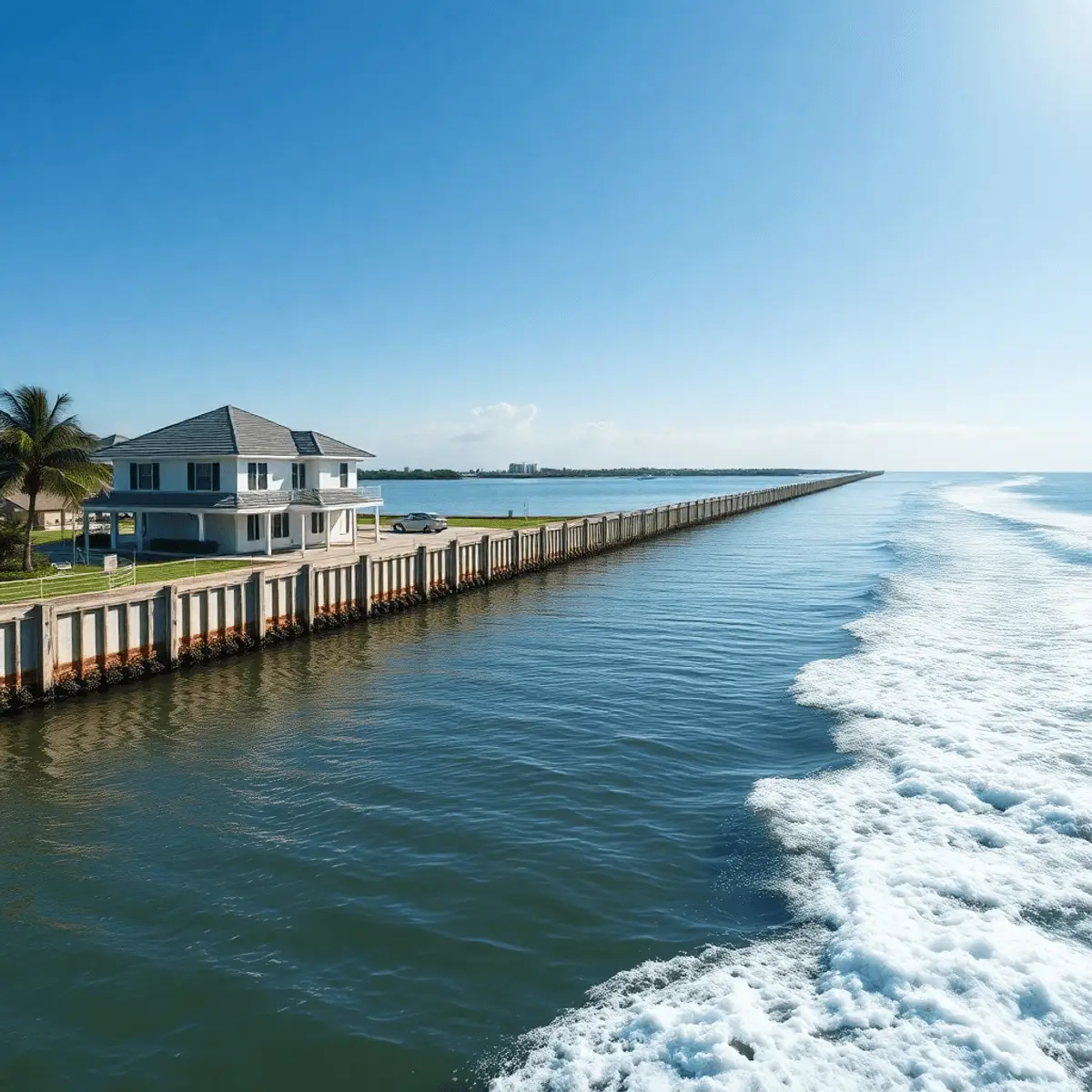
On a South Florida Intracoastal or oceanfront lot, a seawall protects the land: it retains upland soil, resists tidal and storm loading at the shoreline, and prevents the erosion that undermines everything built behind it. - When is the shoreline the governing risk?
On canal and Intracoastal parcels where the land ends in a vertical wall and the upland sits close to the water. - When does elevation carry the burden?
Elevation carries the burden where flood depth and wave action reach the structure: high-risk coastal zones, oceanfront parcels, and low-lying sites where a wall cannot realistically hold back a surge event. - How do the two interact on one property?
Seawall and elevated foundation interact on one South Florida property closely, and by design. Wall height influences site grading and drainage; grading influences finished floor elevation; foundation depth interacts with the soils the wall retains; and drainage behind the wall affects both.
What does each strategy actually protect?
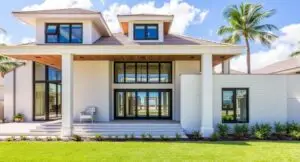
On a South Florida Intracoastal or oceanfront lot, a seawall protects the land: it retains upland soil, resists tidal and storm loading at the shoreline, and prevents the erosion that undermines everything built behind it. An elevated foundation protects the structure: it lifts living space above base flood elevation so surge and flooding pass beneath rather than through. Neither substitutes for the other.
The elevation half of seawall vs elevated foundation is detailed in elevated foundation and coastal home design.
When is the shoreline the governing risk?
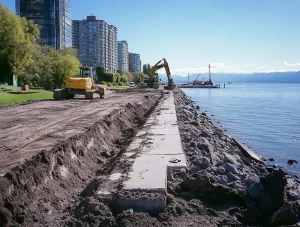
On canal and Intracoastal parcels where the land ends in a vertical wall and the upland sits close to the water. There, soil retention is continuous, daily, and non-negotiable: a failing wall takes hardscape, pool decks, landscaping, and eventually foundations with it. On those sites the wall is not optional, and its condition governs the whole project.
On those sites seawall vs elevated foundation resolves toward the wall, and construction and approvals are covered in seawall construction and permitting.
When does elevation carry the burden?
Elevation carries the burden where flood depth and wave action reach the structure: high-risk coastal zones, oceanfront parcels, and low-lying sites where a wall cannot realistically hold back a surge event. Elevation is also what insurance and the building code respond to, which means it affects premiums and compliance in ways a seawall does not.
Where seawall vs elevated foundation resolves toward elevation, the requirements come from FEMA’s Coastal Construction Manual, with local detail in base flood elevation requirements.
How do the two interact on one property?
Seawall and elevated foundation interact on one South Florida property closely, and by design. Wall height influences site grading and drainage; grading influences finished floor elevation; foundation depth interacts with the soils the wall retains; and drainage behind the wall affects both. Designing them separately produces a wall and a house that each work alone and fight each other on site.
Seawall vs elevated foundation is a coordination problem before it is a choice, expanded in engineering challenges for Intracoastal and oceanfront homes.
How do the costs compare?
Seawall and elevation costs are different in kind. A seawall is a bounded scope with a defined life, driven by length, height, embedment, soils, and access, and it recurs on a generational cycle. Elevation is embedded permanently in the structure, priced into foundations, stairs, lifts, and enclosure detailing, and it does not need replacing. One is a maintained asset; the other is a design decision.
The economics of seawall vs elevated foundation are broken down in seawall construction costs and ROI and the luxury construction cost breakdown.
What do regulators require regardless of preference?
In Florida, elevation is not optional where the flood map says so, and shoreline armoring is not automatic where the state has jurisdiction. Seaward of the Coastal Construction Control Line, a wall may be restricted or unavailable; in mapped flood zones, the finished floor elevation is set by code. Preference operates only inside what regulation permits.
Regulation often settles seawall vs elevated foundation outright, and the oceanfront constraint is explained in the Coastal Construction Control Line explained and CCCL and seawall requirements.
How does long-term water level change the calculus?
Long-term water level change in South Florida pushes both upward. Rising water reduces the freeboard of an existing wall and shrinks the margin on a finished floor set decades ago. Designing to today’s minimum is what leaves owners retrofitting later, which is why cap elevations and floor elevations on new luxury work are set with headroom rather than at the line.
Rising water pushes seawall vs elevated foundation in the same direction, and trends are published by NOAA, with the planning response in sea level rise and waterfront design.
How should an owner decide?
A South Florida owner should decide by evaluating the site rather than the options: flood zone and required elevation, existing wall condition and remaining life, soils, exposure, and regulatory jurisdiction. Those five facts usually make the answer obvious, and they are gathered during due diligence, before design, when the answer is still cheap to act on.
Those seawall vs elevated foundation facts belong in due diligence, and the checklist is in what to know before building a waterfront home.
How does Kass Construction & Development approach it?
As one shoreline system rather than two scopes: Kass Construction & Development, a state-licensed (CGC1529472) boutique luxury builder led by Mitch Kass, a licensed general contractor and attorney, with 100+ luxury residences delivered by Mitchell Kass and the firms he has led across Broward, Palm Beach, and Miami-Dade, resolves seawall vs elevated foundation with the coastal engineer at concept stage so the wall, the grading, and the finished floor are designed together.
A custom build often runs 18 to 36 months, and shoreline decisions belong at month one. Contact Kass Construction & Development or call 954-607-4335.
How do seawall and elevated foundation compare on what they protect and what they cost?
Seawall vs elevated foundation is best understood as two strategies that protect different things, and the table below compares them on the questions an owner actually asks.
| Question | Seawall | Elevated foundation |
|---|---|---|
| What it protects | The land: prevents erosion, retains fill, holds the yard, pool and dock in place | The house: keeps living space, structure and equipment above surge and flood |
| What it does not protect | The house from water that rises over the cap or comes through the ground | The land, the seawall or the yard from erosion and scour |
| Governing risk it answers | Wave action, boat wake, tidal scour, loss of land | Storm surge depth, flood elevation, insurance rating |
| Where it dominates | Canal and Intracoastal lots with wall frontage; every lot with a failing wall | AE and VE zones; oceanfront lots where armoring is restricted |
| Regulatory driver | County environmental permits, cap elevation minimums, CCCL rules on the ocean | FEMA flood zone, base flood elevation, local freeboard, V-zone foundation rules |
| Cost pattern | Priced per linear foot; driven by height, panel type, tie-backs and access | Priced with the structure; driven by pile count, elevated slab area and ground-level finish |
| Life and maintenance | Decades with inspection; cap and tie-back maintenance | Life of the building; minimal maintenance |
| Effect on insurance | Indirect; supports the property’s condition | Direct; rated on the elevation certificate |
Flood zone definitions are on FEMA’s flood zones page, and long-term water level data for South Florida stations is published by NOAA Tides and Currents. The wall side is detailed in seawall construction and permitting and the house side in elevated foundation and coastal home design.
How should an owner work through the seawall vs elevated foundation decision?
Seawall vs elevated foundation is settled by a short sequence of questions about the specific parcel, and on most South Florida waterfront lots the answer is both, in a defined order.
- Identify the shoreline type: canal, Intracoastal, river or ocean, because the ocean restricts armoring under CCCL rules; see CCCL seawall requirements for luxury estates.
- Assess the existing wall: age, cap elevation in NAVD 88, tie-back condition and any movement; a failing wall governs everything else.
- Establish the flood zone and base flood elevation from the FEMA Flood Map Service Center, plus local freeboard, which sets the required elevation of the house.
- Model the surge and wave exposure with a coastal engineer, per engineering challenges on Intracoastal and oceanfront sites.
- Set the seawall cap to the county minimum or higher, with an allowance for future water levels discussed in sea-level rise in waterfront infrastructure design.
- Set the house elevation with an owner’s margin above the requirement, following base flood elevation requirements and luxury living in VE zones.
- Coordinate the two: the seawall, dock, pool shell and house foundation are engineered as one system so loads and drainage do not conflict.
- Sequence the work: seawall first where it is failing or where the house foundation depends on it, then the building.
How do the two strategies interact on one waterfront property?
Seawall vs elevated foundation becomes seawall and elevated foundation on most lots, and the interaction between the two is where design and cost are won.
- A higher seawall cap raises the yard, which reduces the visible height of an elevated house and allows a level garden within fill rules.
- Drainage behind the wall and under the elevated house is designed as one system, with backflow prevention on outfalls.
- Pile foundations for the house are set back from the wall so pile driving does not disturb the tie-backs, and the wall’s return legs are coordinated with the pool shell.
- Dock, lift and utilities are elevated and routed with the house systems; see the waterfront home construction guide.
- Budget is allocated across both, using the figures in seawall construction costs and ROI and the Miami-Dade cost breakdown.
- On the ocean, where the state restricts new walls, the balance shifts toward dune restoration and deep foundations set landward under the rules in the Coastal Construction Control Line in South Florida.
Kass Construction & Development approaches every waterfront project in Broward, Palm Beach and Miami-Dade by asking what threatens the property first, then designing the wall and the foundation as one answer.
Frequently Asked Questions
Is a seawall or an elevated foundation better?
The seawall vs elevated foundation question addresses two different risks: the wall retains land and resists erosion, elevation lifts living space above flooding. Most Intracoastal estates need both, and the site’s flood zone and shoreline condition set the balance.
Can elevation replace a failing seawall?
No. Elevating the house does nothing for the soil the house sits on. A failing wall still loses upland, undermines hardscape, and eventually threatens foundations regardless of finished floor height.
Can a seawall keep me out of flood requirements?
No. Flood-zone elevation requirements are set by mapping and code, not by the presence of a wall, and insurance responds to elevation rather than armoring.
Which is more expensive?
Elevation is usually the larger embedded cost because it is built into the structure permanently, while a seawall is a bounded scope with a defined replacement cycle. Site conditions can reverse that on any given parcel.
How long does a seawall last?
Life depends on construction type, embedment, corrosion protection, drainage, and maintenance. An engineer’s assessment of the cap, face, and tie-backs gives a realistic remaining life for a specific wall.
Do I need both on a canal property?
Usually yes: the wall is what holds the land, and elevation is what code requires for the structure. The proportion changes with flood zone, exposure, and the existing wall’s condition.
When should seawall vs elevated foundation be decided?
During due diligence, before design. Foundation type, grading, drainage, budget, and the approvals calendar all follow from it, so deciding late means redrawing rather than choosing.