The luxury home permitting process in South Florida is not one process. It is four or five reviews running on independent calendars, each with its own submittal requirements, its own comment cycles, and its own idea of what a complete application looks like. Owners who understand that structure plan around it. Owners who expect a single queue spend the first six months surprised.
Key takeaways
- Who actually reviews a luxury home here?
Five bodies, typically: the municipal or county building department for structure and code, zoning for siting and use, county floodplain administration for elevation, the state through Florida DEP for submerged lands and coastal jurisdiction, and the water management district for stormwater and environmental resources. - What does the building department actually check?
Compliance with the Florida Building Code: structural calculations, wind loads and the high-velocity hurricane zone provisions where they apply, flood elevation, product approvals for impact-rated assemblies, energy compliance, and the mechanical, electrical, and plumbing designs. - Why does zoning come first?
Zoning comes first in the South Florida luxury home permitting process because it decides whether the design is legal before anyone checks whether it is buildable. - What triggers state and federal review?
Water triggers state and federal review in South Florida. Any structure on or over sovereign submerged lands, any work affecting wetlands or protected habitat, any construction seaward of the Coastal Construction Control Line, and any structure in navigable waters.
Who actually reviews a luxury home here?
Five bodies, typically: the municipal or county building department for structure and code, zoning for siting and use, county floodplain administration for elevation, the state through Florida DEP for submerged lands and coastal jurisdiction, and the water management district for stormwater and environmental resources. Federal review applies to work in navigable waters.
The luxury home permitting process spans all of them; state programs are published by Florida DEP and the South Florida Water Management District.
What does the building department actually check?
Compliance with the Florida Building Code: structural calculations, wind loads and the high-velocity hurricane zone provisions where they apply, flood elevation, product approvals for impact-rated assemblies, energy compliance, and the mechanical, electrical, and plumbing designs. The luxury home permitting process runs longest here because luxury homes carry the most engineered systems.
The code is published at floridabuilding.org, with regional differences in permitting differences across Broward, Miami-Dade, and Palm Beach.
Why does zoning come first?
Zoning comes first in the South Florida luxury home permitting process because it decides whether the design is legal before anyone checks whether it is buildable. Setbacks, height, lot coverage, floor area, parking, and any homeowners association architectural review all constrain the envelope. A luxury home permitting process that begins with structural drawings before zoning confirmation is a process that will redraw them.
A luxury home permitting process that starts with zoning avoids redrawing, and the site checks belong in pre-construction planning.
What triggers state and federal review?
Water triggers state and federal review in South Florida. Any structure on or over sovereign submerged lands, any work affecting wetlands or protected habitat, any construction seaward of the Coastal Construction Control Line, and any structure in navigable waters. On waterfront parcels these run in parallel with local review and frequently set the start date rather than the building department.
On waterfront parcels the luxury home permitting process is governed by these; the coastal program is at Florida DEP, with detail in environmental and coastal construction permits.
| Reviewer | What it examines | When to open it |
|---|---|---|
| Municipal or county building | Code compliance, structure, wind, systems | Once documents are complete |
| Zoning | Setbacks, height, coverage, floor area, use | Before design development |
| County floodplain | Elevation and construction below the flood line | With the survey |
| Florida DEP | Submerged lands and coastal jurisdiction | First, on any waterfront parcel |
| Water management district | Stormwater and environmental resources | First, alongside DEP |
| Federal reviewers | Structures in navigable waters | First, with the shoreline scope |
What makes a submittal complete?
A complete submittal in Broward, Palm Beach, or Miami-Dade means signed and sealed drawings coordinated across every discipline, structural calculations, product approval numbers for every impact-rated assembly, a survey, an elevation certificate or design elevation, energy calculations, and the site and drainage plan. Anything missing does not sit in the queue waiting; it comes back as comments and restarts the clock.
Completeness is what carries a luxury home permitting process through in one round, and the common failures are cataloged in common luxury home permitting mistakes.
How do comment cycles work?
In a South Florida comment cycle, a reviewer issues comments, the design team responds and resubmits, and the file re-enters review. Each cycle costs real weeks. The single strongest lever an owner has over the luxury home permitting process is reducing the number of cycles, which is decided by the quality of the first submittal rather than by anything that happens afterwards.
The mechanics are explained in why permit delays happen.
How long does it take?
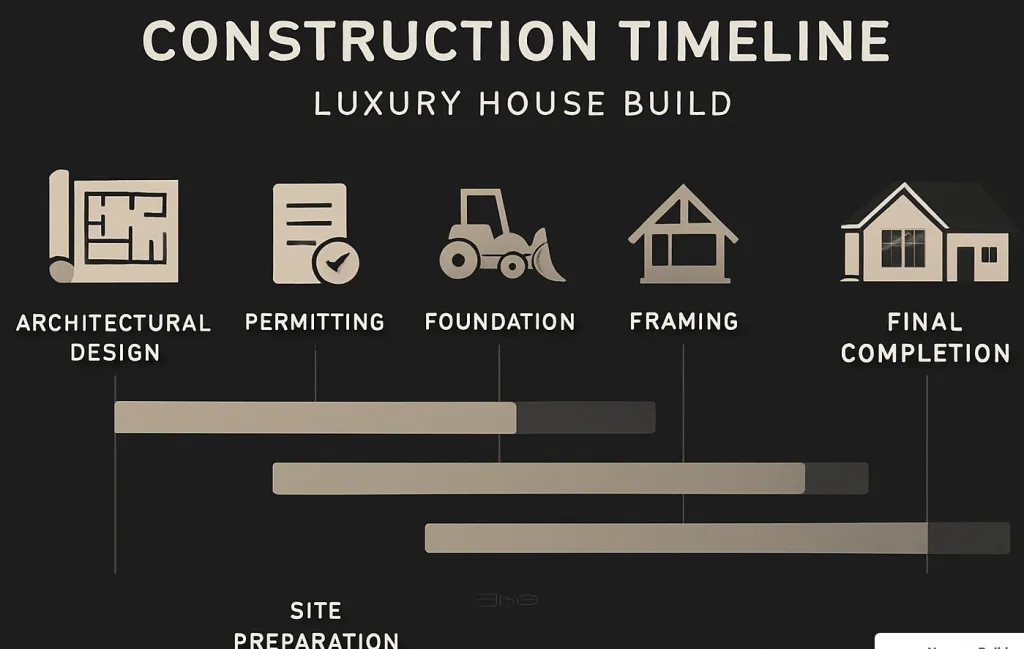
Permitting a South Florida luxury home takes long enough to sit on the critical path. A custom build often runs 18 to 36 months overall, and on waterfront parcels the permitting and environmental tracks routinely occupy the front of that. The honest planning assumption is that approvals determine the construction start date, not the other way round.
The luxury home permitting process therefore sits on the critical path, and the phase detail is in the South Florida custom home permitting timeline.
What can genuinely compress it?
Five things can genuinely compress the South Florida permitting process: opening the slowest review first, submitting complete and coordinated documents, holding a pre-application meeting where the jurisdiction offers one, responding to comments within days rather than weeks, and separating permits so site work can begin while the vertical package is still in review. None of these speed up the reviewer.
These are the only real levers on a luxury home permitting process, and they are set out in fast-tracking luxury home approvals.
How does Kass Construction & Development manage approvals?
By treating them as the schedule: Kass Construction & Development, a state-licensed (CGC1529472) boutique luxury builder headquartered in East Fort Lauderdale and led by Mitch Kass, a licensed general contractor and attorney, with 100+ luxury residences delivered by Mitchell Kass and the firms he has led across Broward, Palm Beach, and Miami-Dade, runs the luxury home permitting process from the first week of design rather than after it.
Contact Kass Construction & Development or call 954-607-4335.
Which agencies take part in the luxury home permitting process?
The luxury home permitting process in South Florida involves a fixed cast of reviewers, and knowing who has jurisdiction over a parcel is the first planning task.
| Reviewer | Jurisdiction | What it decides |
|---|---|---|
| Municipal or county building department | Every parcel | Structural, mechanical, electrical, plumbing, fire and energy compliance with the Florida Building Code |
| Zoning and planning | Every parcel | Setbacks, height, lot coverage, floor area ratio, and any variance or design review |
| Floodplain administrator | Parcels in FEMA special flood hazard areas | Design flood elevation, freeboard, enclosure limits below the flood line |
| County environmental agency | Seawalls, docks, dredging, mangroves, submerged lands | Environmental resource permits and shoreline work |
| Florida DEP | Oceanfront parcels seaward of the CCCL; some state-owned submerged lands | Coastal construction control line permits |
| South Florida Water Management District | Drainage and larger site work | Stormwater and water-use approvals |
| U.S. Army Corps of Engineers | Navigable waters and wetlands | Federal authorization for docks and fill |
| Historic preservation board | Designated districts and structures | Certificate of appropriateness |
County-by-county differences in how these reviewers are organized are covered in permitting differences across Broward, Miami-Dade and Palm Beach; the environmental layer is described in environmental and coastal construction permits.
What does a complete submittal checklist contain?
Most delay in the luxury home permitting process is a completeness problem, and the checklist below is what reviewers expect on the first pass.
- A current boundary and topographic survey with elevations in the datum the floodplain administrator uses.
- A coordinated drawing set: architectural, structural, mechanical, electrical, plumbing, civil and landscape, all at the same revision.
- Structural calculations sealed by a Florida-licensed engineer, including wind design to the Florida Building Code and the high-velocity hurricane zone where it applies.
- Florida product approval or Miami-Dade Notice of Acceptance numbers for every impact window, door, roofing system and shutter, matched to the drawings.
- Energy code compliance forms and mechanical load calculations.
- Flood zone documentation and a proposed elevation certificate; see FEMA elevation certificates.
- Geotechnical report and foundation design consistent with it.
- Contractor license, insurance certificates and a recorded Notice of Commencement.
- Environmental resource permit applications for any seawall, dock or dredging, per seawall construction and permitting.
The errors that most often send a set back are listed in common luxury home permitting mistakes.
How long does each stage of the luxury home permitting process take?
The luxury home permitting process runs three to six months for a well-prepared set, and the stages are easier to manage when their ranges are known.
- Zoning confirmation or pre-application meeting: two to six weeks, done before design is finalized.
- Building department first review: four to eight weeks, longer in municipalities with heavy volume.
- Comment response and resubmittal: two to four weeks per cycle, with two cycles being typical and one being the goal.
- Environmental and coastal permits: three to nine months, which is why they are opened first and run in parallel.
- Variance, design review or historic board hearings: add one to three months where they apply, because boards meet on fixed dates.
A fuller timeline is in the South Florida custom home permitting timeline, and the causes of slippage are in permit delays on South Florida luxury homes.
What happens after the permit is issued?
The luxury home permitting process continues through construction as a sequence of inspections, and every permit opened has to be closed before the home can be occupied.
- Scheduled inspections at each structural stage: piles or footings, slab, masonry, tie beams, roof deck, dry-in, framing, and rough-ins for each trade.
- Special inspections by the engineer of record for threshold or complex structures.
- Revisions filed for any change that alters the approved drawings, which is one of the hidden costs of late design changes; see change order abuse.
- Final inspections by every discipline, a final elevation certificate, and the certificate of occupancy.
- Closure of sub-permits for pool, dock, generator, fence, irrigation and landscape that are easy to forget.
How Kass Construction & Development sequences these approvals within the overall program is described in luxury home approvals in South Florida and the pre-construction planning guide.
Frequently Asked Questions
What is the luxury home permitting process in South Florida?
Four or five parallel reviews: municipal building and zoning, county floodplain, state submerged lands and coastal jurisdiction, the water management district, and federal review for navigable waters. Each runs on its own calendar.
Which review takes longest?
On waterfront parcels, usually the environmental, coastal, or marine review rather than the building department. The slowest one governs the construction start.
Can I start any work before full approval?
Sometimes, through separated permits such as demolition or site work, where the jurisdiction allows it. Everything else waits, and unpermitted work invites enforcement.
What makes a submittal complete?
Coordinated signed and sealed drawings, structural calculations, product approvals for impact assemblies, a survey, elevation documentation, energy calculations, and the site and drainage plan.
How many comment cycles are normal?
Fewer than most projects experience. Each cycle costs weeks, and the number is decided almost entirely by the completeness of the first submittal.
Does a bigger house take longer to permit?
Usually, because luxury homes carry more engineered systems, more product approvals, and more site scope, each of which is reviewed.
Should I hire a permit expediter?
Often worthwhile on complex or multi-agency projects. An expediter manages the file and the relationships; it does not shorten the review itself.