
Most established builders run capable in-house builder teams: a project manager, a superintendent, a scheduler, sometimes an in-house designer. Owners frequently ask whether that makes an independent representative redundant. It does not, but the reason is subtle, and it has nothing to do with the quality of the builder’s staff.
Key takeaways
- What do in-house builder teams actually do well?
In-house builder teams on a South Florida luxury home do a great deal well: sequencing trades, procurement, site supervision, safety, subcontractor management, and daily problem-solving. - So where is the gap?
The gap on a South Florida build sits in the questions where the builder's interest and the owner's interest are not identical: whether a draw reflects completed work, whether a change is genuinely extra, whether an allowance was set realistically, whether a delay was avoidable. - Is this a question of trust?
Independent review of a South Florida builder is not a question of trust, and framing it that way misleads owners. - What does the owner gain in practice?
The South Florida owner gains a second technical reading of the same facts. The builder's project manager reports progress; the representative verifies it.
For the independent alternative, see our owner’s representative services in South Florida.
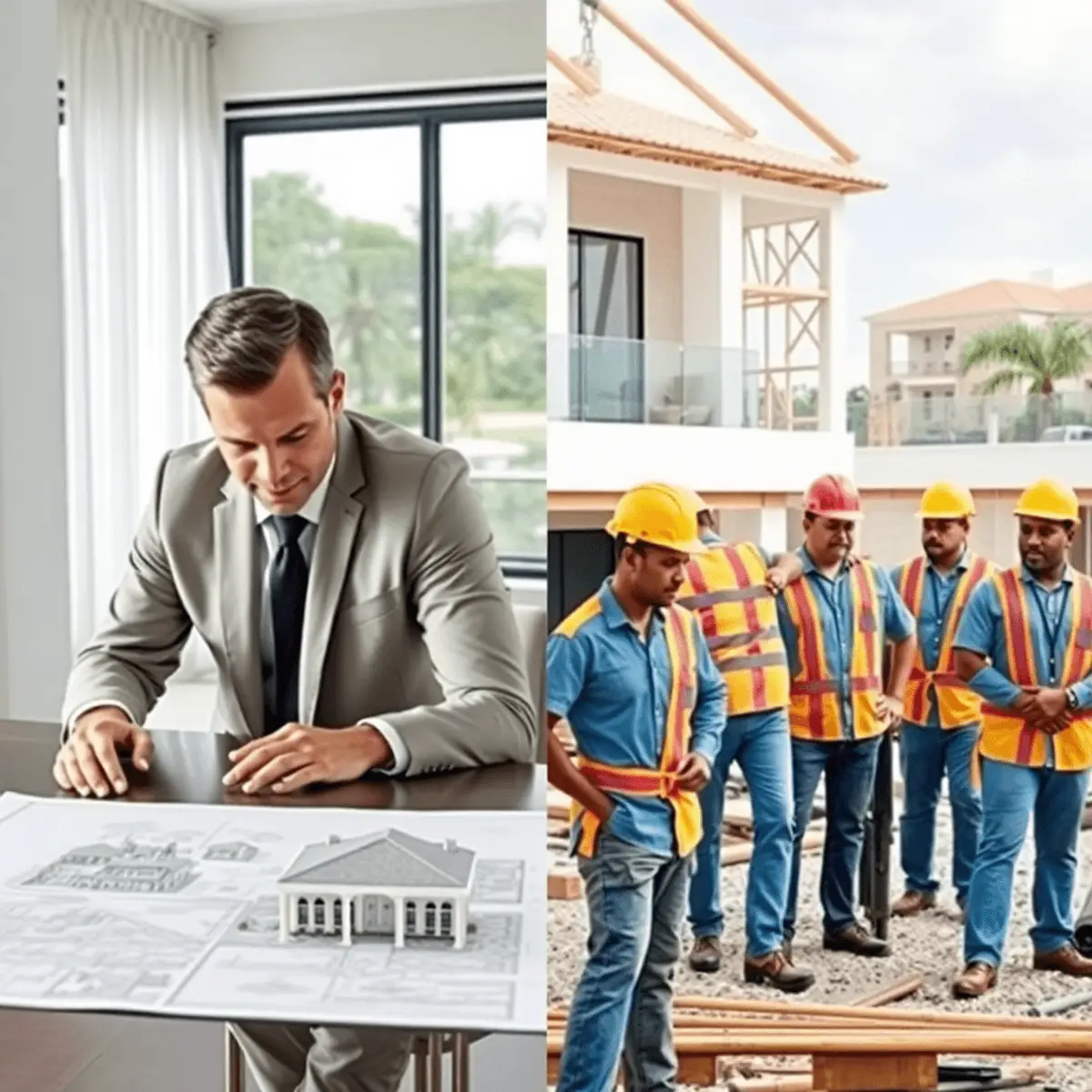
What do in-house builder teams actually do well?
In-house builder teams on a South Florida luxury home do a great deal well: sequencing trades, procurement, site supervision, safety, subcontractor management, and daily problem-solving. On a well-run project the builder’s team is the reason work proceeds smoothly, and none of that is improved by adding external oversight. In-house builder teams are the operating engine of the project.
The builder’s role is defined in owner’s representative versus general contractor.
So where is the gap?
The gap on a South Florida build sits in the questions where the builder’s interest and the owner’s interest are not identical: whether a draw reflects completed work, whether a change is genuinely extra, whether an allowance was set realistically, whether a delay was avoidable. In-house builder teams are not dishonest about these; they simply cannot be the impartial party.
The financial checks are described in high-net-worth construction oversight.
Is this a question of trust?
Independent review of a South Florida builder is not a question of trust, and framing it that way misleads owners. Independent review is normal in every other large transaction: buyers commission surveys, lenders order appraisals, and boards appoint auditors, none of which implies suspicion. Asking in-house builder teams to also verify their own performance is simply asking the wrong party.
The protective logic is in how owner’s representation protects high-net-worth clients.
| Function | In-house builder team | Independent representative |
|---|---|---|
| Sequencing trades and procurement | Yes | No |
| Site supervision and safety | Yes | No |
| Subcontractor management | Yes | No |
| Verifying draws for the owner | No | Yes |
| Testing change order pricing | No | Yes |
| Reconciling allowances | No | Yes |
| Presenting owner decisions with options | Partly | Yes |
What does the owner gain in practice?
The South Florida owner gains a second technical reading of the same facts. The builder’s project manager reports progress; the representative verifies it. The builder proposes a change; the representative prices it against the contract. Both are working from the same site, and the owner receives two informed views rather than one.
The deliverables are in what an owner’s representative does.
Does it slow the project down?
An owners representative usually speeds a South Florida project up rather than slowing it down. Most delay on luxury projects comes from owner decisions waiting, and a representative who presents choices with recommendations and deadlines accelerates exactly that. Where in-house builder teams have a competent counterpart, approvals move faster because the questions arrive already analyzed.
The schedule effect is described in a realistic timeline for luxury custom home construction.
How should the two work together?
The representative and the in-house builder team should work together with a clear boundary: the representative observes, verifies, and advises the owner, and never directs trades or interferes with means and methods. Observations go to the builder in writing. In-house builder teams that understand this boundary find the relationship productive; friction almost always traces to an undefined scope.
Team management is covered in managing the professional team.
What should in-house builder teams deliver to the owner?
In-house builder teams on a South Florida luxury build should deliver five things to the owner, in writing: a weekly report with dated photography, draws evidenced against completed work, change orders priced by the contract method, allowances reconciled openly, and a forecast to completion. In-house builder teams that deliver all five give the owner most of the transparency the role exists to provide, and that is the standard worth insisting on.
The cost-benefit question is in whether hiring an owner’s representative is worth it.
What should an owner ask their builder?
A South Florida owner should ask their builder four questions: what reporting will I receive and how often, how are draws supported and evidenced, how are change orders priced and approved, and who is accountable if the schedule slips. In-house builder teams that answer all four crisply are already providing much of the transparency an owner needs.
Licenses and history can be verified at Florida DBPR.
How does Kass Construction & Development see it?
From both sides of the relationship: Kass Construction & Development, a state-licensed (CGC1529472) boutique luxury builder led by Mitch Kass, a licensed general contractor and attorney, with 100+ luxury residences delivered by Mitchell Kass and the firms he has led across Broward, Palm Beach, and Miami-Dade, runs its own in-house builder teams when building and represents owners alongside other builders, which is why it knows exactly what to ask of either.
Contact Kass Construction & Development or call 954-607-4335.
What do in-house builder teams cover, and where does independent representation add to it?
In-house builder teams are organized to deliver the contract, and the table below sets each function they perform beside what an independent owner’s representative adds to the same function.
| Function | What in-house builder teams do | What the owner’s representative adds |
|---|---|---|
| Project management | Plans, sequences and directs the work; manages subcontractors and suppliers | Checks the plan against the contract baseline and reports variance to the owner |
| Superintendence | Runs the site daily; coordinates trades and inspections | Attends defined inspection points independently and records them |
| Estimating and cost control | Prices the work, change orders and allowances | Verifies pricing method, entitlement and allowance reconciliation for the owner |
| Scheduling | Maintains the construction schedule | Tracks slippage, assigns causes and forecasts the finish date |
| Pay applications | Prepares draw requests | Verifies progress and lien releases before the owner pays |
| Quality | Self-inspects to its own standard and the code | Inspects to the owner’s specification and drawings |
| Design coordination | Raises constructability and pricing questions | Manages the architect and engineers on the owner’s behalf |
| Reporting | Reports as the contract requires | Sets the reporting standard and reads it critically |
A builder’s license and any disciplinary history are public at myfloridalicense.com; Kass Construction & Development builds under CGC1529472. The roles are contrasted further in owner representative vs general contractor.
What should an owner ask about the in-house builder teams before signing?
In-house builder teams vary widely in depth and in how they report, and the questions below tell an owner what they are buying before the contract is signed.
- Who is the named project manager and superintendent for this home, how many projects does each carry at once, and what happens if either leaves mid-project?
- What does the weekly report contain, and can the owner see a sample from a live project?
- How are pay applications prepared, and are lien releases collected from every subcontractor and supplier as required under Chapter 713, Florida Statutes?
- How are change orders priced, and what is the contract method for markup and unit rates?
- Which inspection points are photographed before cover, and does the owner receive the photographs?
- How are allowances tracked and reconciled, and when does the owner see the ledger?
- How does the team work with an independent owner’s representative, and has it done so before?
- Who owns the permit file and the close-out documentation, and what does the handover package contain?
Contract terms that put the answers in writing are covered in construction contracts for high-end residential builds and negotiating stronger contractor agreements.
How do in-house builder teams and the owner’s representative work together without friction?
In-house builder teams and an independent representative work well together when the rules of engagement are written into both agreements, and the arrangement below is the one that keeps a South Florida project moving.
- The builder’s team directs the work and the trades; the representative observes, verifies and reports, and never instructs subcontractors.
- One weekly meeting with a fixed agenda: schedule, cost, quality, decisions required, attended by both.
- Inspection points agreed in advance so the representative’s visits are planned into the schedule rather than treated as interruptions.
- One draw route: builder’s pay application, representative’s verification, owner’s approval, per escrow and milestone payments.
- Change orders reviewed before work starts, by the contract method, as described in change order abuse.
- The design team managed through the representative so the builder receives coordinated answers; see managing architect, engineer and contractor relationships.
- A shared document of record, so the builder’s team and the representative work from the same drawings, specification and change log.
The value the arrangement recovers is quantified in high-net-worth construction oversight and whether an owner’s representative is worth it. Kass Construction & Development runs its own in-house teams to the reporting standard an independent representative would demand, and welcomes one on any project in Broward, Palm Beach or Miami-Dade; the representative’s duties are in what an owner’s representative does and owner’s representation for luxury homes.
Frequently Asked Questions
If my builder has in-house builder teams, what does a representative add?
A second technical reading of the same facts on your behalf: draws verified, change orders tested against the contract, allowances reconciled, and decisions presented with options rather than conclusions.
Does hiring one imply I distrust my builder?
No. Independent review is standard in every large transaction. Buyers commission surveys and boards appoint auditors without implying suspicion.
Will it slow my project?
Usually it speeds it up, because most delay comes from owner decisions waiting, and a representative presents choices already analyzed with deadlines.
Who directs the trades?
The builder, always. The representative observes and reports in writing to the builder and advises the owner, never instructing the builder’s staff.
What should I require from the builder’s team?
Weekly written reporting with dated photography, draws evidenced against completed work, change orders priced by the contract method, allowances reconciled openly, and a forecast to completion. Insist on all five.
What should I ask my builder about transparency?
What reporting you will receive, how draws are evidenced, how change orders are priced and approved, and who is accountable for schedule slippage.
Can one firm cover building and representation?
Kass is licensed and experienced in both, so owners can engage the firm to build, to represent them alongside another builder, or in an integrated engagement with a single accountable party and one documentation standard.