
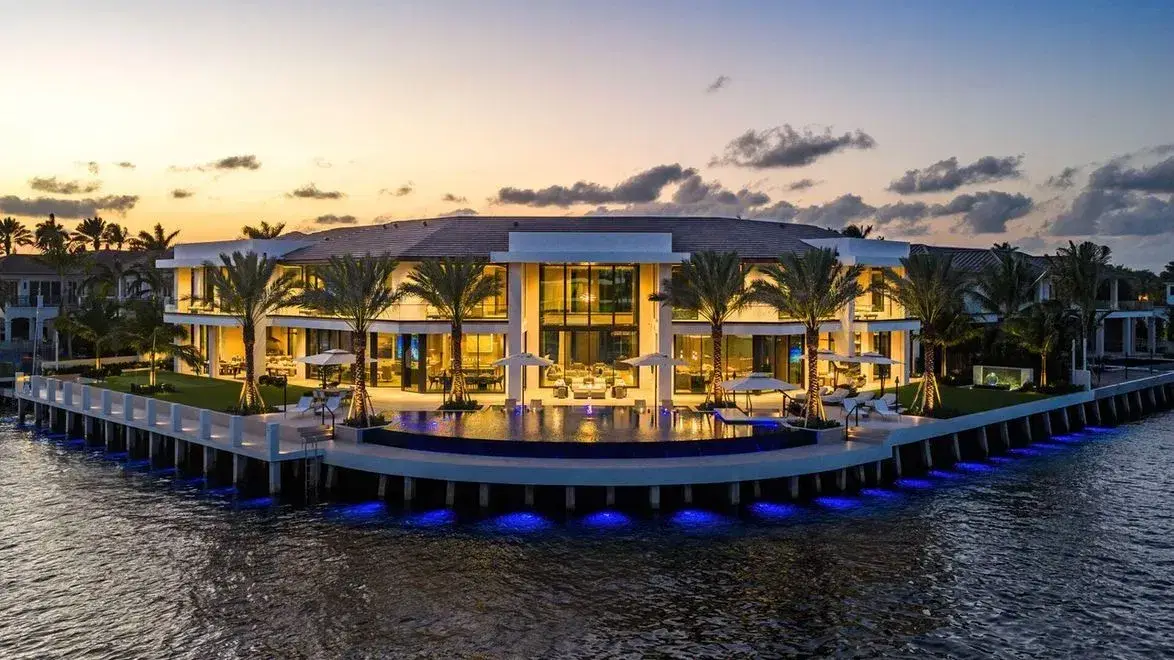
Boca Raton estate pricing only makes sense when you stop reading it as one market. The city’s luxury stock splits into distinct segments, deepwater canal, direct Intracoastal, oceanfront, golf and country club, and gated non-waterfront estates, and each moves on its own supply, its own buyer pool, and its own value drivers. This analysis explains how the segments are structured, which attributes actually earn premiums, how to think about waterfront investment here, and when building beats buying.
Key takeaways
- How is Boca Raton estate pricing segmented?
Boca Raton estate pricing segments by water first, then by community. - What actually drives Boca Raton estate pricing within each segment?
Within each Boca Raton segment pricing is driven by attributes that cannot be manufactured: water depth and bridge clearance for vessel owners; frontage width and exposure; lot dimensions and privacy; and, increasingly, the resilience and age of the structure itself. - How should investors analyze a Boca Raton waterfront purchase?
Boca Raton estate pricing analysis treats the asset as land plus liabilities: the irreplaceable part of the asset is the lot, its water, and its position; the structure, seawall, and dock are depreciating systems with real replacement costs. - When does building beat buying in Boca Raton?
Building beats buying in Boca Raton when the segment you want offers lots better than its houses. If turnkey new construction matching your specification exists, buying is faster.
How is Boca Raton estate pricing segmented?
Boca Raton estate pricing segments by water first, then by community. Deepwater canal homes price on dockage and ocean access; direct Intracoastal estates on wide-water frontage; oceanfront on pure scarcity; club communities on membership, golf, and amenity depth; and gated inland estates on land, privacy, and school access. Comparing across segments produces nonsense; comparing within them produces insight.
The broader market mechanics behind this structure are analyzed in the Boca Raton waterfront estate market analysis and the regional luxury construction market outlook.
What actually drives Boca Raton estate pricing within each segment?
Within each Boca Raton segment pricing is driven by attributes that cannot be manufactured: water depth and bridge clearance for vessel owners; frontage width and exposure; lot dimensions and privacy; and, increasingly, the resilience and age of the structure itself. New construction built to current wind and flood standards carries a widening premium over dated homes on comparable lots, because buyers now price insurance, maintenance, and retrofit risk into every offer.
FEMA explains how flood risk feeds into lending and insurance decisions; the construction side of that premium is covered in hurricane-resistant construction.
How should investors analyze a Boca Raton waterfront purchase?
Boca Raton estate pricing analysis treats the asset as land plus liabilities: the irreplaceable part of the asset is the lot, its water, and its position; the structure, seawall, and dock are depreciating systems with real replacement costs. Sound analysis underwrites the flood zone, seawall condition, dock rights and depth, and the realistic cost of bringing the property to modern standards, then weighs the price against the segment, not the citywide average.
Start with the parcel’s flood designation at the FEMA Flood Map Service Center, then work through what to know before building a waterfront home and flood zone requirements, which explains the substantial-improvement rule that can reshape renovation economics on older stock.
When does building beat buying in Boca Raton?
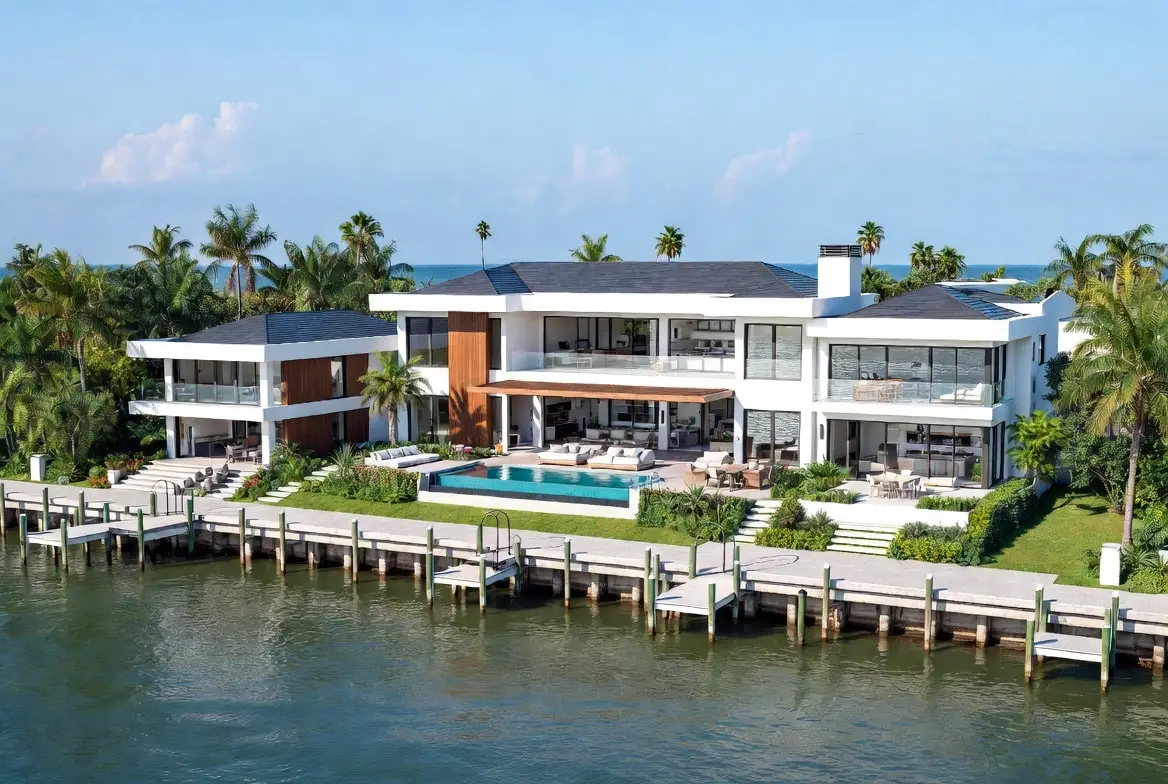
Building beats buying in Boca Raton when the segment you want offers lots better than its houses. If turnkey new construction matching your specification exists, buying is faster. But in supply-constrained segments, the best water frequently carries dated homes, and acquiring one as a teardown converts Boca Raton estate pricing logic in your favor: you pay for the irreplaceable part and replace the depreciating part with a custom build, often over 18 to 36 months.
The framework is expanded in choosing the right luxury custom home builder, with budget structure in the luxury construction cost breakdown and approvals in waterfront construction regulations in Boca Raton.
What is the renovation angle on older Boca estates?
The renovation angle on older Boca Raton estates is selective and real: where the structure, elevation, and layout justify it, a high-end renovation, often 6 to 12 months, can reposition a dated estate inside its segment at a fraction of replacement cost. In Boca Raton estate pricing terms, the discipline is knowing when it does not pencil: flood-zone thresholds, seawall replacement, and structural surprises can push a renovation past the logic of rebuilding.
The decision factors are laid out in renovation versus new construction.
How does Kass Construction & Development support Boca Raton buyers and investors?
By underwriting Boca Raton estate pricing before the purchase: Kass Construction & Development, a state-licensed (CGC1529472) boutique luxury builder led by Mitch Kass, a licensed general contractor and attorney, with 100+ luxury residences delivered by Mitchell Kass and the firms he has led across Broward, Palm Beach, and Miami-Dade, evaluates lots, seawalls, structures, and approval pathways so offers reflect what the property will actually cost to become what the owner wants.
That preconstruction lens is described in pre-construction planning and owner’s representation. Contact Kass Construction & Development or call 954-607-4335.
| Segment | What sets the price | What cannot be manufactured |
|---|---|---|
| Deepwater canal | Dockage and ocean access | Water depth and bridge clearance |
| Direct Intracoastal | Frontage width and open-water exposure | Position on the waterway |
| Oceanfront | Beach position and state coastal constraints | Frontage, and the CCCL line behind it |
| Country club and gated | Membership and amenity depth | Lot size, privacy, and community standing |
| Older estate stock | Discounted against resilient new build | Structural age, seawall and insurance profile |
How do the Boca Raton estate segments compare on the factors that set price?
Boca Raton estate pricing is set within each segment by a few fixed attributes, and the table below compares the segments on those attributes so a buyer can see what a premium is actually paying for.
| Segment | Fixed attributes that drive price | Construction implications | Typical stock |
|---|---|---|---|
| Deepwater canal | Canal width, bridge-free access to the Boca Inlet, dock length, lot depth | Seawall cap elevation, AE-zone elevation, dock and lift permits | Mid-century houses being replaced; some newer estates |
| Direct Intracoastal | Wide-water views, exposure, frontage length, proximity to the inlet | Heavier seawalls, wake and wind exposure, larger glazing packages | Mixed; strongest teardown activity |
| Oceanfront | Beach frontage, dune condition, position relative to the CCCL and the erosion projection | State CCCL permit, VE-zone open foundations, turtle lighting, design review | Fewest lots; long approval tracks |
| Golf and country club | Course and lake views, club membership, gated privacy | Association design review, drainage easements, lower flood exposure | Renovation and rebuild within design guidelines |
| Gated non-waterfront estates | Lot size, privacy, proximity to schools and downtown | Standard AE or X-zone construction; association review | Larger lots; new construction common |
Flood zones for any lot are at the FEMA Flood Map Service Center, and zone definitions on FEMA’s flood zones page. The waterfront segments are analyzed further in the Boca Raton waterfront estate market analysis and the rules in waterfront construction trends and regulations in Boca Raton.
How should an investor analyze a Boca Raton waterfront purchase, step by step?
Boca Raton estate pricing rewards buyers who separate the value of the lot from the value of the house on it, and the sequence below is how a waterfront purchase is analyzed before an offer.
- Value the lot on its fixed attributes: water type, width, access, exposure and orientation, using comparable lot sales rather than house sales.
- Establish the flood zone, base flood elevation and the city’s freeboard, which set the finished floor of any new home; see flood zone requirements for waterfront construction for the method, which applies in Boca Raton with the city’s own figures.
- Inspect the seawall and record the cap elevation; a replacement is the first line in any budget.
- Assess the existing house against the FEMA substantial improvement rule: if a renovation would exceed 50 percent of the structure’s value, the home must be brought into full flood compliance, which often tips the decision toward rebuilding; see renovation vs new construction.
- Price the build or renovation from a builder’s estimate rather than a per-foot rule, using the components in the Miami-Dade cost breakdown adjusted for Palm Beach County.
- Add soft costs, carrying costs through a 18 to 36 month build, and property tax at the completed value.
- Compare the all-in cost to recent sales of completed new estates in the same segment.
- Model the hold: insurance at the proposed elevation, maintenance, and the exit, with the market context in the tri-county luxury real estate and construction outlook.
When does building beat buying in Boca Raton, and what does the renovation angle look like?
Boca Raton estate pricing for completed new construction usually carries a premium over the sum of lot and build cost only in the segments where finished stock is scarce, and the conditions below are where building or renovating wins.
- Building wins on deepwater and Intracoastal lots where the existing house is mid-century, below the flood elevation, and on a seawall that needs replacement; the lot carries the value and the house is a teardown.
- Building wins when the buyer wants a resilient home built to the current Florida Building Code, elevated above the requirement, with the specification in hurricane-resistant construction.
- Buying wins when a recently completed estate in the right segment is available at or near replacement cost, and the buyer’s timeline cannot absorb a build.
- Renovation wins on newer estates with sound structure, compliant elevation and a good seawall, where the work stays below the substantial improvement threshold.
- Renovation of older estates is a trap when the threshold is crossed mid-project; the feasibility work in pre-construction planning settles this before contract.
- Whichever route, the builder is chosen on verified coastal experience, per how to choose the right luxury custom home builder, and the owner’s interests are protected as in owner’s representation for luxury homes.
Kass Construction & Development supports Boca Raton buyers and investors with lot feasibility, build and renovation pricing, and construction across the city’s waterfront and gated segments; the waterfront method is set out in the waterfront home construction guide.
Frequently Asked Questions
Why does Boca Raton estate pricing vary so much between similar-sized homes?
Because in Boca Raton estate pricing, segment attributes outweigh square footage: water type, dockage, exposure, community, and structural age move value more than interior finish. Two comparable houses on different water types are effectively in different markets.
What is the most reliable value driver on the waterfront?
Deepwater access without fixed bridges, combined with protected exposure and solid seawall infrastructure. In Boca Raton estate pricing, those attributes cannot be created after purchase, so they hold value through every market cycle.
How does new construction affect Boca Raton estate pricing?
New resilient homes command a widening premium over dated stock because buyers price in insurance, maintenance, and retrofit risk. On equal lots, current-code construction is the segment’s price leader almost everywhere.
What should investors check before buying an older waterfront estate?
For Boca Raton estate pricing: flood zone and base flood elevation, seawall and dock condition, water depth and bridge clearance, and the realistic cost to modernize or rebuild. The purchase price is only the first number; the underwriting is what protects the investment.
Is a teardown on good water a sound strategy in Boca Raton?
Frequently, yes: it concentrates spending on the irreplaceable part of the asset and replaces the depreciating part with a current-code custom build. The strategy depends on verifying approvals, seawall, and flood parameters before closing.
How long do build and renovation paths take?
A custom build often runs 18 to 36 months; a high-end renovation often 6 to 12 months. Waterfront parcels add marine permitting tracks that deserve the earliest start in either path.
Do club and non-waterfront estates follow the same pricing logic?
The same structure with different drivers: membership and amenity depth replace dockage, and lot size, privacy, and location replace water type. Within each community, new and renovated product still leads pricing.