
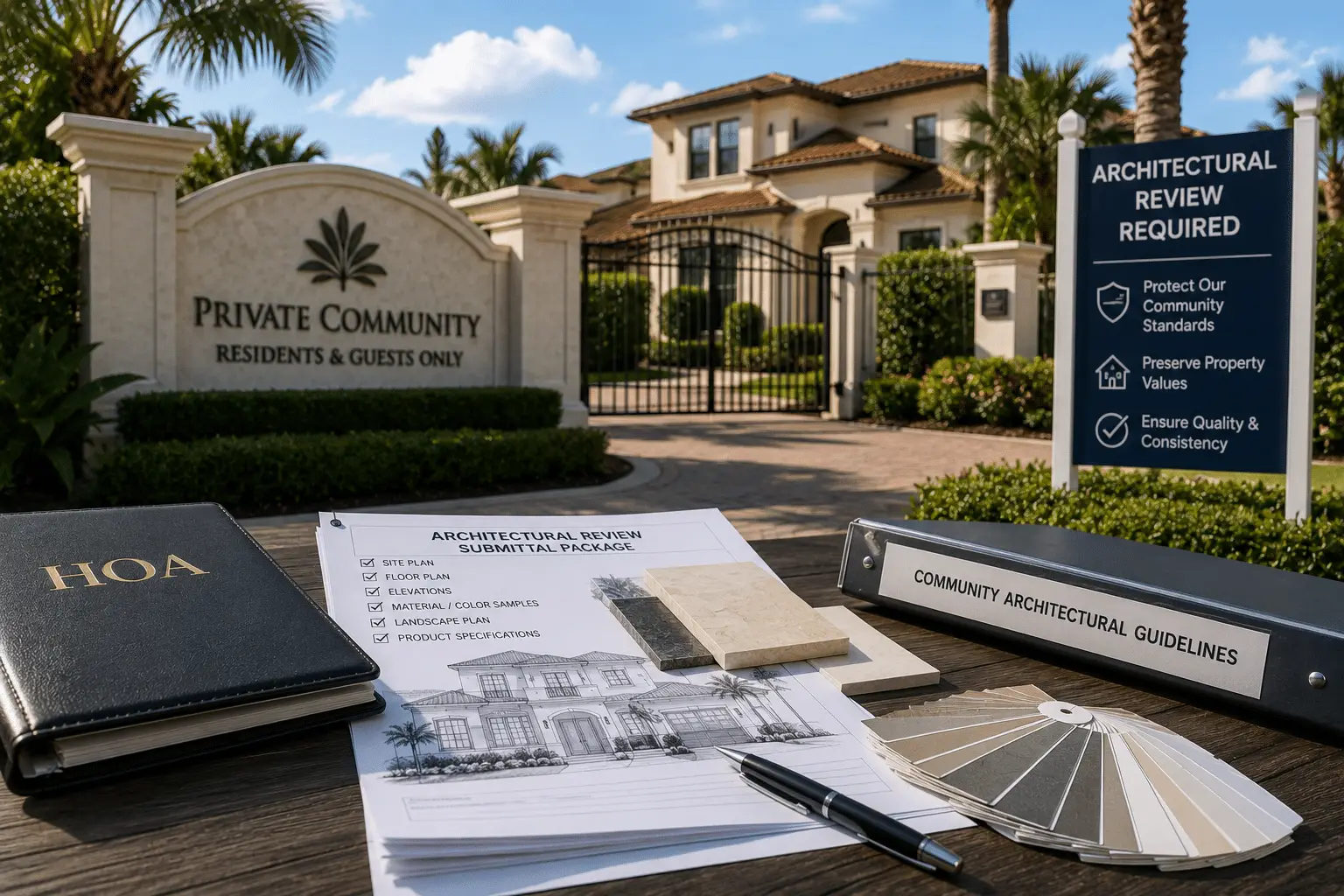
In South Florida’s gated communities and estate municipalities, architectural review boards are effectively a second permitting authority: they rule on massing, materials, colors, landscaping, and construction logistics before the county ever sees the plans, and their decisions are enforceable. Owners who treat HOA and board review as a formality lose months; owners who treat it as a design input from day one sail through. This guide explains how the authority works, what a strong submission looks like, and how to handle timelines, denials, and construction rules without burning goodwill.
Key takeaways
- Where does HOA and board authority come from, and where does it stop?
From the community's recorded covenants: the documents every buyer accepts at closing give the association, and its architectural review boards, the power to approve or deny changes visible to the community. - Which projects trigger review, and why do they get flagged?
Architectural review boards flag anything visible: new construction and additions, exterior renovations, roofs, windows and doors, pools and outdoor kitchens, landscape and hardscape, fences, lighting, and even paint. - What should you learn before you apply?
The community's playbook, and it is what architectural review boards judge against: the recorded design standards, the application checklist, the meeting calendar and submission deadlines, the review fees and deposits, and how the board has ruled on projects like yours. - What does an approval-ready submission to architectural review boards look like?
An approval-ready submission to South Florida architectural review boards is complete, visual, and responsive to the standards: full drawings with elevations and site plans, real material and color samples, landscape plans, renderings where massing is at issue, and a cover narrative that connects the design to the community's own language.
Where does HOA and board authority come from, and where does it stop?
From the community’s recorded covenants: the documents every buyer accepts at closing give the association, and its architectural review boards, the power to approve or deny changes visible to the community. The authority is contractual and enforceable, but bounded: boards must follow their own documented standards and procedures, and they never replace government permitting, which still applies in full.
Florida’s HOA framework is set by state statute, and the government side of approvals is covered in the South Florida luxury home permitting process under the Florida Building Code.
Which projects trigger review, and why do they get flagged?
Architectural review boards flag anything visible: new construction and additions, exterior renovations, roofs, windows and doors, pools and outdoor kitchens, landscape and hardscape, fences, lighting, and even paint. Boards flag what conflicts with the community’s standards, what crowds setbacks or neighbors, and what arrives incompletely documented, the last being the most common and most avoidable.
The design directions boards see most are covered in luxury home design trends and private resort homes.
What should you learn before you apply?
The community’s playbook, and it is what architectural review boards judge against: the recorded design standards, the application checklist, the meeting calendar and submission deadlines, the review fees and deposits, and how the board has ruled on projects like yours. An hour with the covenants and two prior approvals teaches more than any amount of guessing, and it shapes the design before the design hardens.
This research belongs in pre-construction planning, where it can still steer the drawings.
What does an approval-ready submission to architectural review boards look like?
An approval-ready submission to South Florida architectural review boards is complete, visual, and responsive to the standards: full drawings with elevations and site plans, real material and color samples, landscape plans, renderings where massing is at issue, and a cover narrative that connects the design to the community’s own language. Boards approve what they can understand and defend; ambiguity is what gets tabled.
Assembling that package is a team exercise, covered in how builders and architects collaborate.
How long do approvals take, and how do you keep them moving?
Architectural review boards run on meeting cycles, often monthly, so one incomplete submission costs a month by definition. The schedule levers are simple: submit complete before the deadline, answer questions before the meeting, attend when invited, and sequence board review ahead of or parallel to government permitting so neither waits on the other.
How the full approvals stack is sequenced, community, municipal, county, and coastal, is laid out in the Palm Beach County waterfront luxury construction guide and building codes across the three counties.
What if architectural review boards deny or modify your plans?
When South Florida architectural review boards deny or modify your plans, read the denial as information: boards almost always state which standard the design missed. The productive path is a targeted revision that addresses the stated objection, resubmitted through the normal process, with dialogue rather than confrontation; the covenants also define appeal routes where genuine disagreement remains. Escalation is a last resort that costs relationships the project still needs.
Owners who want a professional managing that dialogue use owner’s representation.
What rules apply once construction starts?
The community’s construction regime, enforced by the same architectural review boards: working hours, contractor registration and insurance on file, road and gate logistics, staging and dumpster placement, site cleanliness, and damage deposits. These rules protect the neighbors and the owner’s standing; a builder who runs a disciplined site inside a gated community is protecting the client’s approval as much as the schedule.
Government inspections continue in parallel through the county process described in Miami-Dade custom home permitting for that county’s projects.
How does Kass Construction & Development work with review boards?
As allies, not obstacles: Kass Construction & Development, a state-licensed (CGC1529472) boutique luxury builder led by Mitch Kass, a licensed general contractor and attorney, with 100+ luxury residences delivered by Mitchell Kass and the firms he has led across Broward, Palm Beach, and Miami-Dade, designs to the community’s standards from the first sketch, submits complete, and runs job sites that keep associations comfortable for the project’s duration.
A custom build often runs 18 to 36 months and a high-end renovation 6 to 12 months; board cycles are built into both schedules from the start. Contact Kass Construction & Development or call 954-607-4335.
| Stage | What the board wants | What costs you a cycle |
|---|---|---|
| Before design | You to read the recorded standards and recent approvals | Designing first and discovering the standards later |
| Submission | Full drawings, elevations, site plan, real material and color samples | Missing samples or unclear drawings |
| Meeting | Someone accountable present to answer questions | Nobody attending, so questions become deferrals |
| Denial or modification | A targeted revision against the standard cited | Arguing the standard rather than meeting it |
| Construction | Contractor registration, insurance, hours, staging, cleanliness | Gate and road violations that stop work |
Historic and ornament-heavy designs meet these boards most often; our Victorian homes Florida guide covers that review path in detail.
What do architectural review boards typically rule on, and what do they need to see?
Architectural review boards in South Florida’s gated communities and estate municipalities rule on a defined set of subjects, and the table below pairs each subject with the documents a submission needs to be approved on the first hearing.
| Subject | What the board evaluates | What the submission needs |
|---|---|---|
| Massing, height and setbacks | Compatibility with neighbors; community design guidelines; sightlines | Site plan, elevations, sections, height calculations, three-dimensional views from the street and neighbors |
| Architectural style | Conformance to the community’s permitted styles or its character standard | Elevations with materials called out; precedent images; a written design narrative |
| Exterior materials and colors | Durability, palette rules, roof material and color | Physical samples, color boards, product data with approvals |
| Windows, doors and shutters | Proportions, muntins, frame colors, shutter type | Window schedule, product data, elevations |
| Landscape and hardscape | Screening, tree preservation, plant palette, lighting, fences and walls | Landscape plan, irrigation, lighting plan, fence and wall details |
| Pools, docks and accessory structures | Location, screening, height, dock length and lift | Pool and dock plans, structural details |
| Construction logistics | Hours, staging, parking, deliveries, dust and noise, road protection | Construction management plan, deposit, insurance |
| Technology and equipment | Visibility of generators, condensers, antennas, cameras and solar | Equipment locations and screening details |
Structural and product requirements remain governed by the Florida Building Code and the municipal permit; association authority comes from the community’s recorded covenants under Chapter 720, Florida Statutes. How the board fits into the permit sequence is described in the South Florida luxury home permitting process.
What is the sequence for an approval-ready submission to architectural review boards?
Architectural review boards approve complete submissions and defer incomplete ones, and the sequence below is how a South Florida luxury project reaches the board ready for a first-hearing approval.
- Obtain the current design guidelines, application form, fee schedule, meeting calendar and submission deadlines from the association or municipality.
- Read recent approvals and denials, which show what the board actually enforces.
- Meet the board’s staff or architect informally with schematic drawings before the formal submission.
- Design to the guidelines from the start, drawing on the directions in luxury home design trends in South Florida that suit the community’s character.
- Assemble the package: every document in the table above, with physical samples and a written narrative that explains how the design meets the standard.
- Include the construction management plan and the neighbors’ considerations, which boards weigh heavily in estate communities.
- Submit by the deadline for the target meeting, and attend with the architect and builder to answer questions.
- Record the approval conditions and carry them into the permit drawings and the construction contract, per pre-construction planning.
What happens if architectural review boards deny or modify the plans, and what rules apply during construction?
Architectural review boards can deny, approve with conditions or request revisions, and the responses below keep the project moving without a dispute; the same boards also enforce rules once construction starts.
- A denial usually names the guideline at issue; revise to meet it and resubmit, rather than arguing the guideline, unless it is being applied inconsistently with recent approvals.
- Conditions are carried into the drawings and the contract so the builder prices and builds them.
- Appeals follow the covenants and, where applicable, the statute; counsel is engaged only when the process has been exhausted.
- During construction, boards enforce hours, staging, road protection, dust and noise, deposits and inspections of exterior work against the approved package.
- Any change to the approved exterior, including materials, colors, windows or landscape, goes back to the board before it is built.
- Final inspection by the board or its staff may be required before the deposit is returned and, in some communities, before occupancy.
- Waterfront communities layer these rules on top of the coastal and flood approvals in the Palm Beach County waterfront luxury construction guide and the code differences in building codes across Palm Beach, Broward and Miami-Dade; historic districts add their own review, illustrated in Victorian homes in Florida.
Kass Construction & Development prepares board submissions with the architect on projects across Broward, Palm Beach and Miami-Dade, following how builders and architects collaborate, and manages construction logistics to the community’s rules; the outdoor scope boards examine most closely is described in private resort homes with pools, spas and outdoor kitchens, with oversight through owner’s representation for luxury homes.
Frequently Asked Questions
Are architectural review boards legally binding in Florida?
Yes: the authority of architectural review boards comes from recorded covenants that run with the property, enforceable under Florida’s community association statutes. Boards must follow their own documented standards and procedures, and government permitting still applies separately.
Do I need board approval and a building permit?
Both, for most visible work: the board approves against community standards, the municipality and county permit against the Florida Building Code. Running the two tracks in parallel, with consistent documents, protects the schedule.
What causes most board delays?
Incomplete submissions are what architectural review boards reject most: missing samples, unclear drawings, or applications that ignore the community’s stated standards. Because boards meet on cycles, each deficiency typically costs a full month, which makes completeness the cheapest schedule insurance available.
Can architectural review boards reject my architect’s design outright?
They can deny what conflicts with documented standards, and they usually state which standard. A targeted revision addressing the stated objection nearly always moves faster than an appeal, and preserves the working relationship the build will need.
How early should the HOA process start?
Before the design hardens, because architectural review boards shape drawings cheaply and revisions expensively: reading the covenants and recent approvals during pre-construction lets the standards shape the drawings, which is far cheaper than reshaping finished plans after a denial.
What construction rules do gated communities impose?
Working hours, contractor registration and insurance, gate and road logistics, staging, cleanliness, and deposits. A disciplined site inside the gates protects the owner’s standing with the association for the entire 18 to 36 month build.
Who should manage the board relationship during the project?
One accountable voice: the builder or an owner’s representative who submits complete packages, attends meetings, and answers questions promptly. Boards respond to professionalism, and a single point of contact prevents mixed messages.