
Builder default protection is not a single clause. It is a set of arrangements that keep an owner’s exposure small at every point in the job: money that never runs ahead of work, subcontracts that can be taken over, documents the owner already holds, and a termination procedure that can actually be used.
Key takeaways
- What actually counts as default?
Builder default on a South Florida project counts as abandonment, persistent failure to progress, failure to pay subcontractors, insolvency, loss of license or insurance, and refusal to correct defective work. - What are the early warning signs?
The early warning signs are subcontractors asking the owner about payment, crews shrinking, deliveries delayed for no stated reason, draws requested ahead of progress, lien notices arriving, and reporting that becomes vague. - Which contract terms make recovery possible?
The contract terms that make recovery possible are a notice and cure procedure with a stated period, a right to take assignment of the subcontracts, ownership of the drawings and submittals, a requirement that the builder maintain a current schedule of values, and a right of entry to complete. - How do payment controls limit exposure?
Payment controls limit exposure by ensuring the value of completed work always exceeds the money paid. Draws measured against verified progress, retainage held, conditional lien waivers exchanged with every payment, and no payment for uninstalled material without proof of title.
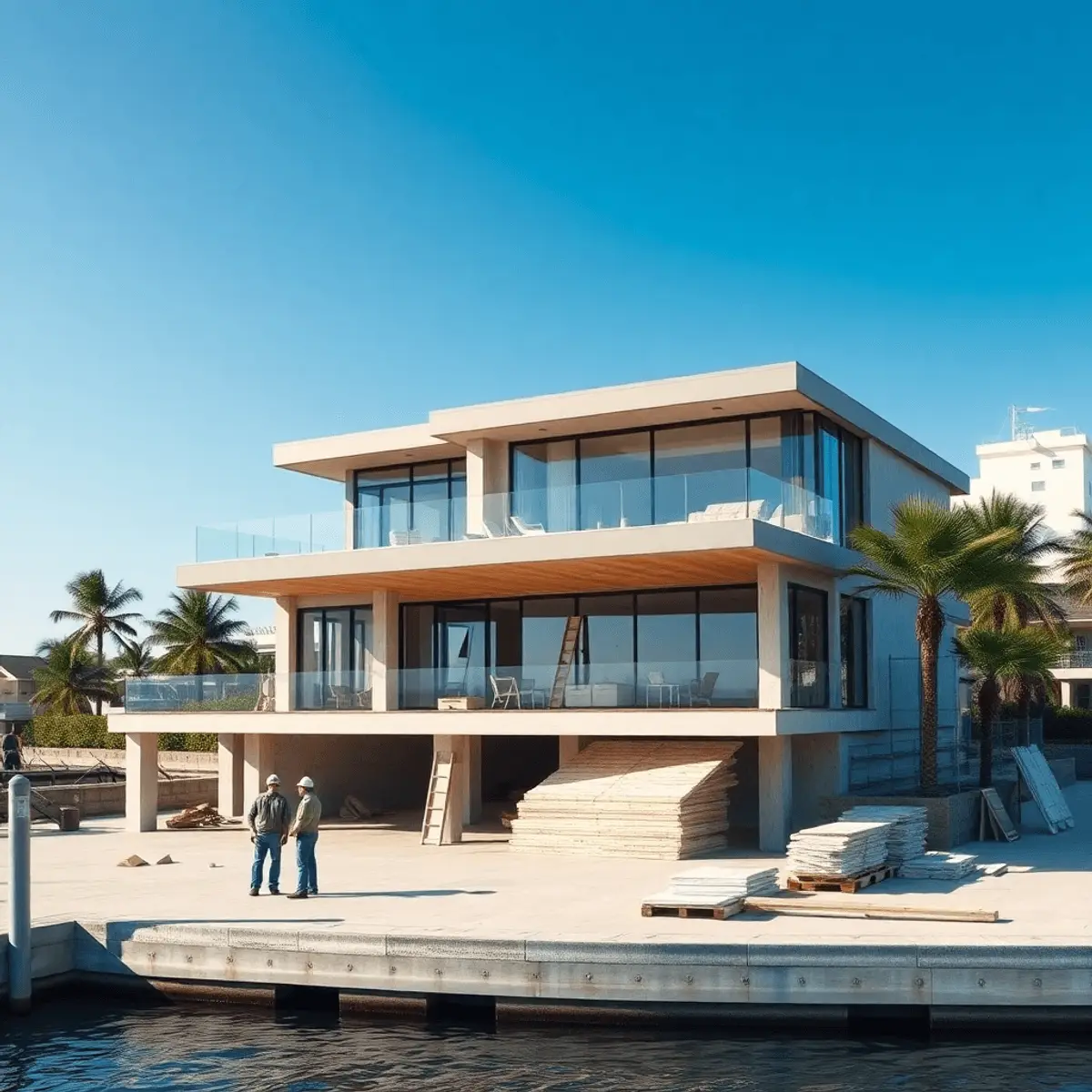
What actually counts as default?
Builder default on a South Florida project counts as abandonment, persistent failure to progress, failure to pay subcontractors, insolvency, loss of license or insurance, and refusal to correct defective work. Builder default protection starts with a contract that defines these precisely, because a vague default clause is unusable in the moment it is needed.
Where that definition sits in the agreement is described in construction contracts for high end residential work.
What are the early warning signs?
The early warning signs are subcontractors asking the owner about payment, crews shrinking, deliveries delayed for no stated reason, draws requested ahead of progress, lien notices arriving, and reporting that becomes vague. Every one of these is visible weeks before a site stops.
Builder default protection starts with notice: preliminary lien notices are governed by Chapter 713 of the Florida Statutes, and license status is checkable at the Florida DBPR.
Which contract terms make recovery possible?
The contract terms that make recovery possible are a notice and cure procedure with a stated period, a right to take assignment of the subcontracts, ownership of the drawings and submittals, a requirement that the builder maintain a current schedule of values, and a right of entry to complete. Those five clauses are the core of builder default protection.
They are best agreed during negotiation, as described in negotiating stronger contractor agreements.
How do payment controls limit exposure?
Payment controls limit exposure by ensuring the value of completed work always exceeds the money paid. Draws measured against verified progress, retainage held, conditional lien waivers exchanged with every payment, and no payment for uninstalled material without proof of title. This is the most practical form of builder default protection an owner has.
The payment mechanics of builder default protection are described in escrow milestone payments.

When does a bond actually help?
A performance bond on a Florida luxury build gives a surety obligation to complete or fund completion, which is valuable on a large contract with a builder whose capacity is unproven. It costs money, takes time to arrange, and pays slowly. On private residential work it supplements payment control rather than replacing it.
Surety basics are explained by the US Small Business Administration, and the wider coverage question in insurance and bonding requirements.
What about the subcontractors and suppliers?
Subcontractors and suppliers are where continuity lives. Keeping a current subcontractor list with contacts and contract values, requiring assignment rights, and confirming that specialist trades and long-lead suppliers are being paid all shorten the recovery if the general contractor stops.
Procurement exposure sits alongside builder default protection, and is covered in contingency planning for supply chain issues.
What should happen in the first week?
In the first week after a default, secure the site and the materials, notify the insurer and any surety, stop further payments, issue the contractual notice, obtain the current schedule of values and subcontractor list, photograph the work in place, and take advice before terminating. Terminating incorrectly converts builder default protection into a claim against the owner.
The forum for the argument that follows is set out in dispute resolution clauses, with counsel referral through The Florida Bar.
How is the risk reduced before it starts?
The risk is reduced before it starts by selecting a South Florida builder for capacity rather than for price: comparable completed projects, a stable named team, evidence of working capital, current licensing and insurance, and references who will discuss what went wrong. Selection is cheaper than every other form of builder default protection.
The screening tests that precede builder default protection are set out in the risks of hiring an unqualified luxury builder.
How does Kass Construction & Development reduce this exposure?
Kass Construction & Development reduces this exposure by being the counterparty an owner does not need to plan around. Kass Construction & Development is a state-licensed (CGC1529472) boutique luxury builder in East Fort Lauderdale led by Mitch Kass, a licensed general contractor and attorney, with 100+ luxury residences delivered by Mitchell Kass and the firms he has led across Broward, Palm Beach, and Miami-Dade, and builds the documentation and payment discipline that makes builder default protection straightforward.
A custom build often runs 18 to 36 months and a high-end renovation often 6 to 12 months. Contact Kass Construction & Development or call 954-607-4335.
| Layer | What it does | When it matters most |
|---|---|---|
| Selection | Screens for capacity, capital, and comparable work | Before any contract exists |
| Contract definition | Defines default, notice, cure, and termination | The week performance stops |
| Payment control | Keeps completed value ahead of money paid | Continuously |
| Lien waivers | Confirms subcontractors and suppliers are paid | Every draw |
| Document ownership | Owner holds drawings, submittals, and subcontract list | During transition to a new builder |
| Surety bond | Third-party obligation to complete or fund completion | Large contracts or unproven counterparties |
Which arrangements provide builder default protection at each stage of the project?
Builder default protection is a set of arrangements rather than a single clause, and the table below shows which arrangement protects the owner at each stage of a South Florida luxury build and what it limits.
| Stage | Arrangement | What it limits |
|---|---|---|
| Before contract | License, insurance, entity, references, litigation and lien search; financial capacity check | Contracting with a builder already in trouble |
| At contract | Milestone draws, retainage, lien releases as a payment condition, right to terminate for cause with cure, right to complete, assignment of subcontracts, ownership of documents | Exposure at any point in the job |
| Funding | Escrow or third-party disbursement; verified pay applications | Money running ahead of work |
| Bonding | Performance and payment bond where the project size and builder profile warrant it | Cost to complete and unpaid subcontractors |
| During construction | Weekly reporting, independent verification, subcontractor and supplier contact list, Notice to Owner tracking | Late discovery of distress |
| Early warning | Slowing crews, unpaid suppliers, late reports, draw requests ahead of progress, key staff leaving | Time lost before action |
| Default | Written notice, cure period, site secured, documents and materials retained, subcontracts assumed, completion contractor engaged | Cost and delay of recovery |
| After | Claims on the bond and insurance; lien defense; recovery fund where applicable | Residual loss |
Contractor licenses and complaints can be checked at myfloridalicense.com, the lien and licensing statutes are Chapter 713 and Chapter 489, Florida Statutes, and bonding is explained by the U.S. Small Business Administration. The contract terms are detailed in construction contracts for high-end residential builds.
What should happen in the first week after a builder default?
Builder default protection is exercised in the first week, and the sequence below is what an owner and their representative do when a default is declared or a builder walks off a South Florida site.
- Serve the written notice required by the contract and start the cure period, with counsel copied; see when to use a construction attorney.
- Secure the site: locks, insurance notification, protection of the open structure, and an inventory of materials on site.
- Freeze payments; reconcile the last pay application against verified progress and lien releases.
- Collect the documents: permits, approved drawings, submittals, product approvals, inspection records and the subcontract list; the value of holding these already is explained in quality control, inspections and punch lists.
- Contact every subcontractor and supplier who served a Notice to Owner, establish what they are owed, and identify which subcontracts can be assumed.
- Notify the surety if a bond exists, in the form and time the bond requires.
- Engage a completion contractor to assess the work in place and price the cost to complete.
- Notify the building department of the change of contractor and re-establish the permit under the new license.
How is builder default risk reduced before the project starts?
Builder default protection is cheapest before contract, and the practices below are what reduce the chance of ever needing the first-week sequence.
- Verify the builder thoroughly: license, insurance, entity filings, years in business, references from completed projects of similar scale, lien and litigation history; the warning signs are in the risks of hiring an unqualified luxury builder.
- Ask about financial capacity: bank references, supplier credit and the number of concurrent projects relative to staff.
- Use milestone draws with retainage and lien releases, and consider escrow where the owner is remote; see escrow and milestone payments.
- Confirm insurance and decide on bonding using insurance and bonding requirements in South Florida luxury construction.
- Negotiate the termination, assignment and document clauses per negotiating stronger contractor agreements, with the dispute path in dispute resolution clauses in Florida luxury contracts.
- Keep supply and procurement visible, since a builder in distress often shows it first in unpaid suppliers; see contingency planning for supply chain issues.
- Maintain independent verification through the build, so distress is seen in weeks rather than months.
Kass Construction & Development reduces this exposure for owners in Broward, Palm Beach and Miami-Dade by building under license CGC1529472 with verifiable insurance, milestone draws and lien releases as standard, and by providing the documents an owner would need in any event as part of ordinary reporting.
Frequently Asked Questions
What is builder default?
A material failure to perform as defined by the contract, such as abandonment, failure to progress, insolvency, loss of license or insurance, or refusal to correct defective work.
Can I terminate immediately?
Rarely. Most agreements require written notice and a cure period. Terminating without following the procedure usually exposes the owner to a claim.
Does a performance bond guarantee completion?
It obliges the surety to complete or fund completion within the bond amount, subject to its terms. It is a financial backstop, not an instant remedy.
What happens to unpaid subcontractors?
They may record liens against the property even where the owner has paid the general contractor, which is why conditional waivers with every draw matter.
Who owns the drawings if the builder leaves?
Whatever the agreements say. Owner ownership of drawings, submittals, and shop drawings should be stated in both the design and construction contracts.
How much does a replacement builder cost?
More than the original, because the incoming firm inherits unknown work and warranty risk. Retainage and unpaid balance are what fund the difference.
What is the best single protection?
Never being ahead on payment. If completed value always exceeds money paid, most default scenarios become manageable rather than ruinous.