Dispute resolution clauses decide how an argument about your house will be settled, where, under whose rules, by whom, and at whose cost. The clause takes a paragraph to write and a year to escape, which is why it deserves attention long before anyone disagrees about anything.
Key takeaways
- What does the clause actually control?
A dispute resolution clause in a Florida luxury contract controls the forum, the governing law, the venue, the rules and the institution, the qualification of the decision maker, whether other parties can be joined, who pays fees, and whether mediation must come first. - What does arbitration offer?
Arbitration offers privacy, a decision maker who can be required to have construction experience, a schedule the parties influence, and a final award with very limited appeal. - What does litigation offer?
Litigation in a Florida court offers full discovery, established procedure, appellate rights, and the ability to bring in every party at once without their consent. - Which fits which kind of dispute?
On a South Florida luxury home, workmanship and technical defect claims usually suit arbitration. Payment and lien enforcement often need the court, because lien procedure is statutory.

What does the clause actually control?
A dispute resolution clause in a Florida luxury contract controls the forum, the governing law, the venue, the rules and the institution, the qualification of the decision maker, whether other parties can be joined, who pays fees, and whether mediation must come first. Dispute resolution clauses that name only arbitration have decided almost none of this.
Where dispute resolution clauses sit in the agreement is described in construction contracts for high end residential work.
What does arbitration offer?
Arbitration offers privacy, a decision maker who can be required to have construction experience, a schedule the parties influence, and a final award with very limited appeal. For technical disputes about workmanship, arbitration usually reaches a better-informed result faster than a general civil docket.
Selecting the institution and the arbitrator qualification is the part of dispute resolution clauses most often left blank.
What does litigation offer?
Litigation in a Florida court offers full discovery, established procedure, appellate rights, and the ability to bring in every party at once without their consent. It is public, usually slower, and the judge will not be a construction specialist unless the case is assigned to one.
Litigation under dispute resolution clauses runs through the Florida court system, described at the Florida State Courts.
Which fits which kind of dispute?
On a South Florida luxury home, workmanship and technical defect claims usually suit arbitration. Payment and lien enforcement often need the court, because lien procedure is statutory. Multi-party design and construction claims suit whichever forum can hear everyone together. Dispute resolution clauses should be written with those three cases in mind.
Lien enforcement follows Chapter 713 of the Florida Statutes.
Why does the multi-party problem matter?
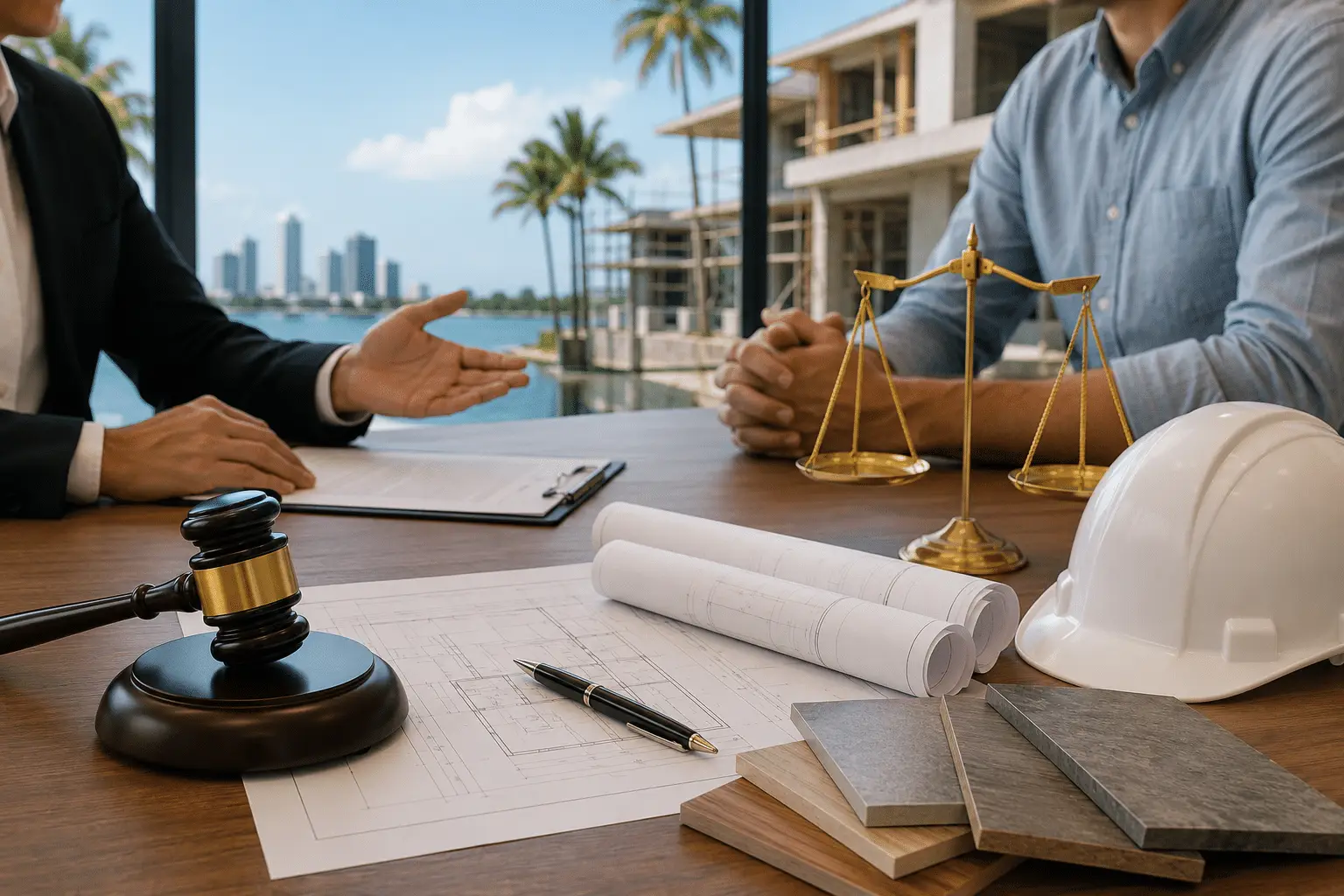
The multi-party problem matters because the architect, the engineers, and the builder normally sign separate agreements with separate clauses. If they do not match, a single defect can require two proceedings with inconsistent outcomes. Aligning the clauses across every agreement is the highest-value edit available.
The coordination question behind multi-party dispute resolution clauses is described in managing architect, engineer, and contractor relationships.
What comes before either forum?
Before either forum in Florida comes usually a notice, then negotiation, then mediation. Florida also has a statutory pre-suit notice and opportunity to repair procedure for construction defect claims, which applies before an action is filed and should be understood before a dispute is escalated.
The procedure sits in Chapter 558 of the Florida Statutes; confirm application with counsel.
Which details decide the outcome?
The details that decide the outcome are venue and governing law, the number of decision makers, required construction experience, the discovery limits, consolidation and joinder rights, a fee-shifting rule, and a time limit for bringing a claim. Dispute resolution clauses without these read as fair and behave unpredictably.
Dispute resolution clauses belong on the negotiation list in negotiating stronger contractor agreements.
How are most disputes actually avoided?
Most South Florida construction disputes are avoided by documentation: a referenced scope, an agreed change method, verified draws, dated photography, mockups approved before installation, and a decision log remove the ambiguity that disputes feed on. The best dispute resolution clauses are the ones never used.
The document discipline that keeps dispute resolution clauses unused is described in quality control, inspections, and punch lists, and counsel referral is available through The Florida Bar.
How does Kass Construction & Development approach it?
Kass Construction & Development approaches disputes by making the record unambiguous. Kass Construction & Development is a state-licensed (CGC1529472) boutique luxury builder in East Fort Lauderdale led by Mitch Kass, a licensed general contractor and attorney, with 100+ luxury residences delivered by Mitchell Kass and the firms he has led across Broward, Palm Beach, and Miami-Dade, so dispute resolution clauses are negotiated with a clear view of how each forum behaves in practice.
A custom build often runs 18 to 36 months and a high-end renovation often 6 to 12 months. Contact Kass Construction & Development or call 954-607-4335.
| Factor | Arbitration | Litigation |
|---|---|---|
| Privacy | Private proceeding and award | Public record |
| Decision maker | Can be required to have construction experience | Assigned judge, specialist only by chance |
| Discovery | Limited by the rules chosen | Full civil discovery |
| Speed | Usually faster where the parties cooperate | Set by the court calendar |
| Appeal | Very limited | Established appellate rights |
| Joining other parties | Only with consent or matching clauses | Available without consent |
| Cost | Party-paid arbitrator and institution fees | Court fees plus longer timelines |
How do the dispute resolution options compare for a Florida luxury home contract?
Dispute resolution clauses choose among a small number of forums, and the table below compares them on the questions that matter to a South Florida owner: speed, cost, privacy, appeal and fit with multi-party projects.
| Forum | Speed | Cost | Privacy | Appeal | Fit for multi-party disputes |
|---|---|---|---|---|---|
| Negotiation between principals | Days to weeks | Minimal | Complete | Not applicable | Good if everyone attends |
| Mediation | Weeks | Low; shared mediator fee | Confidential | Non-binding unless settled | Good; all parties can join one session |
| Arbitration | Months to a year | Moderate to high; arbitrator fees plus counsel | Private | Very limited | Poor unless every contract has a matching clause and consolidation is allowed |
| Litigation in state court | A year or more | High | Public record | Full appellate rights | Good; all parties can be joined |
| Statutory pre-suit process for construction defects | Defined notice and response periods | Low | Private until suit | Precedes either forum | Required before defect claims proceed |
Florida’s courts are described at flcourts.gov, the construction defect pre-suit procedure is in Chapter 558, Florida Statutes, and counsel can be found through The Florida Bar. The multi-party problem arises because the owner holds separate agreements with the architect, the builder and consultants, as described in managing architect, engineer and contractor relationships.
Which details in dispute resolution clauses decide the outcome?
Dispute resolution clauses are decided by their details rather than by the choice of forum, and the items below are the ones an owner should settle before signing a South Florida construction agreement.
- A stepped procedure: notice, principals’ meeting, mediation, then arbitration or litigation, with time limits at each step so nobody can stall.
- Venue and governing law set to the county where the home is built.
- Consistency across contracts: the same clause in the architect’s, builder’s and major consultants’ agreements, with consent to consolidation, so one dispute is heard once.
- Arbitration specifics where chosen: the administering body, the number of arbitrators, their qualifications in construction, discovery limits, and whether reasoned awards are required.
- Fee provisions: whether the prevailing party recovers fees, and whether that applies both ways.
- Continuation of work: whether the builder must keep working during a dispute and whether the owner must keep paying undisputed sums.
- Carve-outs: lien enforcement, emergency injunctions and small claims that should not wait for a full process.
- Interaction with the statutory defect process and with any bond or insurance claim procedure; the contract context is in construction contracts for high-end residential builds.
How are most disputes avoided before the clause is ever used?
Dispute resolution clauses are rarely invoked on projects that keep a record and follow a procedure, and the practices below are what keep South Florida luxury builds out of any forum.
- A document of record from day one: drawings, specification, change log, decision log, photographs and correspondence, so disagreements are settled from evidence.
- Change orders priced and signed before work, per the procedure in change order abuse.
- Inspection points photographed before cover and a punch process run by method, per quality control, inspections and punch lists.
- Draws verified and lien releases collected, so payment disputes have nothing to attach to.
- A weekly meeting where disagreements are raised in writing while they are small.
- A negotiated agreement both parties would be comfortable enforcing, per negotiating stronger contractor agreements.
- Counsel consulted early on a genuine dispute and kept in the background otherwise.
Kass Construction & Development’s agreements on projects across Broward, Palm Beach and Miami-Dade carry a stepped procedure with local venue and mediation first, and the company’s reporting is designed so that the clause is the least-used paragraph in the contract.
Frequently Asked Questions
Is arbitration better than court?
It is different. Arbitration offers privacy, a technically qualified decision maker, and finality. Court offers full discovery, appeal rights, and easier joinder of multiple parties.
Can I be forced to arbitrate?
If the contract contains a valid arbitration agreement, courts generally enforce it. That is why the clause should be read before signature rather than after a dispute.
Is arbitration cheaper?
Not automatically. Arbitrator and institutional fees are paid by the parties, so savings come from shorter timelines and narrower discovery rather than from lower fixed costs.
Should mediation come first?
Usually yes. A required mediation step resolves many disputes at a fraction of the cost and rarely delays a determined claimant for long.
What is a fee-shifting clause?
A provision making the losing party pay the winner’s costs. It discourages weak claims and raises the stakes, so it should be a deliberate choice.
Where should the venue be?
Normally the county where the project sits, which keeps witnesses, records, and inspections local.
Does the clause apply to the architect too?
Only if the design agreement says so. Matching clauses across all project agreements is what allows one proceeding instead of two.