Choosing among custom home builders Miami has to offer comes down to three checks: a verifiable Florida general contractor license, documented Miami-Dade permitting experience, and real waterfront work you can inspect. Price matters, but on a luxury build the expensive mistakes come from process, not markup, so vet the process first.
Key takeaways
- What does a custom home builder actually do on a Miami build?
A custom home builder in Miami does everything between your architect's drawings and your certificate of occupancy: pre-construction planning, budgeting, permitting, subcontractor management, inspections, and the documentation that proves each step happened. - Why is building in Miami-Dade its own environment?
Miami-Dade sits in the High-Velocity Hurricane Zone, the strictest wind design category in the Florida Building Code. Windows, doors, roofing assemblies, and many exterior components must carry product approvals rated for that zone, and inspections check the installed product against the approved documents. - Why do elevation, seawalls, and dockage come first on a Miami waterfront lot?
On a Miami waterfront lot, the water side of the project shapes the house side. - What happens in pre-construction, and why does it decide everything?
Pre-construction is where custom home builders Miami projects are won or lost: the survey, the geotechnical work, the budget model, the permit strategy, and the procurement plan all happen before a shovel moves.
What does a custom home builder actually do on a Miami build?
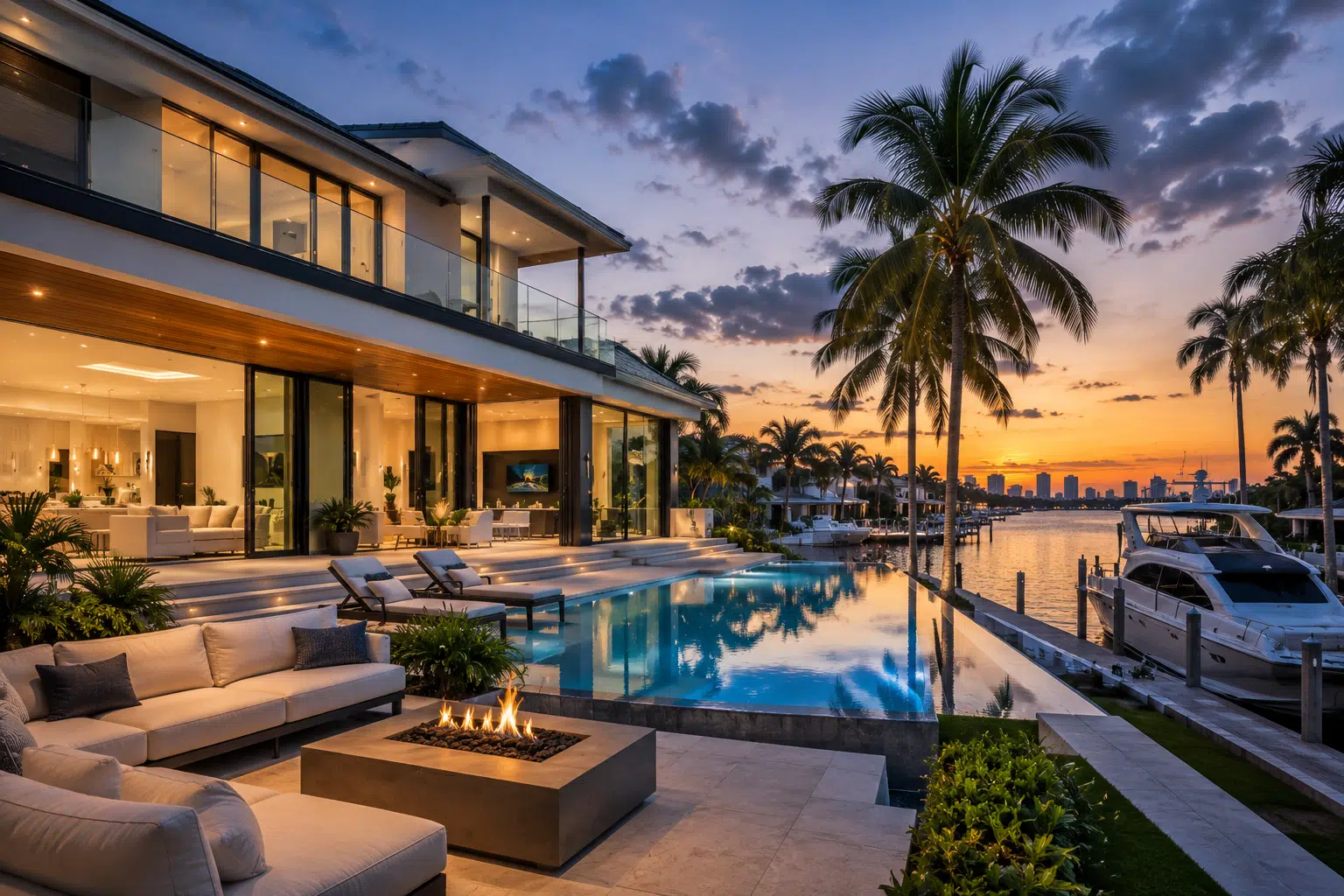
A custom home builder in Miami does everything between your architect’s drawings and your certificate of occupancy: pre-construction planning, budgeting, permitting, subcontractor management, inspections, and the documentation that proves each step happened. The best custom home builders Miami buyers can hire treat paperwork as part of the product. Draw requests are verified, change orders are priced before work proceeds, and decisions are logged so the project stays auditable.
That discipline matters more in Miami-Dade than almost anywhere else in Florida, because the county layers its own requirements on top of the Florida Building Code, and every layer is another place where an undocumented decision becomes a delay.
Why is building in Miami-Dade its own environment?
Miami-Dade sits in the High-Velocity Hurricane Zone, the strictest wind design category in the Florida Building Code. Windows, doors, roofing assemblies, and many exterior components must carry product approvals rated for that zone, and inspections check the installed product against the approved documents. A builder who works here routinely maintains a library of approved assemblies; one who does not will learn at your expense.
The practical consequence: material substitutions that would be trivial elsewhere need review here. Good custom home builders Miami homeowners recommend will price alternates early and lock selections before ordering, because a swapped window line can mean a new approval cycle. The broader hurricane engineering behind this is covered in our guide to hurricane resistant construction in South Florida.
Why do elevation, seawalls, and dockage come first on a Miami waterfront lot?
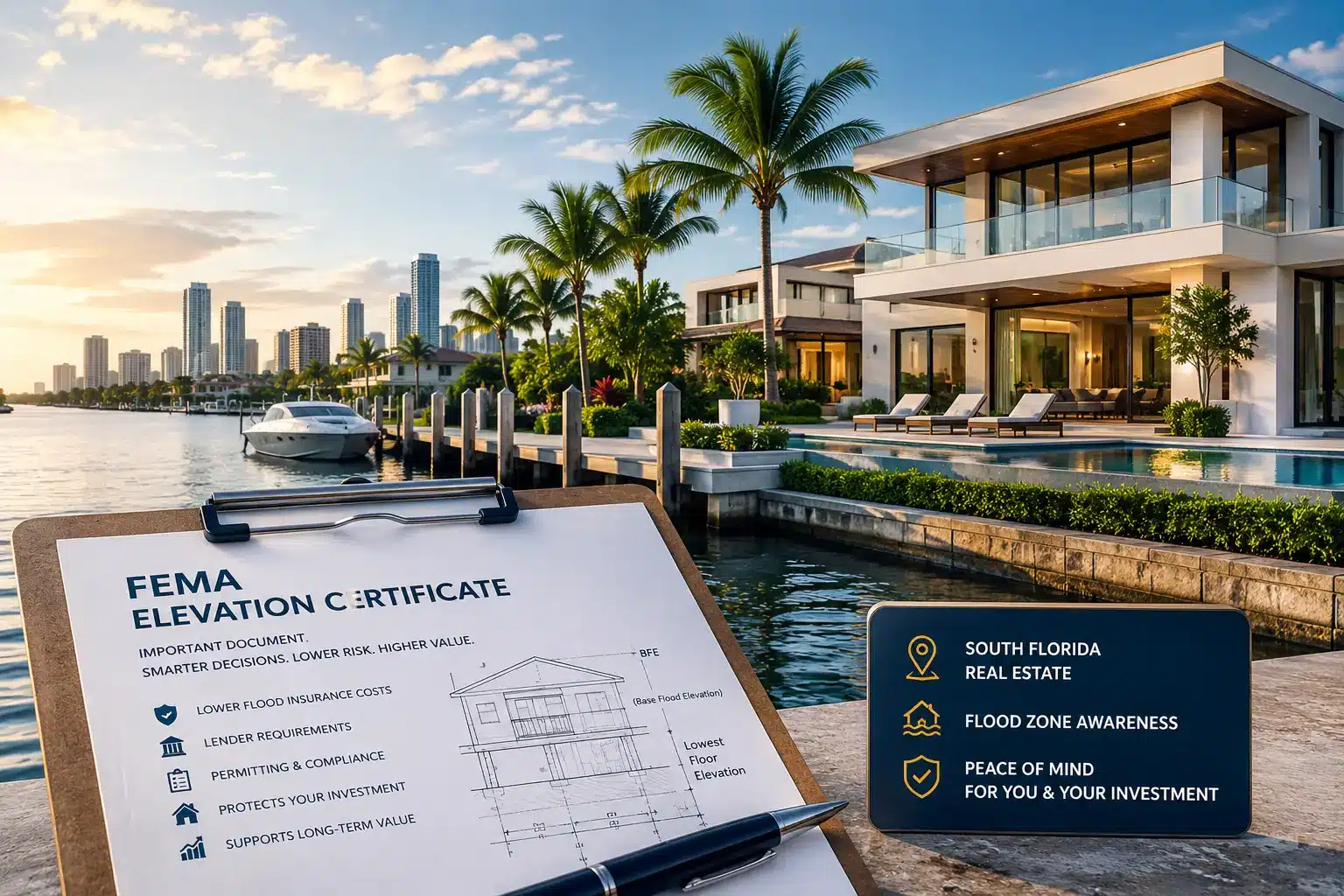
On a Miami waterfront lot, the water side of the project shapes the house side. Finished floor elevation is driven by the flood zone, and the documentation lives in an elevation certificate; our primer on FEMA elevation certificates explains what buyers and builders each need from it. FEMA’s own flood maps are searchable at the FEMA Map Service Center.
Seawall condition belongs in due diligence, not in the construction budget as a surprise. If the wall needs repair or replacement, the approval path runs through its own agencies and its own timeline, which we walk through in seawall construction and permitting in South Florida. Dock and lift plans deserve the same early attention.
What happens in pre-construction, and why does it decide everything?
Pre-construction is where custom home builders Miami projects are won or lost: the survey, the geotechnical work, the budget model, the permit strategy, and the procurement plan all happen before a shovel moves. Skipping or rushing this phase does not save time; it moves the time into construction, where it costs far more. Our walkthrough of pre-construction planning for luxury custom homes covers each deliverable.
Ask any candidate builder what their pre-construction package contains and what it costs as a standalone engagement. A builder with a real answer has done this before. A builder who waves it into “we handle all that” has not, or handles it badly.
What makes a Miami construction contract protect you, not just the builder?
On a Miami custom home, the construction agreement is the only protection that survives a dispute, so read it like it will be tested. Scope precision, allowance realism, payment schedules tied to verified progress, and warranty terms carry most of the weight. Our guides to high-end residential construction contracts and the ten contract red flags show exactly what to look for before you sign anything.
This is also where the leadership of your builder matters. Kass Construction is led by a general contractor who is also an attorney, which shapes how agreements, change orders, and disputes are documented from the first draft.
How does Miami-Dade permitting shape your schedule?
Miami-Dade permitting is the least visible phase and the most common source of schedule pain. The sequence, the revision cycles, and the inspection cadence differ between municipalities inside the county, and between the county and its neighbors. We compare the three counties in permitting differences across Broward, Miami-Dade, and Palm Beach, and our Miami-Dade permitting and cost guide goes deeper on this county specifically.
When you interview custom home builders Miami candidates, ask each one to narrate the permit path for your specific address: which jurisdiction, which reviews, what typically bounces, and how revisions are handled. The quality of that answer predicts the project.
What does a luxury custom home cost in Miami?
The honest answer for a Miami luxury custom home: it depends on scope, site, and selections, and any builder quoting a tight number before design documents exist is guessing. The drivers are knowable, though: lot and water frontage, elevation and foundation approach, structural spans, glazing packages rated for the wind zone, finish level, and the schedule itself. We break the components down in our Miami-Dade luxury construction cost breakdown.
What separates serious custom home builders Miami wide is not the number but the budget’s transparency: allowances that reflect your actual taste, alternates priced in writing, and a change order process that keeps the running total current instead of surprising you at the end.
How long will it take?
Ground-up luxury custom builds in South Florida often run 18 to 36 months, depending on scope, complexity, approvals, and procurement. Waterfront work can add to that when seawall or dock approvals run long. The full breakdown of what consumes that time, and what an owner can actually compress, is in our custom build timeline guide.

How do you vet custom home builders Miami buyers can actually trust?
Run the same five checks on every Miami custom home builder, in the same order. First, verify the general contractor license yourself at the Florida DBPR license portal. Second, confirm general liability and workers compensation insurance directly with the carrier. Third, ask for two projects at your scale you can see, ideally one in progress. Fourth, read a real change order and a real monthly report from a past job. Fifth, ask who supervises your site day to day and how often the builder is physically there.
Some owners add an independent layer of protection on top: an owner’s representative who verifies draws and documents decisions. On complex waterfront builds that oversight tends to pay for itself.
Which parts of Miami-Dade does this apply to?
All of it: the same code, county review, and coastal physics apply whether you are building on the Intracoastal, a canal, or a dry inland lot. The waterfront communities simply add layers, and they are where custom home builders Miami owners compare tend to separate. For a worked example at neighborhood level, see our Bal Harbour waterfront homes guide, the first in our Miami-Dade series, and expect that series to grow.
How should builders and architects work together on a Miami estate?
On an architect-driven Miami estate, the builder’s job is to protect the design intent while keeping the budget and the code honest. That means early constructability reviews, pricing feedback while drawings are still cheap to change, and a standing rhythm between architect, engineer, and site team once construction starts. We describe that working relationship in managing the professional team, and the design direction conversation itself in modern coastal architecture trends.
When you interview custom home builders Miami architects already trust, ask the architect which builders made their drawings better rather than cheaper. That referral question produces more signal than any portfolio page.
Renovate the existing house, or build new?
On older Miami waterfront stock this is a numbers question, not a taste question. Flood zone rules, the substantial improvement threshold, and the condition of the structure and seawall decide whether a renovation makes sense or whether a teardown wins. Our feasibility study guide shows how we run that analysis before anyone falls in love with a plan.
Why choose a Fort Lauderdale based builder for a Miami-Dade home?
Kass Construction and Development builds across Broward, Palm Beach, and Miami-Dade counties from its East Fort Lauderdale base. The firm is led by Mitchell P. Kass, a Florida licensed general contractor who is also an attorney, with four decades in Florida real estate, law and construction and 100+ luxury residences delivered by Mitchell Kass and the firms he has led. The same documented, oversight-heavy process described in our Fort Lauderdale custom home builders guide applies to every Miami-Dade project.
If you are comparing custom home builders Miami wide, we are glad to be one of the interviews. Call 954-607-4335 or reach us through the contact page, and bring your toughest permitting question.
What should custom home builders Miami buyers consider be able to show for each phase?
Custom home builders in Miami should be able to show, phase by phase, what they deliver on a Miami-Dade luxury build, and the table below is the checklist a buyer can put in front of any builder before signing.
| Phase | What the builder should show | Why it matters in Miami-Dade |
|---|---|---|
| Feasibility | Survey, soils, flood zone and freeboard findings, seawall assessment, zoning verification, tear-down-or-renovate comparison | Elevation and shoreline decide the project before design |
| Design partnership | Pricing at each design stage, constructability review, product approval strategy | Notices of Acceptance and HVHZ structure drive cost and lead times |
| Pre-construction | Coordinated documents, allowances tied to products, schedule of values, procurement plan | Complete sets pass county review in fewer cycles |
| Permitting | Permit log across building, environmental (DERM), floodplain and sub-permits; intake-to-issuance history | Several agencies on independent calendars |
| Construction | Weekly report, inspection-point photography, verified milestone draws with lien releases, change orders signed before work | County inspectors verify products on site; absent owners need evidence |
| Close-out | Closed permits, elevation certificate, wind-mitigation form, warranties, as-builts | Insurance and resale depend on the file |
A builder’s license and any complaints are public at myfloridalicense.com; Kass Construction & Development builds under CGC1529472. The county’s procedures are published at miamidade.gov, the code is the Florida Building Code, and flood zones are at the FEMA Flood Map Service Center. The permitting detail is in Miami-Dade custom home permitting, costs and market trends.
How do the Miami-Dade waterfront settings differ for a custom home builder?
Custom home builders Miami wide work across several distinct waterfront settings, and the list below shows how the technical picture changes from one to the next.
- Biscayne Bay islands and Coconut Grove: bay frontage, wide-water exposure, deep-water dockage, AE and some VE zones, county Class I environmental permits for seawalls and docks.
- Miami Beach and the barrier islands: oceanfront lots under the Coastal Construction Control Line, bayfront lots with seawalls, historic districts in places; see Bal Harbour waterfront homes.
- Coral Gables canals and waterways: protected water, bridge clearance limits, strong architectural review and historic preservation.
- Pinecrest, Palmetto Bay and the south bay: larger lots, bay access, mangrove and seagrass considerations on the shoreline.
- Inland estate areas: no shoreline scope, but the same HVHZ structure and product regime, with more freedom on foundation type.
- Every setting: elevation set from the zone and freeboard, per FEMA elevation certificates, and the shoreline permitted through seawall construction and permitting.
What is the vetting sequence for custom home builders Miami owners can trust?
Custom home builders Miami buyers can trust are identified by a short vetting sequence, and running it before price is discussed is what protects a luxury build.
- License, entity, insurance and years in business verified from public sources, not from the builder’s brochure.
- Miami-Dade permitting history: which municipalities, how many luxury permits in the past two years, intake-to-issuance timelines, and how the builder handles product control; the county differences are in permitting differences across Broward, Miami-Dade and Palm Beach.
- Finished waterfront work the buyer can walk through, in the same water type as the planned lot, with owner references.
- A sample weekly report and a sample contract with exhibits, read against construction contract red flags and construction contracts for high-end residential builds.
- The builder’s approach to working with the architect during design, per managing architect, engineer and contractor relationships, and with an independent owner’s representative, per what an owner’s representative is.
- A realistic view of cost and time: the components in the Miami-Dade cost breakdown and the 18 to 36 month program in how long it takes to build a custom luxury home.
- The renovate-or-rebuild question settled by a study rather than an opinion, per feasibility studies for luxury home builds.
Kass Construction & Development is a Fort Lauderdale based builder working across Miami-Dade, with the county’s product control and inspection regime treated as the standard for the whole region; the Broward practice is described in custom home builders in Fort Lauderdale and the resilience baseline in hurricane-resistant construction.
Frequently Asked Questions
What should I look for first in custom home builders Miami offers?
Verify the Florida general contractor license, ask for proof of insurance, and look for documented experience with Miami-Dade permitting and waterfront work. A builder who explains process and paperwork before price is usually the safer choice.
How long does a custom home build take in Miami?
Ground-up luxury custom builds in South Florida often run 18 to 36 months depending on scope, complexity, approvals, and procurement. Waterfront lots with seawall or dock work can extend that range.
Do custom home builders Miami residents hire also handle permits?
A full-service builder manages permit applications, revisions, and inspections as part of the job. In Miami-Dade that includes product approvals for windows, doors, and roofing rated for the High-Velocity Hurricane Zone.
What makes waterfront builds different from inland builds in Miami?
Elevation requirements, flood zone documentation, seawall condition, and dock or lift coordination all enter the project before design is finished. Each adds review steps that an experienced builder plans for from day one.
Does Kass Construction build in Miami-Dade County?
Yes. Kass Construction and Development serves Broward, Palm Beach, and Miami-Dade counties from its East Fort Lauderdale base, and is led by a licensed general contractor who is also an attorney.
Should I renovate an existing Miami home or build new?
The structure, the flood zone math, and your goals decide it. A feasibility review comparing teardown and renovation, including the substantial improvement rule, answers it with numbers rather than instinct.