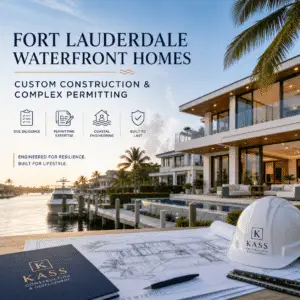
A Strategic Guide for Luxury Homeowners Building in South Florida
Permit delays are one of the most frustrating parts of luxury home construction in South Florida. In this article, Kass Construction explains the common causes of delays and how we help clients in Broward County, Palm Beach County, and Miami-Dade County keep projects on schedule.
Permit delays are one of the most common and financially damaging challenges in South Florida luxury home construction, and this article opens by framing them as a predictable risk rather than an unavoidable setback. In high-end markets like Fort Lauderdale, Boca Raton, and Miami, delays of several months can significantly impact project timelines, increase carrying costs, and disrupt overall investment strategy. This guide establishes that permitting is not a simple approval process, but a multi-layered regulatory system where missteps in planning, documentation, or coordination can quickly compound into costly delays.
The article then breaks down the primary causes of permit delays, including incomplete or poorly coordinated plans, failure to meet Florida Building Code requirements, zoning conflicts, waterfront regulatory complexity, and slow response times during review cycles. It provides a detailed look at how these issues arise and why they are so common, particularly in luxury projects that involve custom architecture and coastal considerations. By quantifying the financial impact, often adding hundreds of thousands of dollars to a project, the guide reinforces the importance of proactive planning and experienced oversight.
Finally, the article delivers a strategic, step-by-step framework for avoiding delays and maintaining momentum through the permitting phase. It emphasizes the importance of submitting complete, high-quality plans, engaging an experienced builder early, understanding local municipal requirements, and maintaining rapid response cycles during reviews. By combining process clarity with actionable best practices, this guide equips homeowners and investors with the tools needed to navigate permitting efficiently, reduce risk, and keep their luxury home project on schedule and on budget.
In markets like Fort Lauderdale, Boca Raton, and Miami, delays of 3 to 9+ months are not uncommon. For high-end projects, these delays can translate into:
- Increased construction costs
- Extended financing and carrying expenses
- Missed market opportunities
- Project timeline disruptions
The key insight:
Most permit delays are predictable and preventable
This guide explains why delays happen and how to avoid them with a disciplined, professional approach.
The Reality of Permitting in South Florida
Permitting is not a simple approval, it is a multi-layered regulatory process involving:
- Zoning departments
- Structural and building review
- Fire safety review
- Engineering and environmental oversight
Each layer introduces potential delays.
The 8 Most Common Causes of Permit Delays
1. Incomplete or Poor-Quality Plans (The #1 Cause)
South Florida has strict requirements for:
- Hurricane resistance
- Structural load calculations
- Energy efficiency
Non-compliance = immediate rejection
2. Failure to Meet Florida Building Code (FBC)
South Florida has strict requirements for:
- Hurricane resistance
- Structural load calculations
- Energy efficiency
Non-compliance = immediate rejection
3. Zoning Conflicts & Setback Violations
Common issues:
- Building too close to property lines
- Exceeding height limits
- Lot coverage violations
These errors can require major redesigns
4. Waterfront & Coastal Regulations
Waterfront homes often require:
- Seawall permits
- Dock approvals
- Environmental reviews
- Coastal Construction Control Line (CCCL) compliance
These layers significantly extend timelines
5. Slow Response to Plan Review Comments
After submission, municipalities issue comments.
Delays occur when:
- Revisions take too long
- Teams are uncoordinated
Time between resubmissions adds up quickly
6. Overloaded Municipal Departments
High construction demand leads to:
- Backlogs
- Slower review times
This is common in South Florida’s luxury markets
7. Design Changes After Submission
Late changes force:
- Plan revisions
- Re-review cycles
This can reset approval timelines
8. Inexperienced Builder or Design Team
Unqualified teams:
- Miss code requirements
- Submit incomplete packages
- Fail to anticipate issues
Result: repeated delays
The True Cost of Permit Delays
Permit delays are not just scheduling issues; they are financial risks.
Example:
- 6-month delay on a $5M project
Potential impact:
- $150K to $300K+ in added costs
- Material price increases
- Labor escalation
- Financing costs
How to Avoid Permit Delays (Pro-Level Strategy)
1. Submit Complete, Coordinated Plans
Plans should include:
- Architecture
- Structural engineering
- MEP systems
- Site plans
Coordination is critical
2. Engage an Experienced Luxury Builder Early
An experienced builder:
- Identifies issues before submission
- Aligns design with code requirements
- Reduces revision cycles
3. Understand Local Municipality Requirements
Each city is different:
- Fort Lauderdale
- Boca Raton
- Miami
Local expertise matters
4. Respond Quickly to Comments
Fast turnaround reduces delays.
Speed = competitive advantage
5. Avoid Mid-Process Design Changes
Lock design before submission.
Changes = resets
6. Plan for Delays in Your Timeline
Even with perfect execution:
- Some delays are unavoidable
Build buffer into your schedule
7. Use a Structured Permitting Strategy
Top builders:
- Track submissions
- Manage revisions
- Communicate with reviewers
This separates professionals from amateurs
Permit Delay Prevention Framework
Risk | Solution |
Incomplete Plans | Full design coordination |
Code Issues | Experienced team |
Zoning Errors | Early feasibility analysis |
Waterfront Complexity | Specialized expertise |
Slow Responses | Rapid revision cycles |
Backlogs | Realistic timelines |
Strategic Insight
Permit delays are not random.
They are the result of:
- Poor planning
- Inexperience
- Lack of coordination
The best projects:
- Anticipate issues
- Solve them before submission
- Move through approvals efficiently
Which causes of permit delays are most common, and what prevents each?
Permit delays in Broward, Palm Beach and Miami-Dade come from a short list of causes, and each has a control that prevents it before the file is submitted.
| Cause of permit delays | What it costs | Control that prevents it |
|---|---|---|
| Incomplete or uncoordinated plans | One or two full comment cycles | Clash review across all disciplines at the same revision before filing |
| Florida Building Code and product approval gaps | A comment cycle; failed inspections later | Product approval or Notice of Acceptance numbers on the drawings, matched to sizes |
| Zoning and setback conflicts | Redesign; variance hearings on fixed dates | Zoning verification or pre-application meeting before schematic design |
| Waterfront and coastal approvals opened late | Months added to the start date | Environmental, seawall and CCCL applications filed as soon as the survey and engineering exist |
| Slow or partial responses to comments | Another cycle per partial response | Comments distributed the day they arrive; item-by-item response log |
| Overloaded municipal departments | Longer review times outside anyone’s control | File complete and early; use the pre-application process; track the portal daily |
| Design changes after submission | Restarted review | Design freeze at filing; changes held for a post-issuance revision |
| Inexperienced team | All of the above | A builder with documented permits in the same municipality; see common luxury home permitting mistakes |
The code and product approval rules sit under the Florida Building Code, the flood zone comes from the FEMA Flood Map Service Center, and coastal permits are administered by the Florida Department of Environmental Protection. The reviewers and their calendars are mapped in the South Florida luxury home permitting process and the timeline in the South Florida custom home permitting timeline.
What is the sequence that prevents permit delays on a South Florida build?
Permit delays are prevented by a sequence that starts months before filing, and the steps below are the ones Kass Construction & Development runs on every South Florida luxury home.
- Survey, soils and zoning confirmation in the first month, before schematic design, so the flood zone, freeboard and setbacks are known; see flood zone requirements for waterfront construction in Broward County.
- Pre-application meeting with the municipality and, on waterfront lots, an early conversation with the county environmental agency; the county differences are in permitting differences across Broward, Miami-Dade and Palm Beach.
- Shoreline and coastal applications filed first, because they run on state and federal calendars; see seawall construction and permitting and environmental and coastal construction permits.
- Homeowners association or design review approval obtained during design development, per HOAs and architectural review boards in South Florida.
- Window, door, roofing and shutter packages selected early so product approvals are on the drawings at filing.
- Design frozen and the set coordinated across architectural, structural, MEP and civil sheets before submission.
- Building permit filed complete, with sub-permit scopes shown; one named owner for the file with weekly status in the project report.
- Comments distributed the day they arrive and answered item by item within a week.
- Long-lead items released the week the permit issues, so the approval is converted into construction time; the whole program is in how long it takes to build a custom luxury home and the planning in pre-construction planning.
Where a municipality’s calendar is the constraint, the role of a specialist is discussed in permit expediting services in Florida, and the levers that compress approvals in luxury home approvals in South Florida.
Frequently Asked Questions
Q. What is the biggest challenge in waterfront construction?
Foundation stability, flood compliance, and regulatory approvals.
Q. How much more expensive is a waterfront home to build?
Typically 15% to 30% more than inland homes.
Q. Do I need a special builder for waterfront homes?
Yes, experience in coastal construction is critical.
Q. What permits are required for waterfront construction?
- Building permits
- Environmental approvals
- Dock/seawall permits
Q. What causes most permit delays?
Incomplete or uncoordinated submittals, and slow responses to reviewer comments. Both are within the owner's team's control and neither is a reflection of reviewer speed.
Q. How many review cycles should I expect?
Fewer than most projects experience. The number is set almost entirely by the completeness and internal consistency of the first submittal.
Q. Can I change the design during review?
You can, but it may reset the file and invalidate coordinated calculations. Closing the design before submittal is far cheaper than changing it during review.
Q. Does an expediter eliminate delays?
No. An expediter manages the file and the relationships well, but a delay caused by an incomplete drawing set is fixed by the design team, not by the expediter.
Why Kass Construction & Development
Kass Construction & Development specializes in efficient, structured project execution.
We provide:
- Full pre-construction coordination
- Code-compliant design planning
- Proactive permit management
- Clear communication with municipalities
We help clients:
- Avoid unnecessary delays
- Reduce costs
- Move from concept to construction faster