
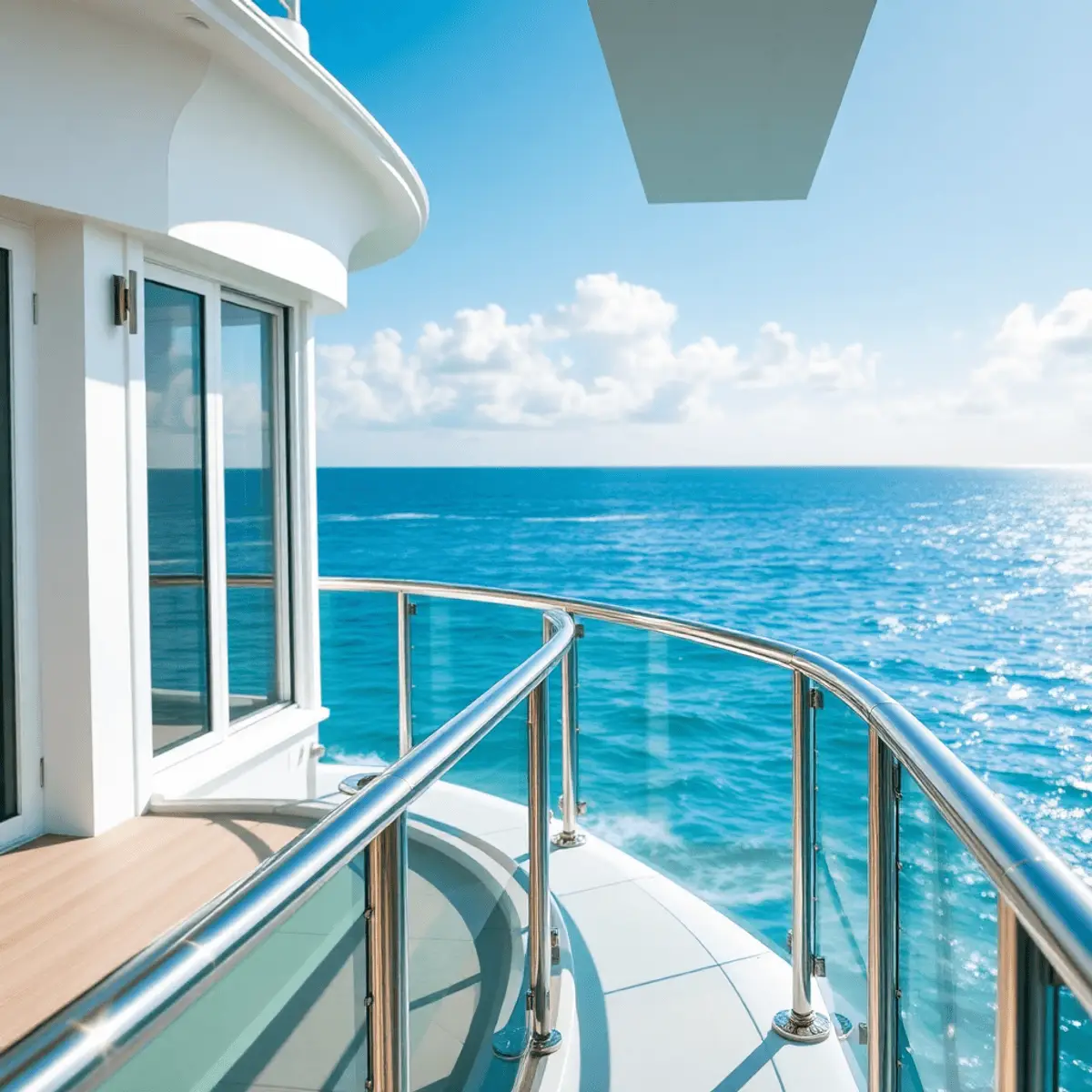
Coastal corrosion-resistant materials are the difference between a waterfront home that ages gracefully and one that begins consuming its owner’s attention in year five. Salt air does not attack dramatically; it works quietly at fasteners, connectors, reinforcing steel, hardware, and coatings until something visible fails and the invisible damage behind it is already extensive. Specifying for that environment is not about buying premium finishes; it is about understanding which metal, which coating, and which detail belongs at which distance from the water.
Key takeaways
- What actually causes corrosion at the coast?
Airborne chloride from the Atlantic is what corrodes South Florida coastal homes: salt carried on the breeze settles on every exposed surface within a few miles of the water. - Why is durability a system rather than a product?
Durability on a coastal South Florida home is a system rather than a product because the best alloy still fails behind a detail that traps water. - Which metals belong near salt water?
Near South Florida salt water, marine-grade stainless belongs on exposed hardware, railings, and fasteners where appearance and longevity both matter; hot-dip galvanised steel where mass and economy matter more than finish; aluminum with marine-rated finishes for framing and trim; and copper or bronze for specific hardware. - How does concrete corrode, and how is it prevented?
On seawalls and balconies along the Intracoastal, chlorides migrate through concrete to the reinforcing steel, which rusts, expands, and cracks the concrete outward from within, the failure mode visible as spalling on older seawalls and balconies.
What actually causes corrosion at the coast?
Airborne chloride from the Atlantic is what corrodes South Florida coastal homes: salt carried on the breeze settles on every exposed surface within a few miles of the water. Salt aerosol settles on surfaces, dissolves in humidity, and creates an electrolyte that drives electrochemical attack on metals, penetrating coatings, migrating into concrete, and reaching embedded steel. Heat accelerates it, wetting and drying cycles concentrate it, and dissimilar metals in contact make it dramatically worse through galvanic action.
Coastal corrosion-resistant materials exist to answer this chemistry, and the building-science consequences are covered in premium sustainable materials.
Why is durability a system rather than a product?
Durability on a coastal South Florida home is a system rather than a product because the best alloy still fails behind a detail that traps water. Coastal corrosion-resistant materials work when four things agree: the base metal or substrate, the coating or finish, the detail that lets water drain and surfaces dry, and the maintenance regime. Change one, and the system’s life is set by the weakest of the four, not the strongest.
The same logic that governs coastal corrosion-resistant materials governs the structure in hurricane-resistant construction.
Which metals belong near salt water?
Near South Florida salt water, marine-grade stainless belongs on exposed hardware, railings, and fasteners where appearance and longevity both matter; hot-dip galvanised steel where mass and economy matter more than finish; aluminum with marine-rated finishes for framing and trim; and copper or bronze for specific hardware. What does not belong: plain carbon steel, standard-grade stainless in splash zones, and any two dissimilar metals allowed to touch.
Coastal corrosion-resistant materials matter most at connectors, which run straight into the structure, detailed in FEMA’s Technical Bulletin 8 on corrosion protection for metal connectors.
How does concrete corrode, and how is it prevented?
On seawalls and balconies along the Intracoastal, chlorides migrate through concrete to the reinforcing steel, which rusts, expands, and cracks the concrete outward from within, the failure mode visible as spalling on older seawalls and balconies. Prevention is unglamorous: adequate cover over the steel, dense low-permeability mixes, appropriate admixtures, corrosion-resistant or coated reinforcement where exposure warrants it, and joints detailed to shed water.
Coastal corrosion-resistant materials face their hardest test at the shoreline, and the seawall version of this problem is covered in seawall maintenance, repair, and replacement costs.
Which coatings and finishes hold up?
Coastal coatings hold up only as systems, applied properly: multi-coat marine finishes over correctly prepared substrates, powder coatings rated for coastal exposure, anodised aluminum at appropriate thickness, and sealers on porous stone. Preparation determines life more than product choice does, and touch-up discipline determines whether year eight looks like year two.
Selecting coastal corrosion-resistant materials by exposure is expanded in modern coastal architecture trends.
Why do fasteners and hidden hardware fail first?
Fasteners and hidden hardware fail first on a coastal home because they are small, numerous, often invisible, and frequently value-engineered. A stainless railing on carbon-steel anchors fails at the anchors; a beautiful roof on under-specified clips fails at the clips. In coastal construction, the specification for hidden hardware deserves more scrutiny than the visible material it holds, because nobody inspects what they cannot see.
Hidden hardware is where coastal corrosion-resistant materials earn their cost, and the structural stakes are covered in hurricane-resistant seawall design standards.
Which design details prevent corrosion before it starts?
On a South Florida waterfront home the details that prevent corrosion start with drainage everywhere: no horizontal surfaces that pond, no traps at connections, drips and reveals that shed water clear of finishes, ventilation that lets assemblies dry, isolation between dissimilar metals, and access for inspection and maintenance. Details defeat corrosion more cheaply than materials do, and they cost nothing at the drawing stage.
Coastal corrosion-resistant materials still need details that drain, and moisture-control fundamentals are collected in the EPA’s moisture control guidance.
How should materials be selected by waterfront zone?
By distance and exposure: splash and immersion zones on docks, seawalls, and lower structures take the highest specification; direct oceanfront exposure comes next; Intracoastal and canal frontage is moderately aggressive; and inland-facing elevations relax somewhat. A single specification applied uniformly either overspends inland or underperforms at the water.
The zone differences are illustrated in engineering challenges for Intracoastal and oceanfront homes.
How does Kass Construction & Development specify for the coast?
By exposure mapping, not catalog: Kass Construction & Development, a state-licensed (CGC1529472) boutique luxury builder led by Mitch Kass, a licensed general contractor and attorney, with 100+ luxury residences delivered by Mitchell Kass and the firms he has led across Broward, Palm Beach, and Miami-Dade, specifies coastal corrosion-resistant materials zone by zone, enforces the hidden-hardware specification, and details drainage so the assemblies dry.
A custom build often runs 18 to 36 months and a high-end renovation 6 to 12 months; material decisions belong at the front of both, in pre-construction planning. Contact Kass Construction & Development or call 954-607-4335.
Which coastal corrosion-resistant materials belong at each part of a waterfront home?
Coastal corrosion-resistant materials are specified by location, because exposure changes from the roof to the seawall, and the table below sets out the right choice and the wrong one for each element.
| Element | Specify | Avoid within sight of salt water |
|---|---|---|
| Structural connectors and straps | Stainless steel or heavy hot-dip galvanised with coated fasteners matched to the connector | Electro-galvanised hardware; mixed metals |
| Reinforcing steel | Epoxy-coated or corrosion-resistant bar with increased concrete cover; dense, low-permeability concrete | Thin cover; high water-cement ratios |
| Roofing | Aluminum standing seam or coated steel with approved fastening; concrete or clay tile with stainless clips | Uncoated steel; galvanised fasteners on aluminum |
| Windows and doors | Aluminum with marine-grade powder coat or anodising; stainless hardware; approved impact units | Standard architectural finishes in the splash zone |
| Railings and metalwork | 316 stainless, marine-grade aluminum, glass panels | 304 stainless at the waterline; mild steel |
| Fasteners and anchors | 316 stainless, isolated from dissimilar metals | Any fastener less noble than the metal it holds |
| Mechanical equipment | Coastal-rated condensers with coated coils, elevated on platforms, rinsed on a schedule | Standard units at grade |
| Exterior lighting and hardware | Marine-grade brass, bronze or 316 stainless; sealed fixtures | Plated zinc or aluminum fixtures |
| Docks and seawall hardware | Stainless or hot-dip galvanised with sacrificial anodes where appropriate; dense concrete caps | Standard galvanised bolts below the tide line |
Flood-damage-resistant material requirements are set out by FEMA, structural connector requirements by the Florida Building Code, and corrosion behavior of metals in marine environments is documented by the National Institute of Standards and Technology. The wider palette is in premium sustainable materials for the South Florida climate.
How are corrosion resistant materials for coastal construction selected and checked, step by step?
Corrosion resistant materials for coastal construction are chosen through a short sequence that runs from the lot to the final inspection, and skipping a step is how a new home starts rusting in year three.
- Map the exposure zones on the site plan: splash zone at the seawall and dock, the salt-spray zone across the yard and the first floor, and the sheltered zones inland of the house.
- Specify by zone: the most severe grade at the waterline, marine-grade throughout the envelope, and standard grades only where salt does not reach.
- Prevent galvanic pairs: every fastener at least as noble as the metal it holds, with isolators where dissimilar metals meet.
- Detail for drainage and drying: no ledges that hold water, weep paths at every sill, sealed penetrations and cladding that can breathe.
- Increase concrete cover and specify dense mixes for anything near the water, per hurricane-resistant seawall design standards.
- Check labels and grades at delivery, photographed for the record, because a 304 railing looks like a 316 railing on site.
- Inspect connectors, flashing and embedded hardware before cover, following quality control, inspections and punch lists.
- Hand over a maintenance schedule: fresh-water rinsing of hardware and equipment, coating inspection and seawall checks, per the seawall maintenance cost guide.
How do coastal corrosion-resistant materials affect cost, insurance and resale?
Coastal corrosion-resistant materials cost more on the day they are bought and less every year afterward, and the effects below are the ones an owner sees over the life of a waterfront home.
- First cost: a modest premium on hardware, fasteners, railings and equipment, concentrated in the splash and spray zones rather than across the whole house.
- Maintenance: fewer repaints, replacements and repairs, and no staining from rusting fasteners on stucco and stone.
- Storm performance: connectors and anchors that still have their full section when the design wind arrives, which is the point of hurricane-resistant construction.
- Insurance: documented product approvals and a wind-mitigation form that reflect the specification.
- Resale: a waterfront buyer’s inspector looks first at the seawall, then at every exposed metal; a home that shows no corrosion sells on its condition.
- Design: the specification supports the durable directions in modern coastal architecture trends and the site strategy in engineering challenges on Intracoastal and oceanfront sites.
- Kass Construction & Development specifies by exposure zone on every waterfront project in Broward, Palm Beach and Miami-Dade, fixed during pre-construction planning.
Frequently Asked Questions
What are the best coastal corrosion-resistant materials?
Marine-grade stainless for exposed hardware, hot-dip galvanised steel for structural elements, marine-finished aluminum for framing, dense low-permeability concrete with adequate cover, and coating systems rated for salt exposure, each matched to its distance from the water.
Are coastal corrosion-resistant materials always stainless steel?
No. Grade matters enormously, and standard grades stain and pit in splash zones. Stainless also needs isolation from dissimilar metals, or it accelerates corrosion in whatever it touches.
Why does concrete spall on older waterfront structures?
Chlorides reach the reinforcing steel, which rusts and expands, cracking the concrete from inside. Adequate cover, dense mixes, and corrosion-resistant reinforcement prevent it; visible spalling means the process is already advanced.
What is galvanic corrosion?
Accelerated attack that occurs when two dissimilar metals contact in the presence of an electrolyte such as salt-laden moisture. It is why isolation details and consistent metal families matter throughout a coastal specification.
Do fasteners really matter that much?
They matter most. Hidden hardware is where coastal assemblies fail first, because it is small, numerous, unseen, and the easiest thing to substitute during construction. Specification enforcement is essential.
How much maintenance does a coastal home need?
Regular rinsing of exposed hardware, scheduled inspection of connectors and coatings, prompt touch-up, and periodic reapplication of sealers. Well-specified homes need attention, not repairs; poorly specified ones need repairs.
Can materials be upgraded on an existing home?
Yes, and it is high-value work: replacing failed hardware with correctly specified components, recoating, improving drainage details, and addressing concrete before spalling spreads, typically within a high-end renovation of 6 to 12 months.