Smart lighting and motorized window treatments do more for the daily feel of a coastal luxury home than any other technology, and the coast makes them harder to get right. South Florida’s glare, salt air, heat gain, and intense sun test fixtures, fabrics, and finishes that would survive anywhere else. This guide covers what smart lighting should do in a coastal estate, which window treatment systems hold up here, how the two work together, and the build details that decide whether the result feels effortless for a decade.
Key takeaways
- Why does the coast demand a different lighting and shading approach?
Smart lighting faces four coastal stresses: glare off water that ordinary dimming cannot tame; solar gain through the big glass coastal architecture loves; salt air that corrodes cheap hardware, tracks, and exterior fixtures; and UV intensity that fades fabrics and finishes fast. - What should smart lighting deliver in a luxury coastal home?
Smart lighting means scenes, not switches: whole-home control with layered interior scenes, warm-dimming that follows the evening, daylight-aware logic that balances artificial light against the sun, and exterior lighting that serves architecture, safety, and landscape on marine-rated hardware. - Which window treatment systems hold up on the coast?
On the South Florida coast the window treatment systems that hold up are motorized shading engineered for the environment: solar shades that cut glare and heat while preserving the water view; blackout systems where sleep and media demand them; dual-roller combinations that do both; and, on exposures that need it, exterior-rated shading that intercepts heat before the glass. - How do smart lighting and shades work best together?
On shared smart lighting logic: morning scenes raise shades and ease lights up; midday logic drops solar shades on the hot exposures while daylight replaces fixtures; evening scenes warm and lower the light as shades close for privacy; and away modes simulate occupancy.
Why does the coast demand a different lighting and shading approach?
Smart lighting faces four coastal stresses: glare off water that ordinary dimming cannot tame; solar gain through the big glass coastal architecture loves; salt air that corrodes cheap hardware, tracks, and exterior fixtures; and UV intensity that fades fabrics and finishes fast. A coastal specification starts from those realities, not from a catalog.
The material logic, marine-grade finishes and UV-stable selections, parallels the exterior rules in coastal corrosion-resistant materials and premium sustainable materials.
What should smart lighting deliver in a luxury coastal home?
Smart lighting means scenes, not switches: whole-home control with layered interior scenes, warm-dimming that follows the evening, daylight-aware logic that balances artificial light against the sun, and exterior lighting that serves architecture, safety, and landscape on marine-rated hardware. The luxury test is simple: one touch changes the whole house’s mood, and nobody ever hunts for a switch.
How smart lighting rides the larger platform is covered in whole home automation and integrating smart systems.
Which window treatment systems hold up on the coast?
On the South Florida coast the window treatment systems that hold up are motorized shading engineered for the environment: solar shades that cut glare and heat while preserving the water view; blackout systems where sleep and media demand them; dual-roller combinations that do both; and, on exposures that need it, exterior-rated shading that intercepts heat before the glass. Quality motors are near-silent, tracks are corrosion-protected, and fabrics are chosen for UV stability.
Shading is also an energy system (ENERGY STAR tracks certified lighting and connected equipment): blocking solar gain before the HVAC pays for it is one of the region’s most reliable savings, covered in energy management and sustainability systems and passive cooling and natural ventilation.
How do smart lighting and shades work best together?
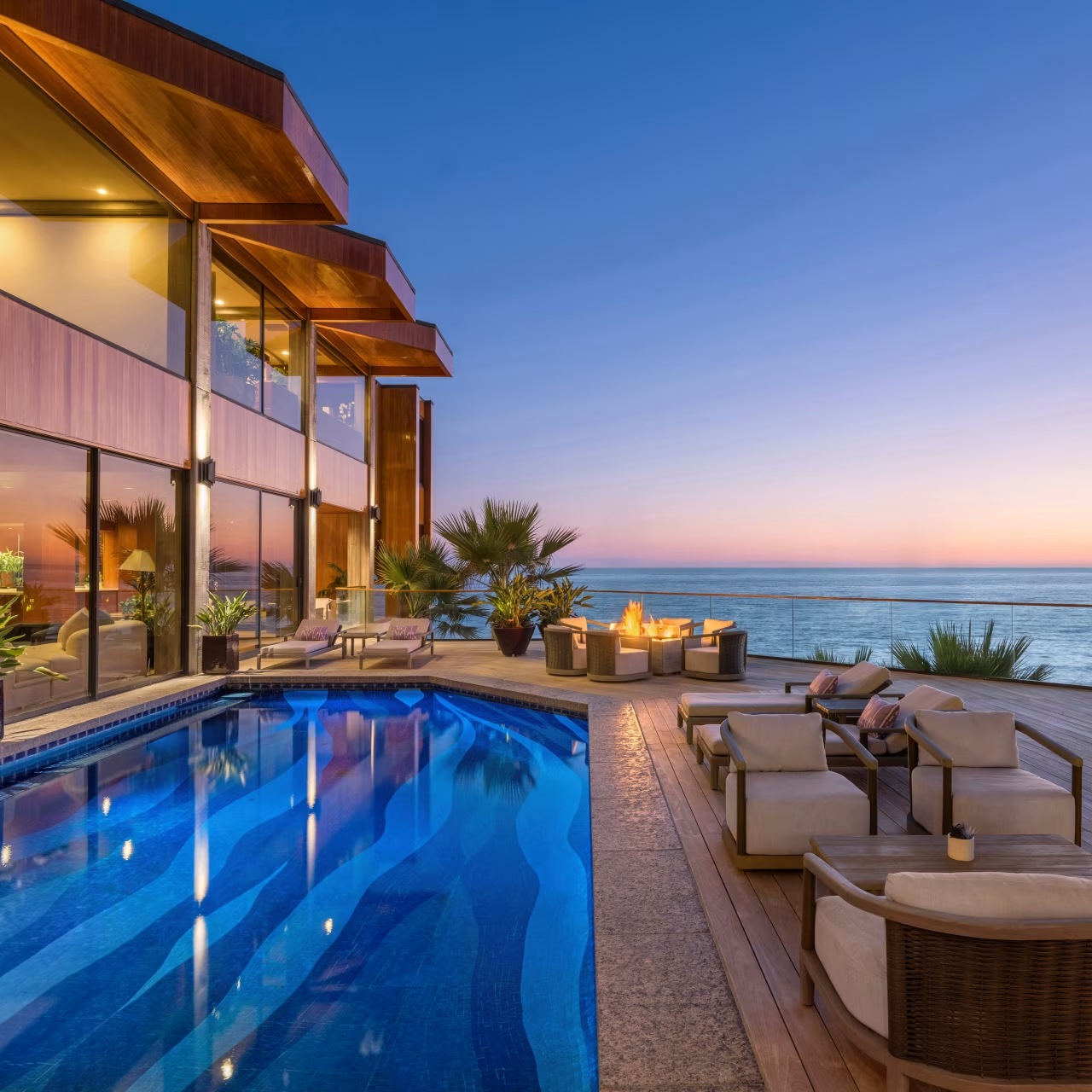
On shared smart lighting logic: morning scenes raise shades and ease lights up; midday logic drops solar shades on the hot exposures while daylight replaces fixtures; evening scenes warm and lower the light as shades close for privacy; and away modes simulate occupancy. Programmed once at commissioning, the choreography becomes the house’s personality.
The scene-first smart lighting philosophy is expanded in home automation for luxury homes.
Which build details decide long-term success?
The invisible smart lighting details: shade pockets framed into the ceiling design so hardware disappears; power and control wiring run to every opening during rough-in; lighting circuits designed for control rather than adapted to it; marine-rated exterior fixtures and fasteners; and generous conduit for whatever the next decade brings. Every one of these is trivial during construction and disruptive afterward.
That is why the specification happens in pre-construction planning, with the wiring strategy in future-proofing your smart home technology investment.
What changes in a renovation versus a new build?
What changes between a South Florida renovation and a new build is pocket and wiring access: new builds hide everything by design, while renovations choose between opening ceilings for concealed pockets, using architect-selected exposed hardware, or battery-motor shades where wiring cannot reach. Lighting retrofits lean on control-capable devices in existing boxes. The results can match a new build; the path is simply more curated.
The retrofit playbook lives in overcoming integration challenges in existing luxury homes.
How does Kass Construction & Development build light and shade?
As architecture, with smart lighting designed in: Kass Construction & Development, a state-licensed (CGC1529472) boutique luxury builder led by Mitch Kass, a licensed general contractor and attorney, with 100+ luxury residences delivered by Mitchell Kass and the firms he has led across Broward, Palm Beach, and Miami-Dade, designs shade pockets, lighting circuits, and control wiring into the drawings, then commissions the scenes with the owner before handover, inside a custom build of often 18 to 36 months or a renovation of 6 to 12 months.
Contact Kass Construction & Development or call 954-607-4335.
| Layer | What it solves | When it must be decided |
|---|---|---|
| Interior scenes | Warm-dimming that follows the day rather than fixed levels | Design, with the control platform |
| Solar shades | Cuts glare off the water while keeping the view | Design, so pockets can be framed |
| Blackout layer | Sleep, on the same opening as the solar shade | Design, two fabrics need the pocket depth |
| Concealed hardware | Shade pockets that disappear into the ceiling | Rough-in, effectively impossible later |
| Exterior and landscape | Architectural and safety light on marine-rated hardware | Design, alongside the landscape plan |
| Shared automation logic | Shades and lights acting as one system through the day | Commissioning, on infrastructure laid earlier |
Where your glass-forward design sits on the style spectrum matters too; our modern vs contemporary architecture guide explains the distinction.
Which window treatment systems suit which coastal conditions?
Lighting and shading control on a coastal home starts with choosing the right shading hardware for each exposure, and the options behave very differently in South Florida sun and salt air.
| System | Best exposure and use | Coastal performance notes |
|---|---|---|
| Interior motorised roller shades (solar screen fabric) | Every glazed room; glare control while keeping the view | Openness factor chosen per exposure; corrosion-resistant hardware in rooms open to the terrace |
| Interior blackout shades | Bedrooms, media rooms | Side channels for full darkness; dual-roller with a solar shade |
| Motorised drapery | Living and dining rooms for softness and acoustics | Fabrics rated for UV; tracks recessed in ceiling pockets |
| Exterior motorised screens | West and south glass walls, loggias, outdoor rooms | Cuts heat before it reaches the glass; marine-grade tracks and motors; retracted in storm mode |
| Exterior louvres and pergola blades | Terraces and pool decks | Aluminum with marine coatings; sensor-driven |
| Switchable or electrochromic glass | Skylights, bathrooms, specific feature glazing | No moving parts; specified with impact-rated units |
| Impact shutters and storm screens | Every opening, by code where shutters are the protection method | Automated deployment in storm mode; separate from daily shading |
Hardware choices that survive salt air are covered in coastal corrosion-resistant materials and premium sustainable materials for the South Florida climate.
How is smart lighting designed room by room?
Smart lighting in a luxury coastal home is designed in layers per room, and the control system is only as good as the lighting design it is asked to run.
- Ambient layer: indirect coves, recessed downlights on dimmers, and wall washing, sized for evening levels rather than showroom brightness.
- Task layer: kitchen counters, vanities, desks and reading positions on their own circuits.
- Accent layer: art lighting, niches and architectural features, aimed on site after installation.
- Exterior layer: landscape, façade, pool and dock lighting, with dark-sky-conscious fixtures and turtle-friendly amber sources on oceanfront lots where local rules require them.
- Color: warm-dim and tunable-white sources in living spaces and bedrooms, consistent color temperature across fixture types.
- Control: scenes by room and by mode on engraved keypads at the door, with the same scene names on the app and on voice.
- Efficiency: LED sources and controls that meet ENERGY STAR benchmarks reduce both energy and heat gain in the cooling season.
How the lighting design integrates with the platform is described in integrating smart systems in luxury homes.
How do smart lighting and shading control work as one system?
Smart lighting and shading control deliver most when they act on the same conditions, so that the house adjusts to the sun and the family adjusts nothing.
- Sun tracking: shades and exterior screens move by exposure through the day, based on solar position and a roof sensor, keeping glare off screens and heat off glass.
- Daylight harvesting: interior lighting dims as daylight rises, saving energy and keeping a consistent level.
- Scenes: a dining scene sets lights and lowers shades together; a night scene closes blackout shades and lights the path.
- Climate coordination: shades close ahead of peak heat on the west elevation, reducing the cooling load addressed in passive cooling and natural ventilation and energy management and sustainability systems.
- Storm mode: exterior screens retract, shutters deploy and interior shades close, as part of the sequence in whole home automation.
- Away mode: shades and lights simulate occupancy and protect furnishings from UV.
Which construction details decide the long-term success of smart lighting and shading?
Smart lighting and shading control succeed or fail on details fixed during construction, most of which are invisible once the home is finished.
- Shade pockets and drapery recesses designed into the ceiling with the architect, sized for the specified hardware, with power and control wiring in place before drywall.
- Hard-wired shade motors and low-voltage control cabling rather than battery motors in the principal rooms.
- Lighting loads circuited by scene rather than by wall, so the control system can do its job without rewiring.
- Fixture specification checked for coastal corrosion at every exterior and open-air location.
- Exterior screen tracks and louvres integrated into the structure and flashing, not surface-mounted afterward.
- Commissioning: scenes programmed on site with the designer, fixtures aimed at night, shade limits set after fabrics are installed; the common pitfalls are in smart home integration challenges.
- Documentation and a service plan at handover, as recommended in smart home technology investment and future-proofing.
Kass Construction & Development builds light and shade as one coordinated trade on every South Florida project, whether a new build or a renovation; the wider technology picture is in home automation for luxury homes, the architectural context in modern vs contemporary architecture, and the planning sequence in pre-construction planning.
Frequently Asked Questions
What makes smart lighting different from dimmers and timers?
Whole-home scenes on one platform: layered light that changes with a touch, warm-dimming evenings, daylight-aware logic, and integration with shades, security, and schedules. Dimmers control fixtures; smart lighting composes the home.
Do motorized shades survive coastal conditions?
Quality systems do: corrosion-protected tracks and hardware, UV-stable fabrics, and near-silent motors are the coastal specification. Consumer-grade shading in a salt-air environment is the category most likely to disappoint within a few years.
Can shades really lower cooling costs?
Meaningfully: intercepting solar gain at the glass, especially on west and south exposures, reduces the load the HVAC must remove all afternoon. Automated solar shades are among the most reliable energy features in South Florida homes.
What is a dual-roller shade and who needs one?
Two fabrics on one opening: a solar shade for daytime glare and view, and a blackout layer for sleep and media. Bedrooms and media rooms in bright coastal exposures are the natural fit.
Should exterior lighting be part of the smart system?
Yes, on marine-rated hardware: architectural, landscape, and safety lighting on scenes and schedules completes the estate after dark and supports security. Coastal fixtures must be specified for salt exposure or they become annual replacements.
When do shade pockets need to be decided?
During design, because smart lighting is infrastructure: concealed pockets are framed into ceilings and window details, and wiring runs at rough-in. It is the classic example of a decision that costs nothing early and a renovation later.
Can existing homes get concealed motorized shades?
Where ceilings can open, yes; elsewhere, architect-selected exposed hardware and battery-motor systems close most of the gap. A high-end renovation often runs 6 to 12 months, and shading rides that schedule.