Indoor-outdoor living trends and open-concept reconfiguration are the two most requested design moves in South Florida luxury homes, and done right they transform how a home feels every day without adding a square foot. The catch: here they are engineering decisions, not decor decisions. Heat, humidity, storms, bugs, and intense sun change how you design openings, shade, drainage, and finishes. This guide covers the five indoor-outdoor living trends and five open-plan moves defining current luxury projects, the seamless-transition checklist, and the structural, systems, and permitting realities in Broward, Palm Beach, and Miami-Dade.
Key takeaways
- Why are indoor-outdoor living trends the defining move in South Florida?
Indoor-outdoor living trends start with what buyers want: brighter interiors, longer sightlines, and comfort that flows from kitchen to pool to shaded lounge; homes that feel expansive but stay practical. - What does open-concept reconfiguration look like now?
Indoor-outdoor living trends deliver more openness and better zoning through five moves: - What makes a South Florida home feel truly indoor-outdoor?
The indoor-outdoor living trends above only feel seamless when the details line up: aligned finished floor levels (with drainage detailed so flush thresholds survive storms); continuous or intentionally paired flooring materials; ceiling planes that extend from interior to covered exterior; consistent lighting temperature across the line; screens and shade that disappear when not in use; and an acoustic and airflow plan so the open wall does not import noise, heat, or humidity. - What is the South Florida reality check: engineering, codes, and permitting?
The engineering behind indoor-outdoor living trends is non-negotiable here. Large openings are structural events: headers, spans, and shear paths must be engineered, and every opening carries wind-load and impact requirements.
Why are indoor-outdoor living trends the defining move in South Florida?
Indoor-outdoor living trends start with what buyers want: brighter interiors, longer sightlines, and comfort that flows from kitchen to pool to shaded lounge; homes that feel expansive but stay practical. The best projects share three traits: cohesion (materials, sightlines, and floor levels visually connect inside and out), everyday function (outdoor spaces designed for weekday life, not just parties), and performance (openings, shade, and finishes specified for coastal conditions).
Indoor-outdoor living trends fail on engineering: a beautiful patio that is not built for wind load, water management, and corrosion becomes a maintenance headache fast. Outdoor zones are no longer extra; they are true extensions of the home for work, dining, wellness, lounging, and retreat. The broader design context sits in luxury home design trends in South Florida and indoor-outdoor living for Florida estates.
What are the five indoor-outdoor living trends that matter now?
The five trends in South Florida:
- Oversized sliders, pocket doors, and disappearing walls that actually perform.
- Outdoor kitchens evolved into full hospitality zones.
- Covered outdoor living that is climate-managed without feeling enclosed.
- Resort-style pools and water features composed as views from inside.
- Courtyard moments and outdoor rooms that create privacy on tighter lots.
Trend 1: Disappearing walls that perform when the weather turns
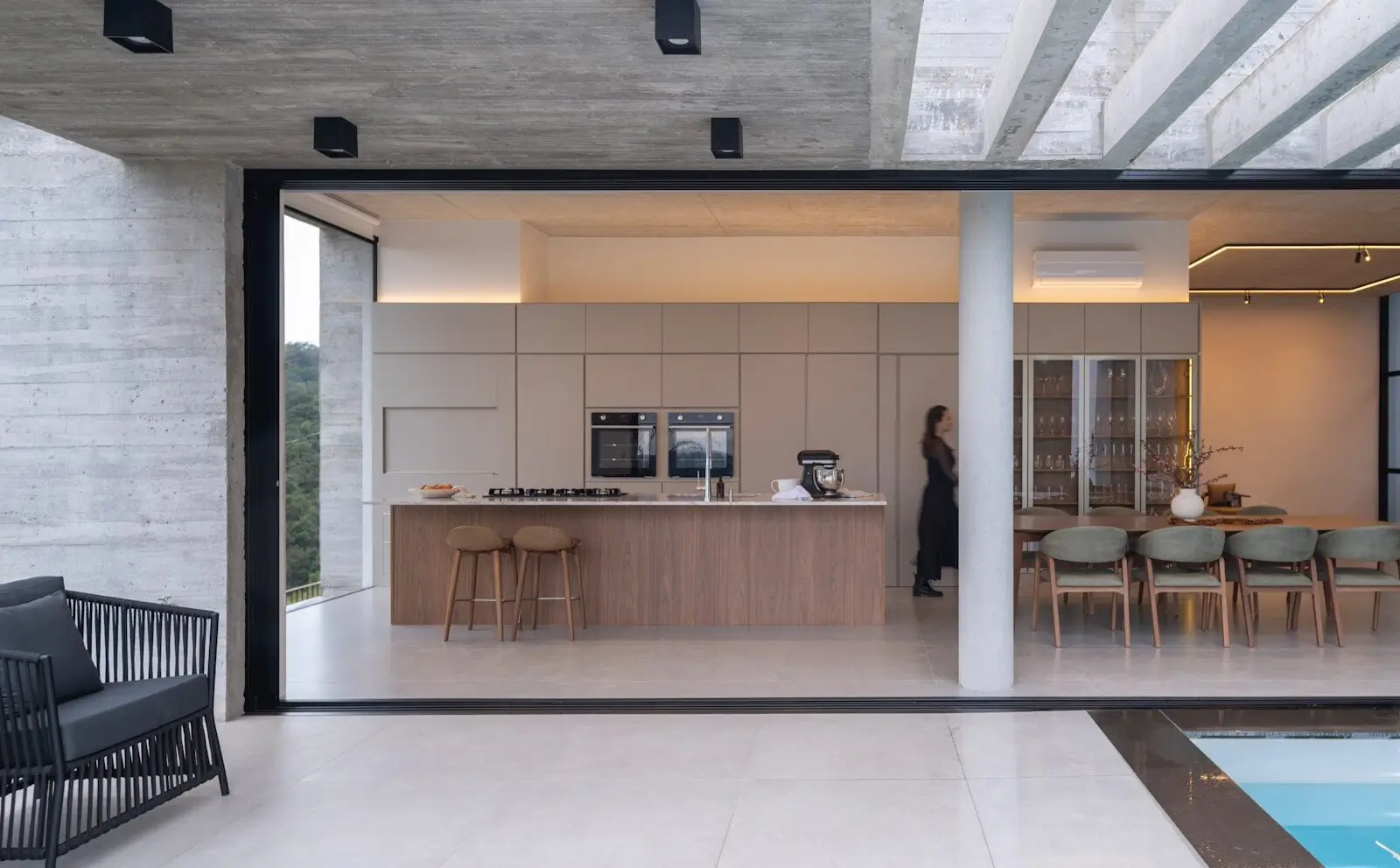
The opening side of indoor-outdoor living trends: multi-panel sliders with minimal frames, pocketing doors that stack out of sight, corner openings that remove the visual post where structure allows, and clerestory glass that carries daylight deep into the plan. The South Florida follow-up questions are the ones that matter: wind-load and impact ratings for your exposure, sill and flashing detailing against water intrusion, drainage planes for wind-driven rain, and thresholds that balance flushness with storm performance.
Comfort upgrades ride along: low-E glazing tuned for solar control, acoustic packages near water or busy streets, and glass that cuts glare without darkening the room. Align major openings to an intentional focal point (pool edge, waterway, courtyard wall) so the reveal feels planned. Openings are verified against the Florida Building Code during permitting.
Trend 2: Outdoor kitchens as full hospitality zones
Outdoor kitchens have moved with the indoor-outdoor living trends, beyond the grill: refrigeration and freezer drawers, pizza ovens, beverage centers and ice makers, warming drawers, bar seating with proper overhang and lighting, and hidden dry storage. Plan in zones (prep, cook, serve, seat), route cleanly between indoor and outdoor kitchens without cutting through seating, and specify marine-grade hardware, corrosion-resistant components, heat- and stain-tolerant stone, covered-installation ventilation, and correct weatherproof electrical. On tighter Fort Lauderdale lots, plan for sound travel, lighting spill, and exhaust direction. The full program is in private resort homes: pools, spas, and outdoor kitchens.
Trend 3: Climate-managed covered living, the most practical of the indoor-outdoor living trends
In current indoor-outdoor living trends, shade, airflow, and rain protection are baseline: motorized screens for bugs, sun, and wind; high-performance fans placed for real airflow; integrated heaters for the few cool evenings; careful misting (added moisture can backfire in humidity); and dehumidification for enclosed lanais so they never feel musty. Roof and ceiling detailing does the quiet work: ventilated soffits, drainage and gutter integration, and corrosion-resistant finishes and fasteners, with layered lighting (ambient, task, accent) finishing the room. The moisture logic is the same one the EPA’s mold and moisture guide describes: control the water and you control the problems.
Trend 4: Pools and water features composed as views
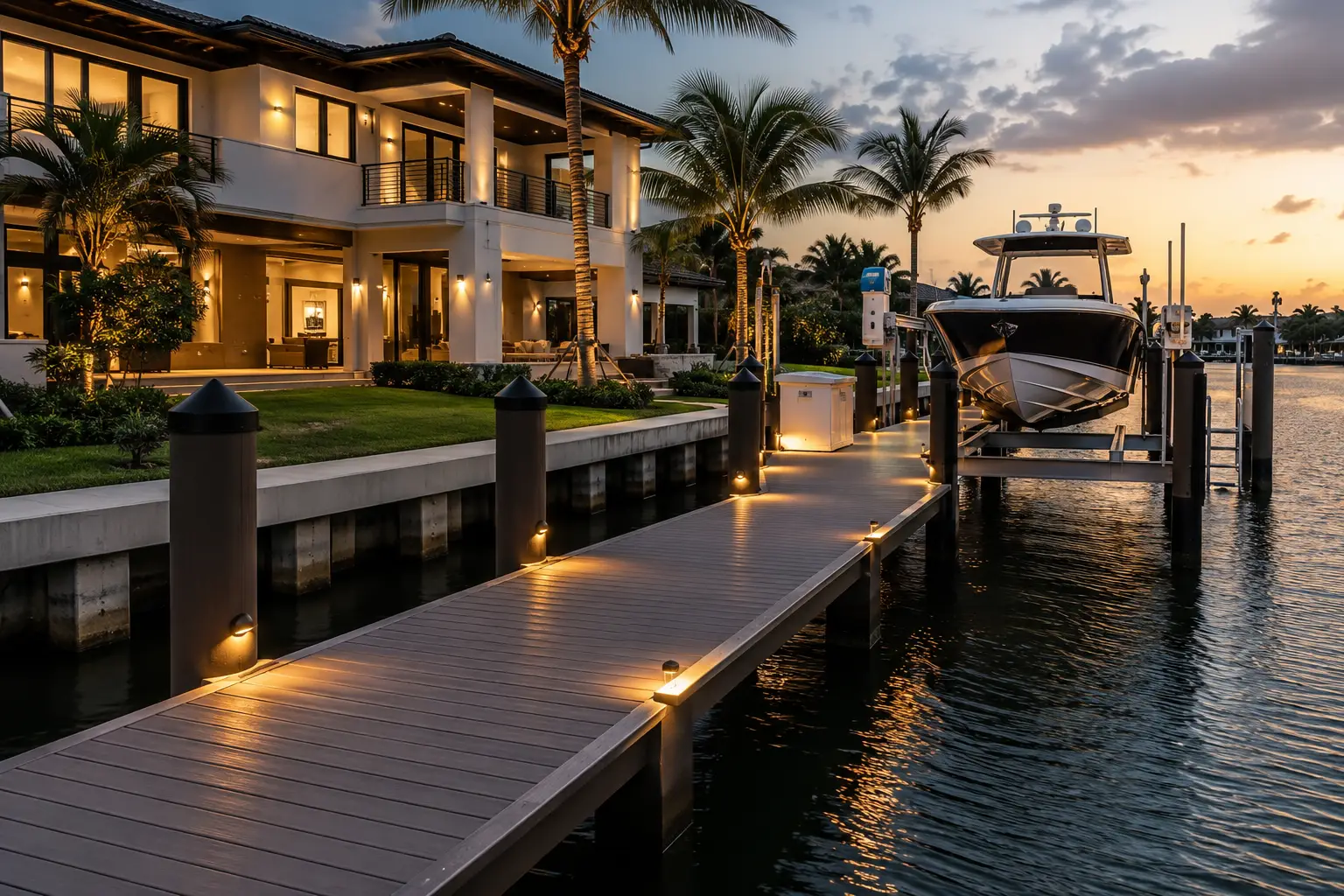
Indoor-outdoor living trends treat the pool as focal artwork seen from the kitchen and great room: reflective water lines, integrated spas, and lighting that reads beautifully from inside at night. Sightline composition drives the site plan, covered in waterfront luxury living.
Trend 5: Courtyards and outdoor rooms for privacy
On tighter lots, indoor-outdoor living trends turn to courtyards for daylight, greenery, and outdoor life without exposure to neighbors, and they create protected microclimates for planting and water features; see biophilic design for luxury coastal homes.
What does open-concept reconfiguration look like now?
Indoor-outdoor living trends deliver more openness and better zoning through five moves:
- The broken-plan layout, open but with intentional separation.
- The kitchen reworked into a showpiece plus a workhorse (scullery or back kitchen).
- Entry sequences that protect the open plan from feeling exposed.
- Flexible rooms that do not kill the flow.
- Ceiling and lighting reconfiguration that makes open spaces feel finished rather than vast.
The broken plan uses level changes, ceiling treatments, partial walls, glazed interior screens, and millwork to define zones without closing them. The kitchen split sends mess, prep, and appliance clutter to a back kitchen while the showpiece island faces the view. Entries gain a real threshold moment so the front door does not open into everything at once. Flex rooms (office, gym, guest) borrow light through interior glazing while keeping acoustic separation.
And ceilings, the forgotten surface, carry beams, coves, and lighting scenes that give big volumes intimacy. Retrofitting these moves into an existing house is its own discipline: structure, spans, and mechanical rerouting decide what is practical, covered in the whole-home luxury renovation guide.
What makes a South Florida home feel truly indoor-outdoor?
The indoor-outdoor living trends above only feel seamless when the details line up: aligned finished floor levels (with drainage detailed so flush thresholds survive storms); continuous or intentionally paired flooring materials; ceiling planes that extend from interior to covered exterior; consistent lighting temperature across the line; screens and shade that disappear when not in use; and an acoustic and airflow plan so the open wall does not import noise, heat, or humidity.
Every item in these indoor-outdoor living trends is decided in design and rough-in, not at the end, which is why the builder belongs in the room early; see pre-construction planning.
What is the South Florida reality check: engineering, codes, and permitting?
The engineering behind indoor-outdoor living trends is non-negotiable here. Large openings are structural events: headers, spans, and shear paths must be engineered, and every opening carries wind-load and impact requirements. Water is the second engineer: sills, flashing, drainage planes, and site grading decide whether the disappearing wall stays luxurious. And permitting in Broward, Palm Beach, and Miami-Dade reviews all of it, so clean submittals and sequencing protect the schedule.
Our guides to hurricane-resistant construction, the permitting process, and why permit delays happen cover the specifics, and coastal corrosion-resistant materials covers what the exterior assemblies should be made of.
New build or high-end renovation: which path fits these goals?
Indoor-outdoor living trends push toward a new build when the existing structure cannot support the spans, openings, or systems the design needs. A high-end renovation wins when the location and bones are right: sliders and pocketing systems, a back-kitchen split, covered outdoor rooms, and broken-plan zoning are all achievable in a renovation with the right engineering. A high-end renovation often runs 6 to 12 months; a custom build often runs 18 to 36 months.
The decision framework is in teardown vs. renovation and the feasibility study approach.
How does Kass Construction & Development execute without renovation chaos?
Kass Construction & Development, a state-licensed (CGC1529472) boutique luxury builder in East Fort Lauderdale led by Mitch Kass, a licensed general contractor and attorney, with 100+ luxury residences delivered by Mitchell Kass and the firms he has led across Broward, Palm Beach, and Miami-Dade, executes these projects with early structural and MEP coordination, detailed specifications and mockups, disciplined sequencing, and communication that keeps owners ahead of decisions instead of behind them.
Done right, indoor-outdoor living trends execute like this: openings and drainage engineered before drawings are finished, long-lead glazing ordered early, trades sequenced so waterproofing is never rushed, and quality checks at the moments that cannot be redone. The oversight model is described in owner’s representation and the Kass difference.
What is the practical planning roadmap?
Five steps:
- Define how you actually live outdoors, weekday and weekend.
- Pick the two or three moves with the highest daily impact (among the indoor-outdoor living trends, usually the main opening, the covered room, and the kitchen split).
- Commission the structural and water-management engineering early.
- Select glazing, screens, and outdoor equipment while permits are in review, because lead times are real.
- Hold the design intent through construction with mockups and checkpoints.
The luxury standard now is simple: a home that lives bigger than its walls. When the openings, shade, drainage, and zoning are engineered as carefully as they are styled, the result feels effortless every single day. Contact Kass Construction & Development or call 954-607-4335 to plan it properly from the start.
| Trend | What it looks like | What it requires structurally |
|---|---|---|
| Disappearing walls | Multi-panel and pocketing sliders, corner openings | Engineered headers, shear paths, impact-rated systems |
| Outdoor kitchens | Refrigeration, specialty cooking, beverage service | Water, waste, gas and power roughed in early |
| Covered outdoor rooms | Motorized screens, shade, rain protection | Wind load, drainage, corrosion-rated hardware |
| Pool as focal point | Reflective water seen from kitchen and great room | Sightlines fixed at plan stage, not after |
| Courtyards on tight lots | Daylight and greenery without exposure | Massing and drainage designed around the void |
| Broken-plan interiors | Open, but zoned by level and ceiling | Structure and ceiling coordination in rough-in |
Which approvals and inspections do indoor-outdoor living trends trigger in South Florida?
Indoor-outdoor living trends add scope that reviewers examine closely, and the table below lists the elements with the review each one draws and what the file needs to pass.
| Element | Review it draws | What the file needs |
|---|---|---|
| Multi-panel and pocketing sliders | Structural and product control | Florida product approval or Miami-Dade Notice of Acceptance at the specified size; header and transfer engineering; anchoring per the approval |
| Corner openings without a post | Structural | Moment frame or transfer design sealed by the engineer |
| Flush thresholds | Floodplain and building | Drainage plane, sill pan and threshold detail that keeps water out under wind-driven rain; finished floor above the flood elevation |
| Covered outdoor rooms and pergolas | Structural and zoning | Wind design for open structures; setbacks and lot coverage |
| Outdoor kitchens | Building, plumbing, gas and electrical | Separate permits; ventilation; GFCI protection; gas line sizing |
| Motorised screens and louvred roofs | Structural and product approval | Approved systems; tracks integrated into the structure; storm-mode retraction |
| Pools and water features as views | Pool permit; environmental near the water | Barrier compliance; structural coordination with the seawall and house |
| Exterior lighting | Zoning; turtle rules on the ocean | Fixture schedule; dark-sky compliance where required |
Structural and product rules are in the Florida Building Code, the flood elevation for the lot is at the FEMA Flood Map Service Center, and moisture control guidance is published by the EPA. The reviewers and their calendars are mapped in the South Florida luxury home permitting process and the flood rules in flood zone requirements for waterfront construction in Broward County.
Which construction details decide whether indoor-outdoor living trends last on the coast?
Indoor-outdoor living trends succeed or fail on details fixed during construction, and the list below is what a South Florida builder checks before the walls close.
- Sill pans, flashing and a drainage plane at every large opening, photographed before stucco and interior finish cover them.
- Impact glazing anchored exactly per the product approval, with a water test on the largest openings before drywall.
- Structural transfers and moment frames inspected and strapped into the continuous load path, per hurricane-resistant construction.
- Terrace and threshold waterproofing carried up behind the wall finish, with drains that can be cleaned.
- Corrosion-resistant hardware, track systems and fasteners at every exterior element, from coastal corrosion-resistant materials and premium sustainable materials for the South Florida climate.
- Shade and screen tracks integrated into the structure, with the automation in smart lighting and window treatment systems.
- Outdoor kitchen utilities roughed in early and equipment elevated above the flood level.
- Landscape and pool set to drain away from thresholds, using native Florida plants in high-end landscape design.
- Independent verification at each of these points through quality control, inspections and punch lists.
Frequently Asked Questions
What defines the current indoor-outdoor living trends in South Florida luxury homes?
Cohesion, everyday function, and performance: disappearing glass walls that meet impact requirements, outdoor kitchens built as hospitality zones, climate-managed covered rooms, pools composed as views, and courtyards for privacy, all specified for heat, humidity, salt, and storms.
Why is indoor-outdoor living an engineering challenge here?
Because in indoor-outdoor living trends, large openings are structural events with wind-load and impact requirements, water intrusion must be managed at sills, flashing, and drainage planes, and humidity, bugs, and sun decide whether an outdoor room is usable. Decor-first patios fail fast in this climate.
What is a broken-plan layout?
An open plan with intentional separation: level changes, ceiling treatments, partial walls, interior glazing, and millwork define kitchen, living, dining, and retreat zones without closing them off, restoring function, privacy, and acoustics that fully open plans lost.
What has changed in sliding glass doors and large openings?
Wider multi-panel spans with minimal frames, pocketing systems that vanish, corner openings without posts, and clerestory glass, now paired with the right questions: impact ratings, water detailing, drainage, threshold design, and low-E and acoustic glazing packages.
How are outdoor kitchens evolving?
From grill stations into zoned hospitality spaces with refrigeration, specialty cooking, beverage centers, warming drawers, and real storage, built from marine-grade and corrosion-resistant components with proper ventilation and weatherproof electrical.
Can indoor-outdoor living trends be applied in a renovation instead of a new build?
Usually yes: sliders and pocketing walls, a back-kitchen split, covered outdoor rooms, and broken-plan zoning are all renovation-feasible with the right structural engineering and mechanical rerouting. A high-end renovation often runs 6 to 12 months depending on scope.
What should homeowners plan for in Broward, Palm Beach, and Miami-Dade?
Engineering and permitting: engineered headers and shear paths for large openings, impact-rated products with approvals, water management from sill to site grading, and municipal review cycles. Early, clean submittals and experienced project management protect the timeline.