
Change order abuse is not usually fraud. It is the predictable result of pricing work after it has been instructed, on a project where the owner has no benchmark and no time. The cure is procedural: agree the pricing method before signature, and require a written instruction before anything moves.
Key takeaways
- What does change order abuse look like?
On a South Florida luxury build it looks like prices with no breakdown, markup applied twice, work already performed presented for approval, scope the drawings arguably already covered, and general conditions extended for a change that added no time. - Why are luxury projects exposed?
Luxury projects are exposed because bespoke scope has no market price, because owners are often absent, because decisions arrive under time pressure, and because a single specialist trade may be the only realistic source. - What pricing method should be agreed?
The pricing method to agree in a Florida contract is documented cost plus a stated percentage, or agreed unit rates, with the same markup applied once and general conditions charged only where the change extends duration. - What must every change order carry?
Every change order must carry three things: a description tied to a drawing or specification reference, a price with a breakdown of labor, material, subcontract, and markup, and a schedule effect stated in days including zero.

What does change order abuse look like?
On a South Florida luxury build it looks like prices with no breakdown, markup applied twice, work already performed presented for approval, scope the drawings arguably already covered, and general conditions extended for a change that added no time. Change order abuse hides in the absence of a method, not in obvious dishonesty.
The contract terms that close those gaps are described in construction contracts for high end residential work.
Why are luxury projects exposed?
Luxury projects are exposed because bespoke scope has no market price, because owners are often absent, because decisions arrive under time pressure, and because a single specialist trade may be the only realistic source. Those four conditions are exactly the environment where change order abuse becomes easy.
Absent owners are the most exposed to change order abuse, and have a specific answer described in absentee owner representation.
What pricing method should be agreed?
The pricing method to agree in a Florida contract is documented cost plus a stated percentage, or agreed unit rates, with the same markup applied once and general conditions charged only where the change extends duration. Writing the method into the contract removes the negotiation that change order abuse depends on.
Where that clause sits in the agreement is set out in negotiating stronger contractor agreements.
What must every change order carry?
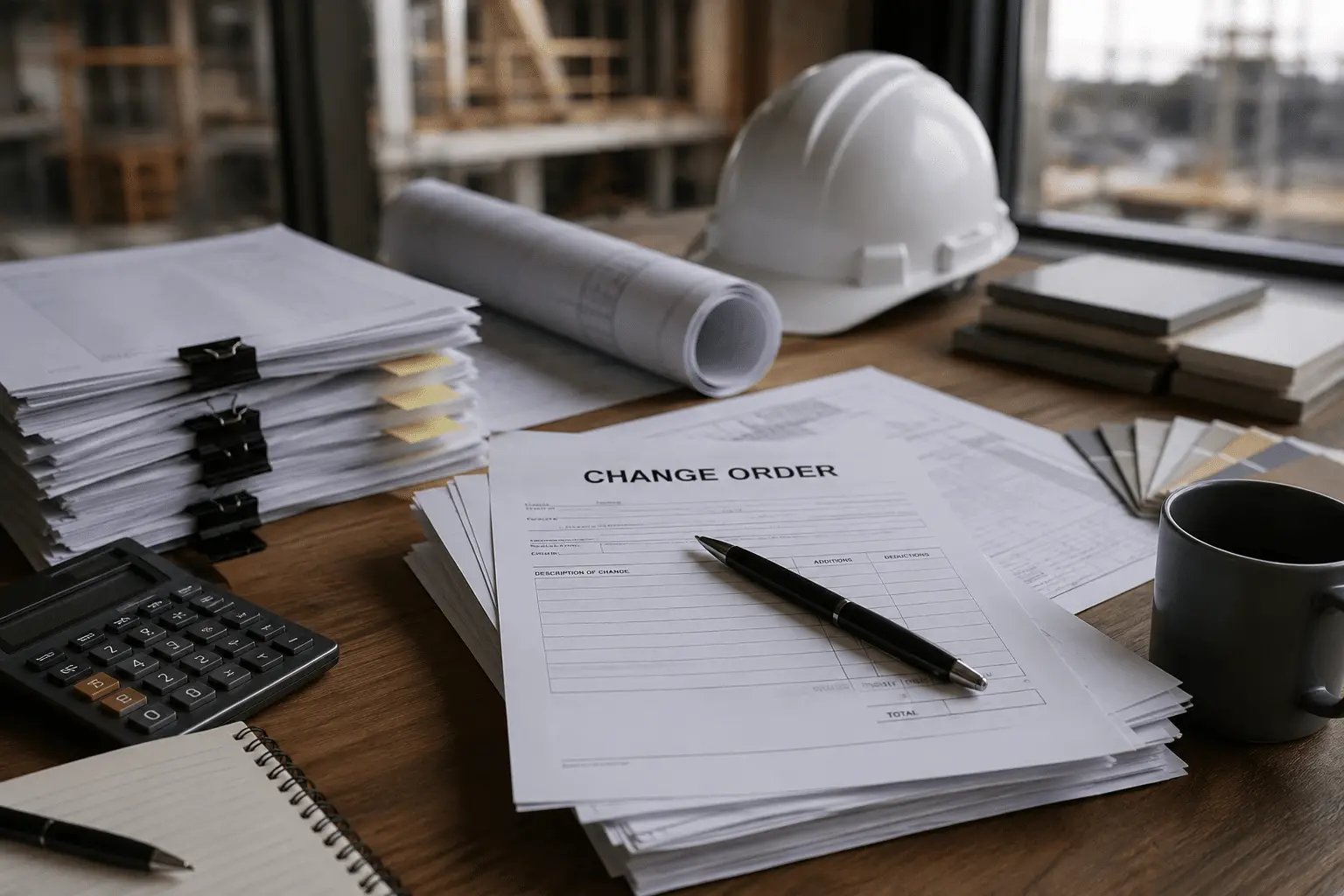
Every change order must carry three things: a description tied to a drawing or specification reference, a price with a breakdown of labor, material, subcontract, and markup, and a schedule effect stated in days including zero. A change order missing any of the three should not be signed.
The record that holds them together is described in quality control, inspections, and punch lists, and standard change order forms are published by AIA Contract Documents.
Why does no signature mean no work?
No signature means no work because once the work exists, the South Florida owner is negotiating about something already built. A standing rule that no change proceeds without a signed instruction converts every disagreement into a conversation before money is spent, which is the single most effective control against change order abuse.
Urgent site decisions need a defined exception with a cap and a same-day written confirmation, so the rule survives contact with a real project.
Who should pay for what?
On a South Florida build, owner-directed upgrades are owner cost. Genuinely differing site conditions are usually owner cost, subject to the contract. Gaps in the drawings are a design responsibility question. Defective work and rework are the builder’s cost. Confusing these four categories is where change order abuse begins.
Distinguishing design gaps from change order abuse is a coordination question, covered in managing architect, engineer, and contractor relationships.
What if a change looks wrong?
If a change looks wrong, ask for the breakdown, ask which drawing the work was excluded from, ask for the subcontractor quotation behind the number, and ask what the schedule effect is. Most questionable pricing does not survive four written questions, which is why change order abuse thrives on verbal approval.
If change order abuse continues, the escalation path is in dispute resolution clauses in Florida luxury contracts.
How does the budget absorb legitimate changes?
The budget absorbs legitimate changes through two separate buckets: a contingency for unknowns and a reserve for owner upgrades, each reported monthly with a remaining balance. When one pot funds both, every change looks like an overrun and genuine change order abuse becomes impossible to see.
The structure is explained in payment schedules, contingency, and budgeting, and the wider pattern in luxury construction cost overruns.
How does Kass Construction & Development run change orders?
Kass Construction & Development runs change orders on a written method, with a numbered register and a monthly balance. Kass Construction & Development is a state-licensed (CGC1529472) boutique luxury builder in East Fort Lauderdale led by Mitch Kass, a licensed general contractor and attorney, with 100+ luxury residences delivered by Mitchell Kass and the firms he has led across Broward, Palm Beach, and Miami-Dade, and that documentation standard is what makes change order abuse a non-event on a properly run job.
A custom build often runs 18 to 36 months and a high-end renovation often 6 to 12 months. Contact Kass Construction & Development or call 954-607-4335.
| Element | Requirement | If it is missing |
|---|---|---|
| Description | Tied to a drawing or specification reference | Arguments about whether it was already included |
| Price breakdown | Labor, material, subcontract, and markup shown separately | No way to benchmark the number |
| Schedule effect | Stated in days, including zero | Delay claimed later on the same change |
| Written instruction | Signed before work proceeds | Negotiating about work already built |
| Markup basis | The rate agreed in the contract, applied once | Markup applied twice through subcontracts |
| Register entry | Numbered, dated, with a running total | No visible balance until closeout |
What are the common forms of change order abuse, and how is each detected and prevented?
Change order abuse takes a small number of recognizable forms on luxury projects, and the table below pairs each with the sign that reveals it and the contract control that prevents it.
| Form | How it shows up | Detection | Prevention |
|---|---|---|---|
| Charging for included work | A change order for an item shown in the drawings or specification | Compare to the priced documents and exhibits | Complete scope and drawing list as contract exhibits |
| Pricing after the work | Verbal instruction on site; price arrives weeks later at the builder’s figure | No signed order predates the work | No signature, no work; written instruction rule |
| Markup stacking | Subcontractor markup plus builder markup plus fee on the same item | Line-by-line pricing reveals repeated percentages | Single agreed markup and unit rates in the contract |
| Inflated quantities or hours | Labor hours or material quantities beyond the work observed | Site verification against the change scope | Unit rates and quantity backup required |
| Owner change absorbing builder error | Rework caused by the builder priced as an owner change | Trace the cause: drawing, site or builder | Contract assigns cost by cause |
| Allowance overage without credit | Overages billed, underages never returned | Allowance ledger reconciled each draw | Reconciliation clause both ways |
| Schedule claims without cause | Days added to every change regardless of critical path | Compare to the baseline schedule | Schedule impact stated and justified on each order |
| Design-team changes routed as owner changes | Coordination errors in the drawings priced to the owner | Identify the source of the change | Errors and omissions addressed with the design team’s professional responsibility |
Standard-form change procedures are published by the American Institute of Architects at aiacontracts.com; Florida contractor conduct is regulated under Chapter 489, Florida Statutes. The contract exhibits that make detection possible are described in construction contracts for high-end residential builds.
What is the change order procedure that prevents change order abuse?
Change order abuse is prevented by a procedure written into the contract and followed without exception, and the sequence below is the one that works on South Florida luxury builds.
- Any proposed change, from the owner, the design team or the builder, is raised in writing with a description and the reason.
- The builder prices it by the contract method: unit rates where they exist, subcontractor quotes with backup where they do not, and the single agreed markup.
- The proposal states the schedule impact in days and identifies whether the change is on the critical path.
- The owner’s representative reviews entitlement (is it really outside the priced scope?), cause (owner, design team or builder), pricing and schedule; see high-net-worth construction oversight.
- The owner approves or declines in writing within the agreed response time.
- Work proceeds only after signature, except for defined emergencies with a written notice the same day.
- The approved change is added to the contract sum and the schedule, and appears in the next pay application as its own line; the draw mechanics are in payment schedules, contingency and budgeting.
- The change log is reported weekly with approved, pending and declined items, so the forecast in luxury construction cost overruns stays current.
How should an owner respond when a change order looks wrong?
Change order abuse is confronted by method rather than by accusation, and the steps below resolve a doubtful order while preserving the working relationship.
- Ask for the backup: the subcontractor quote, quantities, hours and the drawing or specification reference the builder relies on.
- Check entitlement against the documents; if the item is in the priced scope, decline the order with the reference.
- Check cause; if the change corrects a builder error or a drawing coordination error, route it to the responsible party rather than the owner’s contingency, using the relationship structure in managing architect, engineer and contractor relationships.
- Check pricing against unit rates and the agreed markup, and against a second quote where the sum is material.
- Check the schedule claim against the baseline and the critical path.
- Raise the disagreement at the weekly meeting in writing, and escalate under the contract’s dispute clause only if it stalls; see dispute resolution clauses in Florida luxury contracts.
- Owners who are not on site should route every order through an independent reviewer, per absentee owner representation, and negotiate the procedure into the contract from the start using negotiating stronger contractor agreements.
Kass Construction & Development runs change orders by this procedure on every project in Broward, Palm Beach and Miami-Dade: priced by the contract method, stated with schedule impact, signed before work, and reported weekly; the quality side of the same discipline is in quality control, inspections and punch lists.
Frequently Asked Questions
What is a change order?
A written amendment to the contract that adds, removes, or modifies scope, states the price effect, and states the schedule effect. It becomes part of the contract once signed.
Are change orders always a bad sign?
No. Owner-driven improvements and genuine site discoveries are normal. The warning sign is a change order without a breakdown, a reference, or a schedule statement.
What markup is reasonable?
Whatever the contract states, applied once. The problem is rarely the percentage and almost always the absence of an agreed basis before the work begins.
Can I refuse a change order?
You can decline the scope or dispute the price under the contract procedure. That is far easier before the work is performed, which is why the written instruction rule matters.
How do I benchmark a change price?
Ask for the subcontractor quotation, compare to the same trade’s line in the schedule of values, and request an alternative quotation where the amount justifies it.
Should changes be bundled?
Bundling related items reduces administration, but never bundle an urgent item with a disputed one. Keep the disputed item separate so it can be resolved on its own.
What record should I keep?
A numbered register with date, description, price, schedule effect, approval status, and running total, reconciled against the monthly forecast to completion.