A whole home luxury renovation is a construction project that happens inside an existing building, which means the schedule is set less by what you are adding than by what the demolition reveals. The phases are predictable. What is behind the walls is not, and that is the part worth planning for.
Key takeaways
- What counts as a whole home luxury renovation?
A whole home luxury renovation in South Florida is work that touches every room, replaces the major systems, and usually alters the plan: new mechanical, electrical, and plumbing throughout, new finishes throughout, and structural change in at least one area. - What happens before anything is demolished?
Before anything is demolished on a South Florida renovation: survey, structural assessment, existing conditions drawings, a permit history search, and design far enough advanced to price. - What does permitting actually involve?
Permitting in Broward, Palm Beach, or Miami-Dade involves a signed and sealed drawing set, structural calculations where the plan changes, product approvals for windows, doors, and roofing, and often a floodplain review. - What does demolition reveal?
Demolition in an older South Florida home reveals undocumented prior work, corroded plumbing, undersized framing, water damage behind finishes, and wiring that was never brought up to standard.
What counts as a whole home luxury renovation?
A whole home luxury renovation in South Florida is work that touches every room, replaces the major systems, and usually alters the plan: new mechanical, electrical, and plumbing throughout, new finishes throughout, and structural change in at least one area. Anything less is a series of remodels, and it should be priced and scheduled as one.
The decision that precedes a whole home luxury renovation is covered in teardown versus renovation in South Florida.
What happens before anything is demolished?
Before anything is demolished on a South Florida renovation: survey, structural assessment, existing conditions drawings, a permit history search, and design far enough advanced to price. Most of the cost and nearly all of the risk on a whole home luxury renovation is decided here, months before a crew arrives.
The sequence is set out in pre-construction planning for a luxury custom home.
What does permitting actually involve?
Permitting in Broward, Palm Beach, or Miami-Dade involves a signed and sealed drawing set, structural calculations where the plan changes, product approvals for windows, doors, and roofing, and often a floodplain review. Comments come back, and answering them in one complete package rather than piecemeal is what keeps a whole home luxury renovation on schedule.
The review path is mapped in the South Florida luxury home permitting process, and approved products are listed by the Florida Building Code.
What does demolition reveal?
Demolition in an older South Florida home reveals undocumented prior work, corroded plumbing, undersized framing, water damage behind finishes, and wiring that was never brought up to standard. This is the moment a contingency stops being theoretical, and it is why the contingency should be held by the owner and reported monthly.
How to structure that reserve is explained in payment schedules, contingency, and budgeting.
Why do the systems drive the schedule?
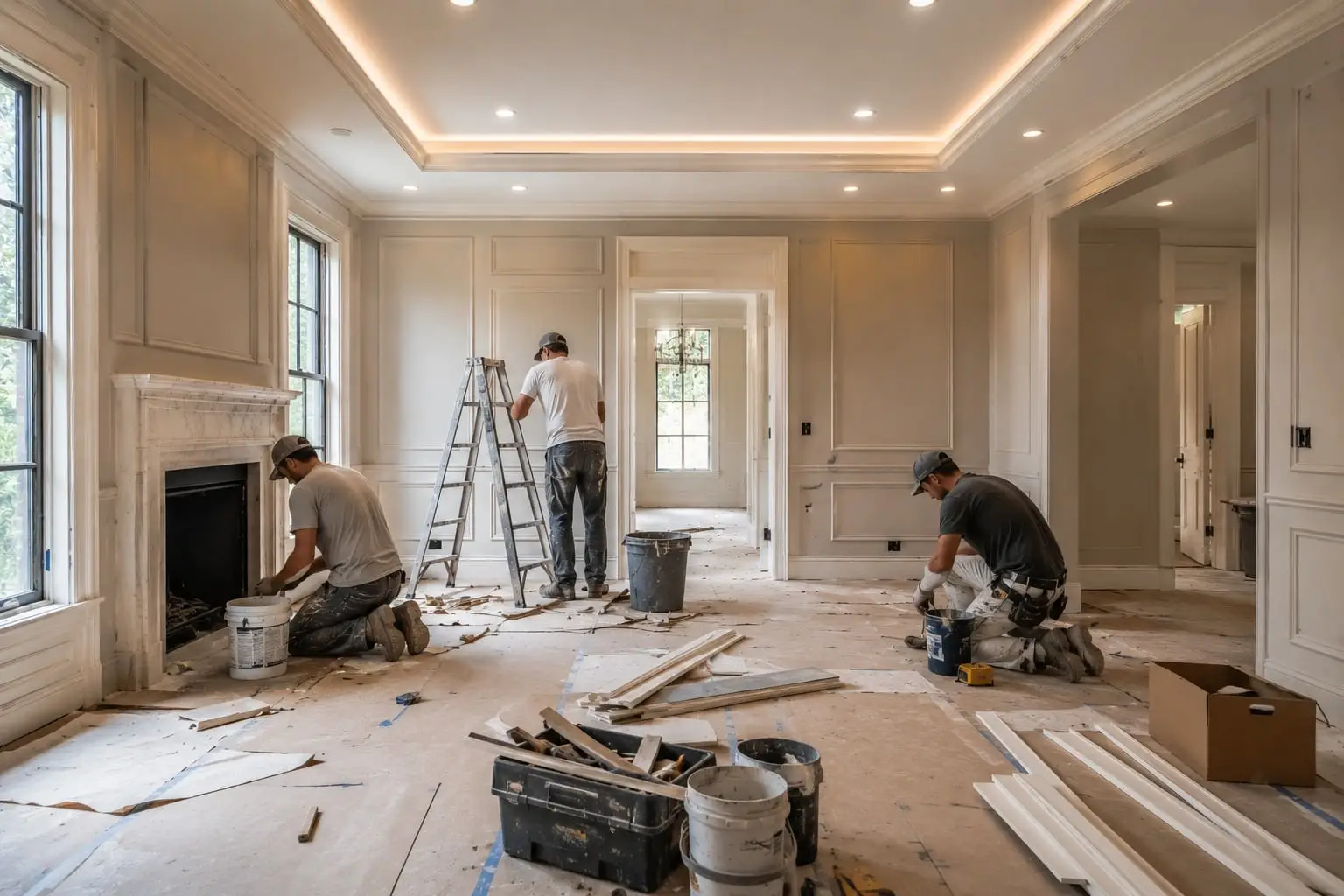
The systems drive a renovation schedule because mechanical, electrical, and plumbing have to be roughed in, inspected, and closed before any finish work can begin, and because they are the trades most affected by a plan change. On a whole home luxury renovation the systems phase is where an optimistic program meets reality.
Equipment and controls are covered in energy management and sustainability systems.
When do finishes actually start?
Finishes on a South Florida renovation start only once the building is dry, the rough-ins have passed inspection, and the selections have arrived. Stone, millwork, and imported fittings carry long lead times, so the selection calendar has to run months ahead of the trades that install them.
Procurement risk on a whole home luxury renovation is covered in contingency planning for supply chain issues.
What has to happen before you move back in?
Before you move back into a renovated Florida home: final inspections passed, the certificate of completion or occupancy issued, punch list closed, systems commissioned, and the closeout package delivered: warranties, manuals, as-built drawings, product approvals, and final lien waivers. Final payment should follow that package, not precede it.
What a whole home luxury renovation must hand over is listed in warranties and guarantees, and Florida lien procedure sits in Chapter 713 of the Florida Statutes.
Can you live in the house during the work?
Rarely, on a true whole home luxury renovation. Once the systems are open and the envelope is being worked on, the house is a construction site. Phasing to allow occupation is possible, but it lengthens the program and raises the cost, so it should be a deliberate decision rather than a hope.
A high-end renovation often runs 6 to 12 months, and how that compares to building new is set out in renovation versus new construction.
How does Kass Construction & Development run one?
Kass Construction & Development runs a whole home luxury renovation as a documented project rather than a series of trades. Kass Construction & Development is a state-licensed (CGC1529472) boutique luxury builder in East Fort Lauderdale led by Mitch Kass, a licensed general contractor and attorney, with 100+ luxury residences delivered by Mitchell Kass and the firms he has led across Broward, Palm Beach, and Miami-Dade, and a whole home luxury renovation here is run with a written schedule, verified draws, and a monthly forecast.
Licenses are verifiable at the Florida DBPR. Contact Kass Construction & Development or call 954-607-4335.
| Phase | What it delivers | What stalls it |
|---|---|---|
| Assessment and design | Survey, structural review, drawings that can be priced | Designing before the existing conditions are known |
| Permitting | An approved set with product approvals identified | Answering plan review comments piecemeal |
| Demolition | The real condition of the structure and services | Discoveries with no contingency behind them |
| Systems | Mechanical, electrical, and plumbing roughed and inspected | Plan changes after the rough-in has started |
| Finishes | Millwork, stone, glazing, and equipment installed | Selections that arrive after the trade needs them |
| Closeout | Punch closed, commissioning, and the handover package | Final payment released before the package arrives |
What is the phase-by-phase schedule of a whole home luxury renovation?
A whole home luxury renovation in South Florida often runs 6 to 12 months once approvals are in hand, and the sequence is fixed even when the duration is not.
| Phase | What happens | What decides the duration |
|---|---|---|
| 1. Assessment and documentation | Survey, structural assessment, existing-conditions drawings, flood determination | Age of the house; quality of prior records |
| 2. Design and specification | Drawings, engineering, selections, long-lead orders | How quickly the owner closes decisions |
| 3. Permitting | Building, trade, floodplain, and any board reviews | Municipality; comment cycles |
| 4. Demolition and discovery | Selective demolition; conditions revealed and priced | What is behind the walls |
| 5. Structure and envelope | Openings, beams, roof, waterproofing, impact-rated windows and doors | Lead times on openings and steel |
| 6. Rough-in systems | Electrical, plumbing, mechanical, low-voltage, inspections | Coordination between trades |
| 7. Finishes | Drywall, millwork, stone, flooring, paint, fixtures | Millwork and stone lead times |
| 8. Commissioning and closeout | Systems demonstrated, punch list, final inspections, permit closure | Punch discipline |
Phase 4 is where the contingency lives, the subject of contingency planning for supply-chain issues; phase 2 selections are the schedule risk described in a realistic timeline for luxury construction.
Which South Florida rules can turn a whole home luxury renovation into an elevation project?
In a mapped flood zone, once improvement costs reach 50 percent of the building’s market value, the whole structure must meet current flood elevation requirements. That single rule changes the scope more often than any design decision:
- The determination is made by the local floodplain administrator at permit application, on the building value, not the land.
- Some jurisdictions count improvements cumulatively over a period of years.
- Crossing the threshold means raising the lowest floor, converting the level below to parking, storage, and access, and relocating mechanical equipment above the design flood elevation.
- Wind-borne debris rules apply to every opening replaced, in all three counties; Broward and Miami-Dade add high-velocity hurricane zone product approvals.
FEMA’s definition is at fema.gov; the elevation consequences are detailed in retrofitting homes for flood zone regulations and the renovate-or-rebuild fork in the feasibility study.
What should a whole home luxury renovation contract contain?
- A scope exhibit that names what is demolished, what is kept, and what is new, room by room.
- Allowances set at the level the owner intends to buy at, tested against three real selections.
- A written procedure for concealed conditions: who documents, who prices, how the owner approves.
- A change order method with a pricing basis agreed before signature.
- Draws against verified progress with lien waivers, and retainage to closeout.
- Protection of retained finishes, dust control, and, if the family stays, a phasing plan.
- A warranty schedule by system with response times and a named contact.
The clauses are covered in negotiating stronger contractor agreements, and the concealed-condition pricing problem in change order abuse.
Which upgrades deliver the most in a whole home luxury renovation?
- Envelope first: roof, impact-rated openings, waterproofing; everything else is protected by them.
- Structure for the plan you want: beams and load paths that open the main level to the water, per structural reconfiguration.
- Systems sized for a decade: variable-speed HVAC with humidity control, a new electrical service, structured cabling.
- Kitchen and primary suite: the rooms buyers read first, the subject of kitchen remodel ROI.
- Indoor-outdoor connection: larger openings on the water elevation and leveled terrace floors.
Frequently Asked Questions
How long does a whole home renovation take?
A high-end renovation often runs 6 to 12 months depending on scope, structural change, approvals, and procurement. Design and permitting happen before that clock starts.
What is the most common cause of delay?
Late decisions. Selections that arrive after the trade needs them stall the sequence more often than the trades themselves do.
Do I need permits for a full interior renovation?
Yes. Structural change, electrical, plumbing, mechanical work, and window or door replacement all require permits and inspections.
What is a realistic contingency?
Enough to absorb what demolition uncovers without touching the upgrade budget. It should be held by the owner and reported with a remaining balance each month.
Should I move out?
On a true whole home project, usually yes. Phased occupation is possible but it extends the program and increases cost.
When are selections needed?
Far earlier than most owners expect. Long-lead stone, millwork, glazing, and equipment should be chosen during design, not during construction.
What should arrive at handover?
Warranties, manuals, as-built drawings, product approvals, commissioning records, closed permits, and final lien waivers, as one package.