Contingency planning for supply chain issues is what separates a project that absorbs a delayed shipment from one that stops because of it. On a luxury build the exposure is concentrated in a small number of items: the ones that are custom, imported, manufactured to order, or all three. Those items deserve a plan each, and the plan is made at the start rather than when the delivery date moves.
Key takeaways
- Which items carry real supply risk?
On a South Florida luxury build the items with real supply risk are impact-rated windows and doors, custom millwork and cabinetry, imported stone and tile, specialty appliances, elevators, generators, roofing systems, and specified plumbing and lighting fixtures. - What does contingency planning actually involve?
Contingency planning on a South Florida build involves five steps per critical item: identify it, establish its real lead time from the supplier rather than the catalog, order it early enough to hold float, agree an acceptable alternative in advance with a pricing rule, and track its confirmed ship date rather than its promised one. - Why is early ordering the strongest control?
Early ordering is the strongest supply-chain control on a South Florida build because it converts an uncertainty into an asset. - How should substitutions be handled?
Contingency planning means agreed in advance or not at all. For each volatile item, name an acceptable alternative during specification, with a rule for how price differences are settled and who approves.
Which items carry real supply risk?
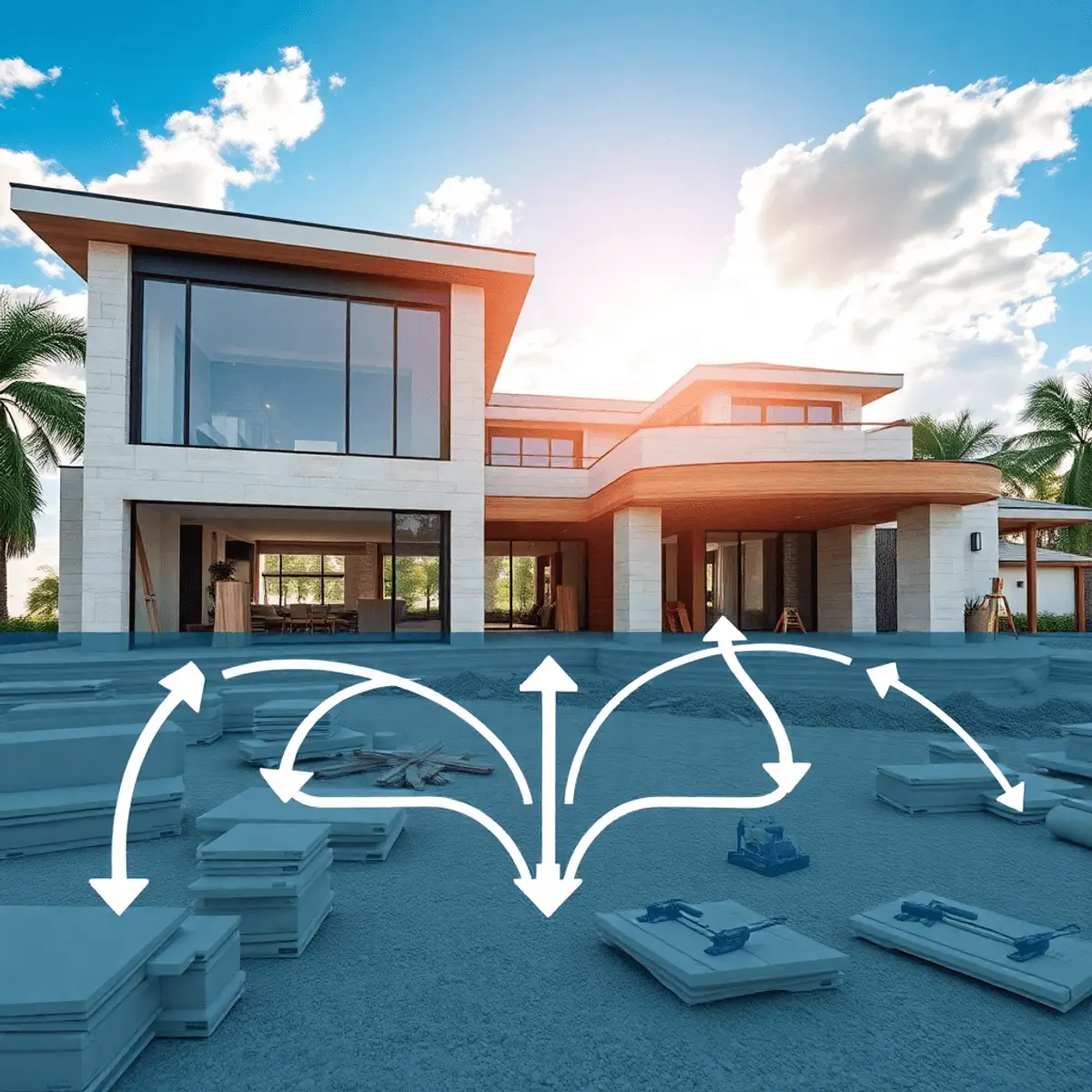
On a South Florida luxury build the items with real supply risk are impact-rated windows and doors, custom millwork and cabinetry, imported stone and tile, specialty appliances, elevators, generators, roofing systems, and specified plumbing and lighting fixtures. These share three traits: long lead times, limited substitutability, and a position in the schedule where other trades wait behind them.
Their place in the sequence is in a realistic timeline for luxury custom home construction.
What does contingency planning actually involve?
Contingency planning on a South Florida build involves five steps per critical item: identify it, establish its real lead time from the supplier rather than the catalog, order it early enough to hold float, agree an acceptable alternative in advance with a pricing rule, and track its confirmed ship date rather than its promised one. Contingency planning is administrative work that prevents structural delay.
The procurement phase is described in pre-construction planning.
Why is early ordering the strongest control?
Early ordering is the strongest supply-chain control on a South Florida build because it converts an uncertainty into an asset. A window package ordered in month three and stored is a window package that cannot be delayed, repriced, or discontinued. Early ordering also protects the budget, which is why contingency planning and cost protection are usually the same set of decisions.
The budget angle is in protecting your build budget.
How should substitutions be handled?
Contingency planning means agreed in advance or not at all. For each volatile item, name an acceptable alternative during specification, with a rule for how price differences are settled and who approves. Substitutions decided in the moment, under schedule pressure, are how a considered specification quietly becomes a compromised one.
Coastal material requirements are covered in coastal corrosion-resistant materials.
What about storage and delivery logistics?
Storage and delivery logistics are part of the plan, particularly on constrained South Florida waterfront sites. Ordering early only helps if there is somewhere secure and climate-appropriate to keep the material, and if delivery access has been thought through. Contingency planning that ignores storage produces goods that arrive on time and then get damaged.
Site safety requirements are published by OSHA, and site constraints are discussed in engineering challenges for Intracoastal and oceanfront homes.
How is the schedule structured around this?
A South Florida build schedule is structured around supply risk with float where it matters. Rather than spreading slack evenly, place it immediately after the items with the least control, so a two-week supplier slip consumes float rather than the critical path. Contingency planning is as much about where the buffer sits as about how large it is.
Duration drivers are in how long it takes to build a custom luxury home.
| Item | Why it is exposed | Contingency |
|---|---|---|
| Impact-rated openings | Made to order, long lead, trades wait behind | Order at permit, agree an alternative |
| Custom millwork | Fabricated to drawings, single source | Release drawings early, stage delivery |
| Imported stone and tile | Shipping and quarry variability | Buy the full quantity at once |
| Specialty appliances | Global supply, model changes | Confirm the model before specifying |
| Elevators and generators | Manufactured to order, install sequence | Order before rough-in |
| Roofing systems | Weather-critical and demand-sensitive | Secure before the structure tops out |
How should suppliers be monitored?
Contingency planning tracks by confirmed milestones rather than by reassurance: purchase order acknowledged, production slot allocated, fabrication started, shipped, and delivered, each with a date. A supplier who cannot confirm a production slot has not started, whatever the delivery date says. This is the earliest point at which a problem is still cheap.
The reporting discipline is described in virtual project management tools.
What happens when an item is genuinely late?
When an item is genuinely late on a South Florida build, the plan is executed rather than invented: assess whether the trade sequence can be resequenced around it, whether the agreed alternative should be triggered, and what the cost and schedule effect of each is, then decide in writing. Projects with contingency planning make this decision in days; projects without it lose weeks discussing it.
Change discipline is covered in how to budget a luxury home build.
Can anything be done at design stage?
Contingency planning at design stage is the cheapest intervention available on a South Florida luxury home. Preferring products with domestic availability, avoiding single-source items where a comparable alternative exists, and standardizing sizes so a substitution does not force rework all reduce exposure before a single order is placed. Contingency planning starts on the drawing board.
Specification thinking is in strategic design decisions and long-term property value.
How does Kass Construction & Development plan for this?
Item by item, from the first schedule: Kass Construction & Development, a state-licensed (CGC1529472) boutique luxury builder led by Mitch Kass, a licensed general contractor and attorney, with 100+ luxury residences delivered by Mitchell Kass and the firms he has led across Broward, Palm Beach, and Miami-Dade, builds contingency planning into procurement so a supplier’s problem does not become the owner’s delay.
A custom build often runs 18 to 36 months. Contact Kass Construction & Development or call 954-607-4335.
Which items carry supply risk on a luxury build, and what is the plan for each?
Contingency planning for supply chain issues concentrates on a short list of custom, imported or made-to-order items, and the table below gives each its typical lead time, the phase that needs it and the control that keeps a delay from stopping the site.
| Item | Why it is exposed | Phase that needs it | Control |
|---|---|---|---|
| Impact windows, doors and sliding walls | Made to order; product approvals; the longest lead time on the project | Dry-in | Order at design development; approved alternate system; delivery scheduled to structure completion |
| Structural steel and custom trusses | Fabricated to approved drawings; mill schedules | Structure | Release from permit drawings; fabricator confirmed before mobilization |
| Roofing (specialty metal and clay tile) | Color runs, imports, coil supply | Dry-in | Order at permit; reserve the run; approved alternate profile |
| Elevator, generator, switchgear | Built to order; electrical supply chains | Rough-in | Order with the electrical package; shaft and pad built to confirmed dimensions |
| Stone slabs and imported tile | Quarry lots, freight, currency | Finishes | Reserve slabs at selection; hold a second-choice lot |
| Custom millwork and cabinetry | Shop capacity; hardwood supply | Finishes | Shop drawings approved early; production slot booked |
| Plumbing fixtures and appliances | Imported lines; model changes | Rough-in and trim | Rough-in valves ordered early; trim held in storage; alternates approved |
| Automation, lighting control and shades | Electronics supply; specific motors and processors | Rough-in and trim | Infrastructure installed first; devices ordered with the integrator’s contract |
| Marine hardware, lifts and dock materials | Specialty suppliers; barge scheduling | Site work | Ordered with the seawall contract |
Site safety rules for material storage and handling are published by OSHA. The price side of the same exposure is covered in protecting your build budget from inflation and material price spikes, and the coastal specification that defines many of the items in coastal corrosion-resistant materials.
What does contingency planning involve, step by step?
Contingency planning for supply is done at the start of the project and maintained weekly, and the sequence below is how it is set up on a South Florida luxury home.
- Identify the exposed items from the specification and list each with its supplier, lead time, order date, required-on-site date and float.
- Fix the specification early enough to order them, which is a design-stage decision described in pre-construction planning.
- Approve an alternate for each exposed item in advance, with its cost and lead time, so a substitution is a decision rather than a scramble.
- Fund deposits through the draw schedule so orders can be placed when the price and slot are available; see how to budget a luxury home build.
- Arrange storage: a secured, climate-controlled space for early deliveries, with insurance for stored materials and inspection at receipt.
- Build the schedule with float on the exposed items and with non-dependent work available to fill a gap; the dependency logic is in a realistic timeline for luxury custom home construction.
- Monitor suppliers monthly: production status, shipping, and any change in the promised date, recorded in the procurement log on the platform described in virtual project management tools for absentee owners.
- When an item slips, decide within days: wait with re-sequenced work, substitute the approved alternate, or split the delivery.
What can be done at design stage to reduce supply exposure?
Contingency planning is most effective before anything is ordered, and the design-stage choices below reduce the number of items that can stop a South Florida project.
- Standardize where it costs nothing: repeated window sizes, one roofing profile, one hardware family, so a delayed item can be replaced from stock.
- Choose systems with more than one approved manufacturer, so a product approval and an alternate exist at filing.
- Specify long-lead structural and envelope items during design development, not after pricing, following strategic design decisions for long-term property value.
- Design the shell so interior work can proceed behind temporary closures if glazing is late.
- Coordinate marine and site packages early on waterfront lots, since barge and pile schedules have their own constraints; see engineering challenges on Intracoastal and oceanfront sites.
- Keep the finish selections calendar ahead of the 18 to 36 month program in how long it takes to build a custom luxury home, so no item is ordered late because a decision was.
Kass Construction & Development maintains a procurement log with an alternate for every exposed item on projects across Broward, Palm Beach and Miami-Dade, and releases long-lead orders while the foundation is still in the ground.
Frequently Asked Questions
What is contingency planning for supply chain issues?
Identifying the items with long lead times and limited substitutes, establishing real lead times, ordering early, agreeing alternatives in advance, and tracking confirmed supplier milestones rather than promised dates.
Which items are most at risk?
Impact-rated openings, custom millwork, imported stone, specialty appliances, elevators, generators, roofing systems, and specified fixtures. All are long-lead with other trades waiting behind them.
Why order so early?
Because a purchased and delivered item cannot be delayed, repriced, or discontinued. Early ordering protects both the schedule and the budget.
Should I agree substitutes in advance?
Yes. Naming an acceptable alternative during specification, with a pricing and approval rule, prevents quality slipping when a decision has to be made under pressure.
Where should schedule float go?
Immediately after the items you control least, so a supplier slip consumes buffer rather than the critical path.
How do I know a supplier is really on track?
By confirmed milestones: order acknowledged, production slot allocated, fabrication started, shipped, delivered. A supplier who cannot confirm a production slot has not started.
Can design reduce supply risk?
Yes, and contingency planning does it cheaply: prefer domestically available products, avoid single-source items where alternatives exist, and standardize sizes so substitution does not force rework.