Integrating smart systems in a luxury home starts with one decision that outlasts every gadget: the platform. Choose well and the estate runs as one coherent system for a decade; choose poorly and the family lives inside a negotiation between apps. This guide covers the criteria that actually matter, how the professional platforms differ, and the construction-phase process that makes integrating smart systems succeed, because in the luxury tier the how of integration matters as much as the what.
Key takeaways
- Why does platform choice matter more in luxury construction?
Platform choice matters more in luxury construction because the platform is wired into the walls: lighting keypads, shade motors, climate zones, security, and audio all commit to an ecosystem during rough-in, and changing course later means construction, not shopping. - Which criteria matter when integrating smart systems?
Six criteria matter when integrating smart systems in a South Florida home, in rough order: reliability under daily family use; the quality of the local integrator bench, because the platform is only as good as its programmer; breadth of integration with lighting, shades, climate, security, and AV; interface quality for every family member, not just the enthusiast; longevity and upgrade path; and serviceability, who answers when something misbehaves at 9 pm. - How do the professional platforms broadly differ?
The professional platforms differ along three axes: customization depth versus configuration speed; dealer-programmed versus owner-adjustable; and hardware ecosystem breadth. - What does integrating smart systems look like during construction?
Integrating smart systems during construction has four phases: design, where the integrator joins the architect and builder to place keypads, panels, and equipment rooms; rough-in, when structured wiring and conduit go in with the walls open; trim and device installation after finishes; and commissioning, the programming and testing phase that turns hardware into a home.
Why does platform choice matter more in luxury construction?
Platform choice matters more in luxury construction because the platform is wired into the walls: lighting keypads, shade motors, climate zones, security, and audio all commit to an ecosystem during rough-in, and changing course later means construction, not shopping. A luxury build gets one clean opportunity to choose; everything afterward is retrofit economics.
Where that opportunity sits in the build sequence is covered in smart home technology in luxury custom homes and pre-construction planning.
Which criteria matter when integrating smart systems?
Six criteria matter when integrating smart systems in a South Florida home, in rough order: reliability under daily family use; the quality of the local integrator bench, because the platform is only as good as its programmer; breadth of integration with lighting, shades, climate, security, and AV; interface quality for every family member, not just the enthusiast; longevity and upgrade path; and serviceability, who answers when something misbehaves at 9 pm.
Brand comparisons come after these criteria, not before: the leading professional platforms (Crestron, Control4, Savant among them) each win under different priorities, deepest customization, broadest dealer network, most elegant interface, and the right answer is the one the owner’s integrator executes brilliantly.
How do the professional platforms broadly differ?
The professional platforms differ along three axes: customization depth versus configuration speed; dealer-programmed versus owner-adjustable; and hardware ecosystem breadth. Fully custom platforms suit estates with complex, bespoke automation; configured platforms deliver excellent results faster and are easier to service; and every serious option now handles voice, mobile, and keypad control competently.
The control-layer strategy, what belongs on keypads versus apps versus automation, is laid out in home automation for luxury homes and the full-estate architecture in whole home automation.
What does integrating smart systems look like during construction?
Integrating smart systems during construction has four phases: design, where the integrator joins the architect and builder to place keypads, panels, and equipment rooms; rough-in, when structured wiring and conduit go in with the walls open; trim and device installation after finishes; and commissioning, the programming and testing phase that turns hardware into a home. Skipping design or compressing commissioning is where most failed systems are born.
The craft of integrating smart systems is a team sport; the coordination model is described in how builders and architects collaborate.
Which infrastructure pays off when integrating smart systems?
The infrastructure that pays off in a Florida luxury home is wiring generously and neutrally: structured cabling to every room, conduit to key locations for whatever comes next, a professional-grade network with proper coverage, an equipment room with power, cooling, and space, and category-neutral wiring that serves any future platform. Infrastructure is the cheapest part of integrating smart systems and the most expensive thing to add later.
Network security fundamentals for connected homes are covered by the FTC’s home Wi-Fi guidance and, for the deeply curious, NIST’s IoT cybersecurity program. The long-horizon plan is expanded in future-proofing your smart home technology investment.
How should budget and timeline be planned?
Plan budget and timeline backbone first, features second: fund the wiring, network, and platform core as non-negotiable construction scope, then scale lighting, shades, and AV to taste. On schedule, integration follows the build’s rhythm, design decisions in pre-construction, rough-in with the trades, commissioning before move-in, inside a custom build that often runs 18 to 36 months or a high-end renovation of 6 to 12 months.
Where technology sits among the budget categories is shown in the luxury construction cost breakdown.
How does Kass Construction & Development manage integration?
As a construction discipline: Kass Construction & Development, a state-licensed (CGC1529472) boutique luxury builder led by Mitch Kass, a licensed general contractor and attorney, with 100+ luxury residences delivered by Mitchell Kass and the firms he has led across Broward, Palm Beach, and Miami-Dade, brings the integrator into design, coordinates the wiring with every trade, and holds commissioning time in the schedule so systems work at handover, not after it.
Contact Kass Construction & Development or call 954-607-4335.
What are the criteria for choosing a platform when integrating smart systems?
Integrating smart systems in a luxury home starts with a platform decision that is easier to make well when the criteria are written down and scored before any product is chosen.
| Criterion | What to ask | Why it matters over a decade |
|---|---|---|
| Scope of control | Does one platform run lighting, shades, climate, audio-video, security, pool, gates and energy? | Every system outside the platform becomes another app |
| Programming model | Is the logic held locally on a processor in the house, or in a vendor’s cloud? | Local logic keeps working through internet outages and vendor changes |
| Dealer network | How many certified integrators serve Broward, Palm Beach and Miami-Dade? | Service continuity if the original integrator changes |
| Openness | Which third-party devices and protocols does it support? | Avoids replacing the whole system when one device is discontinued |
| Interface | Keypads, touch panels, app and voice, all with the same scene names? | The family uses what is consistent and ignores what is not |
| Security | Encryption, user accounts, update policy, remote-access controls | The system is part of the home’s attack surface |
| Lifecycle | Published support windows and upgrade paths | A ten-year home should not depend on a three-year product |
Security guidance for connected devices is published by the National Institute of Standards and Technology and consumer advice by the Federal Trade Commission. The system-level view is in whole home automation.
What happens at each construction phase when integrating smart systems?
Integrating smart systems is a construction sequence, and the work lands in specific phases where it is cheap to do and expensive to revisit.
- Design: the integrator joins the architect, lighting designer and builder to fix the platform, the equipment room location and the scope, as described in how builders and architects collaborate.
- Documents: low-voltage drawings show every keypad, touch panel, speaker, camera, shade motor, sensor and cable path, coordinated with the electrical and mechanical sets.
- Shell: conduit sleeves through slabs and tie beams, and pathways to the roof, gates, dock and pool equipment, are cast in before concrete.
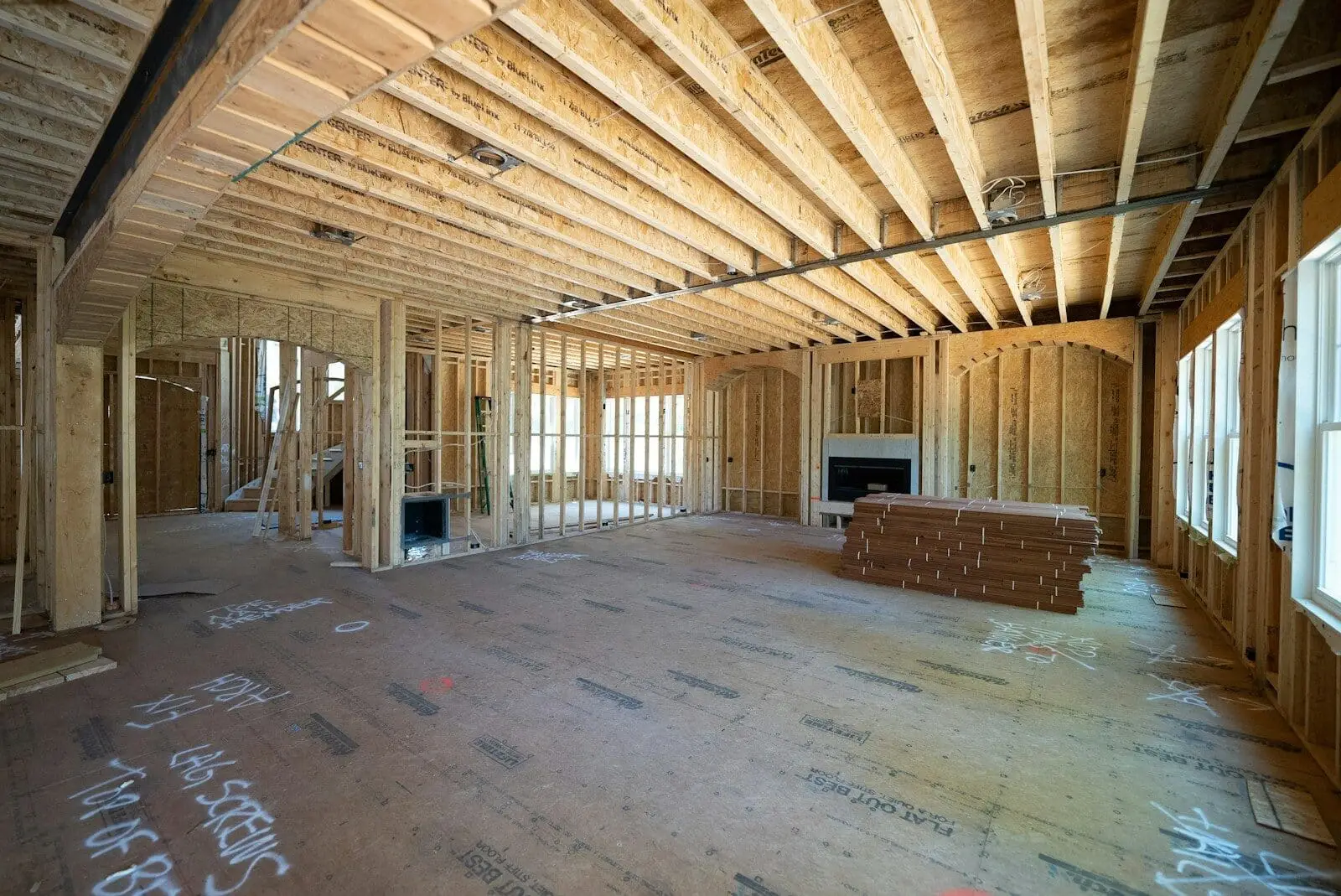
- Rough-in: structured cabling, fiber backbones, shade wiring, lighting control loads and equipment-room infrastructure are installed and photographed before walls close.
- Trim: keypads, panels, speakers and cameras are set after paint; shades are fitted after window treatments are measured on site.
- Commissioning: scenes, schedules and integrations are programmed and tested room by room, then with the family, before handover.
- Handover: documentation, user accounts, passwords and a service agreement are delivered with the warranty file.
The timing fits the 18 to 36 month program in how long it takes to build a custom luxury home.
Which infrastructure decisions pay off when integrating smart systems?
Integrating smart systems well is mostly a matter of infrastructure that costs little during construction and cannot be added afterward without opening walls.
- A dedicated, cooled equipment room above the flood level with clean power, ventilation and space for growth; equipment elevation is covered in smart flood mitigation technologies.
- Category cabling to every room, television, access point, camera and keypad location, with fiber between buildings and to the dock.
- Conduit to exterior locations and spare conduit between floors, so future devices are a pull rather than a demolition.
- Hard-wired shade motors and lighting control loads rather than battery or wireless devices in the primary rooms.
- Enterprise-grade networking with wired access points, segmented networks for cameras and devices, and cellular backup.
- Surge protection and generator or battery backup for the network and control processors; see energy management and sustainability systems.
Future-proofing choices are discussed in smart home technology investment and future-proofing.
How should budget and responsibility be organized for integration?
Integrating smart systems runs across several trades, and a clear budget structure and a single responsible party keep it from becoming everyone’s problem and nobody’s job.
- Budget in three parts: infrastructure (cabling, conduit, equipment room, network), control and devices (processors, keypads, shades, lighting control), and content (audio-video, theater, art lighting).
- Place infrastructure in the base contract, because it is cheapest when the walls are open; the cost picture is in the Miami-Dade cost breakdown.
- Name one integrator as the responsible party for the platform, with the electrical contractor, shade supplier and security contractor working to the integrator’s drawings.
- Fix the scope before rough-in, since late additions are the largest source of change orders in this trade; see change order abuse.
- Agree a service plan and a documented handover as part of the contract; the common failures are listed in smart home integration challenges.
- Decide which features deserve the money, using high-end smart home features that add value.
Kass Construction & Development manages integration as a coordinated trade on every South Florida project, bringing the integrator into design and holding the low-voltage drawings to the same standard as the structural set; the starting point is smart home technology for luxury custom homes and pre-construction planning.
Frequently Asked Questions
What does integrating smart systems mean in a luxury home?
Running lighting, climate, shades, security, audio, and energy on one professional platform with unified control and a wired backbone, designed and installed as part of construction rather than added afterward.
Which smart home platform is best?
The one your integrator executes brilliantly against your priorities: fully custom platforms win on bespoke depth, configured platforms on speed and serviceability. The integrator’s skill affects daily life more than the logo on the processor.
When must the platform decision be made?
Before rough-in: keypads, wiring, and equipment locations commit during construction. Deciding in design keeps every option open; deciding after drywall converts choices into compromises.
Can different brands work together in one home?
Professional platforms integrate many third-party devices, but the experience is best when one platform owns control and everything else serves it. A home of parallel apps is the failure mode integration exists to prevent.
What is commissioning and why does it matter?
The programming, testing, and tuning phase that turns installed hardware into a working home: scenes built, automations tested, interfaces simplified for the family. Systems that skip real commissioning are the ones owners complain about for years.
How is the home network involved?
It is the foundation: every system rides on it, so coverage, capacity, and security are construction-grade concerns. Federal guidance from the FTC and NIST covers the security fundamentals; a professional integrator applies them by default.
What should owners ask when choosing an integrator?
Portfolio of comparable estates, references from projects still being serviced years later, response commitments after handover, and how they document what they build. The relationship outlasts the construction by a decade.