Advanced home security in a luxury estate is a layered engineering problem, not an alarm panel with cameras. The homes worth protecting deserve a design that starts at the property line and ends at the network: perimeter, envelope, access, surveillance, detection, life safety, and cybersecurity, each layer designed during construction so the result is discreet, reliable, and private. This guide walks the layers in order and shows why the best security in a luxury home is the kind guests never notice.
Key takeaways
- Why do standard security systems fall short in luxury homes?
Standard systems fall short in South Florida luxury homes because they bolt on what should be built in: consumer kits protect doors and windows generically, while an estate's real exposures, grounds, water frontage, staff access, deliveries, vehicles, art, and the family's privacy, need a threat-informed design. - How is the perimeter hardened without looking fortified?
The perimeter of a South Florida estate is hardened through landscape and architecture doing double duty: gates and entry sequencing that manage arrival gracefully, planting and grading that guide movement, lighting scenes that eliminate hiding places on schedule, and detection along the property line, especially water frontage, where a dock is also an entrance. - What does the building envelope contribute?
The building envelope contributes passive strength: impact-rated glazing and doors specified for hurricanes are also genuine intrusion barriers, reinforced entry hardware resists force quietly, and a safe room or protected suite gives the family a hardened fallback that doubles as storm shelter. - How should advanced home security handle access and surveillance?
Access and surveillance in a luxury home are handled for daily grace and honest coverage: credentialed access that ends key anxiety and logs staff, vendor, and family entry; video positioned for verification at entries, approaches, and the water side rather than blanket coverage; storage and remote review that let an owner check the estate in ninety seconds; and privacy zones, interiors, guest areas, agreed explicitly with the owner at design.
Why do standard security systems fall short in luxury homes?
Standard systems fall short in South Florida luxury homes because they bolt on what should be built in: consumer kits protect doors and windows generically, while an estate’s real exposures, grounds, water frontage, staff access, deliveries, vehicles, art, and the family’s privacy, need a threat-informed design. Advanced home security starts by asking what is being protected and from what, then engineers each layer to that answer.
Security design belongs in the same early conversations as architecture, covered in pre-construction planning.
How is the perimeter hardened without looking fortified?
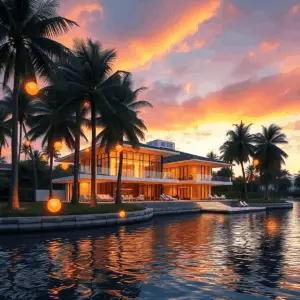
The perimeter of a South Florida estate is hardened through landscape and architecture doing double duty: gates and entry sequencing that manage arrival gracefully, planting and grading that guide movement, lighting scenes that eliminate hiding places on schedule, and detection along the property line, especially water frontage, where a dock is also an entrance. The goal is a property that reads as beautiful and behaves as monitored.
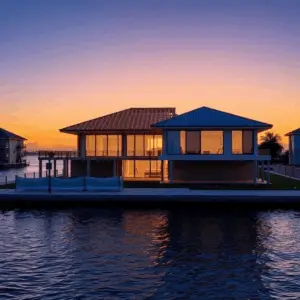
Waterfront exposure is a South Florida particular: the same dockage covered in waterfront home construction is an access point the security design must own.
What does the building envelope contribute?
The building envelope contributes passive strength: impact-rated glazing and doors specified for hurricanes are also genuine intrusion barriers, reinforced entry hardware resists force quietly, and a safe room or protected suite gives the family a hardened fallback that doubles as storm shelter. In South Florida, storm engineering and security engineering are the same investment twice over.
The storm side of that envelope is detailed in hurricane-resistant construction and hurricane resilience design.
How should advanced home security handle access and surveillance?
Access and surveillance in a luxury home are handled for daily grace and honest coverage: credentialed access that ends key anxiety and logs staff, vendor, and family entry; video positioned for verification at entries, approaches, and the water side rather than blanket coverage; storage and remote review that let an owner check the estate in ninety seconds; and privacy zones, interiors, guest areas, agreed explicitly with the owner at design.
How surveillance rides the automation platform, lighting response, occupancy simulation, event scenes, is covered in whole home automation.
Where do detection and life safety converge?
Detection and life safety converge in one engineered system: intrusion sensors designed into openings during construction, glass-break and motion coverage tuned to the family’s life, water leak detection guarding the statistically likeliest loss, and fire, CO, and medical alerting integrated with the same monitoring. Backup power and cellular failover keep every layer alive through outages, when protection matters most.
Power continuity design lives in energy management and sustainability systems, with outage planning basics at Ready.gov.
Why is cybersecurity part of advanced home security?
Cybersecurity is part of it because every camera, lock, and sensor is a networked device: a segmented network that isolates security gear, hardened credentials, encrypted remote access, and disciplined device updates are what keep the protection system from becoming the vulnerability. Federal guidance from CISA on securing network devices and the FTC’s home network guidance covers the fundamentals a professional integrator applies by default.
The network architecture underneath is part of future-proofing your smart home technology investment.
How is advanced home security commissioned and maintained?
Commissioning is the step most South Florida systems skip: every sensor tested, every camera angle verified with the owner, response procedures written, monitoring contracts active, and the family trained on modes they will actually use. After handover, maintenance keeps detection honest, firmware current, and coverage aligned as landscape grows and life changes.
Commissioning discipline across all estate systems is a construction-phase commitment described in integrating smart systems in luxury homes.
How does Kass Construction & Development build security in?
From the drawings: Kass Construction & Development, a state-licensed (CGC1529472) boutique luxury builder led by Mitch Kass, a licensed general contractor and attorney, with 100+ luxury residences delivered by Mitchell Kass and the firms he has led across Broward, Palm Beach, and Miami-Dade, coordinates security design with architecture, wires detection and surveillance during rough-in, and holds commissioning in the schedule, inside a custom build of often 18 to 36 months or a renovation of 6 to 12 months.
Contact Kass Construction & Development or call 954-607-4335.
What does each layer of advanced home security contain on an estate?
Advanced home security is designed as concentric layers from the property line inward, and each layer has its own components and its own job.
| Layer | Components | Purpose |
|---|---|---|
| Perimeter | Walls, hedges, gates, vehicle barriers, waterfront sensors, dock and boat-lift monitoring | Delay and detect before anyone reaches the house |
| Grounds | Thermal and video analytics cameras, lighting on scenes, driveway sensors | Verify intent and record approach |
| Envelope | Impact glazing, reinforced doors, secure hardware, glass-break and contact sensors | Resist entry and confirm breach |
| Access | Credentialed entry, intercom, visitor and staff schedules, secure delivery room | Control who enters, when and where |
| Interior | Motion and occupancy sensing, safe room, secure storage, panic devices | Protect people and valuables inside |
| Life safety | Fire, smoke, carbon monoxide, water leak, medical alert | Detect hazards that are not intruders |
| Network | Segmented networks, encrypted devices, monitored remote access, backups | Keep the system itself from becoming the vulnerability |
| Response | Professional monitoring, cellular and satellite backup, documented procedures | Turn detection into action |
Guidance on securing connected devices is published by the Cybersecurity and Infrastructure Security Agency and the Federal Trade Commission; the platform that ties the layers together is discussed in whole home automation.
How is advanced home security designed into the construction sequence?
Advanced home security is cheapest and least visible when it is built in with the structure, and the work lands in specific phases of a South Florida build.
- Design: a security consultant or the integrator produces a threat assessment and a layered plan with the architect and landscape designer, as part of pre-construction planning.
- Site work: conduit to gates, perimeter camera poles, the dock and the seawall is laid before paving; footings for gates and barriers are poured with the site.
- Shell: reinforced door frames, safe-room structure and concealed conduit for envelope sensors go in with the masonry and tie beams.
- Envelope: impact-rated glazing and doors with Florida product approvals serve both storm and security, as covered in hurricane-resistant construction.
- Rough-in: sensor, camera, access and life-safety cabling is installed and photographed before drywall; the equipment room is placed above the flood level.
- Trim and commissioning: devices are set after finishes, camera views and analytics are tuned, and procedures are tested with the family and monitoring provider.
The coordination model across trades is described in integrating smart systems in luxury homes.
What is different about securing a waterfront estate?
Advanced home security on a South Florida waterfront lot has an open side that a walled garden does not, and the water side needs its own design.
- The seawall and dock are an entry point; thermal cameras, dock sensors and lighting on scenes cover the water approach without floodlighting the neighbors.
- Boats and lifts are monitored for movement and tampering, with lift controls on the access system.
- Ground-level equipment is elevated and protected from flooding so security keeps working during a surge; see smart flood mitigation technologies.
- Storm mode secures gates, shutters and the dock in one sequence and confirms each step, following hurricane resilience design.
- Power and communications are backed up so cameras, locks and monitoring survive an outage; see energy management and sustainability systems; household preparedness guidance is at Ready.gov.
- Marine-grade enclosures and hardware are specified for every exterior device, per coastal corrosion-resistant materials; the waterfront build itself is covered in waterfront home construction in South Florida.
How is advanced home security kept effective after handover?
Advanced home security degrades quietly if it is not maintained, and a short operating discipline keeps a system as effective in year ten as on the day it was commissioned.
- A service agreement with the integrator covering firmware updates, camera cleaning in salt air, battery replacement and annual testing.
- User accounts and credentials reviewed whenever staff, contractors or household members change; remote access limited and logged.
- Network segmentation and update policies maintained, as recommended by the National Institute of Standards and Technology.
- Monitoring contracts, call lists and procedures rehearsed with the family and staff.
- Storm-season checks each spring: backup power, communications, camera coverage and the storm-mode sequence.
- Documentation kept current, which also protects the resale value discussed in smart home technology investment and future-proofing.
Kass Construction & Development builds security into the architecture on estates across Broward, Palm Beach and Miami-Dade, so protection reads as design rather than apparatus; the features worth funding are ranked in high-end smart home features that add value.
Frequently Asked Questions
What makes advanced home security different from an alarm system?
Layered design: perimeter, envelope, access, surveillance, detection, life safety, and network security engineered together during construction, against the estate’s actual exposures, rather than a panel and sensors added at the end.
Do luxury homes really need perimeter detection?
Estates with grounds, gates, or water frontage benefit most: knowing about an approach before it reaches the house is the difference between response and reaction. On waterfront properties the dock is an entrance and belongs in the design.
How is privacy protected with cameras in the home?
By explicit design: exterior verification coverage, interior zones agreed with the owner, guest-area exclusions, local or encrypted storage, and access limited to the family. Privacy is a specification set at design, not an afterthought.
Does impact glazing actually improve security?
Substantially: assemblies engineered to stop hurricane debris resist intrusion far beyond standard glass, making the storm envelope a passive security layer. It is one of South Florida’s quiet dual-purpose investments.
What keeps security running during power outages?
Backup power carrying the network, cameras, and detection, plus cellular failover for monitoring and remote access. A security system that goes dark with the grid protects nothing in exactly the moments that matter.
Can advanced home security be retrofitted?
Largely: access control, surveillance, monitoring, and network hardening retrofit well, and a high-end renovation of often 6 to 12 months can wire detection properly. New construction still wins on concealment and integration depth.
Who should monitor a luxury home’s security?
Professional monitoring with written response procedures, layered with owner verification through the integrated platform. The combination of trained response and ninety-second owner check-in is the standard that fits how these homes are actually lived in.
How does advanced home security handle waterfront exposure?
By treating the dock as a door. Waterfront properties add an approach that street-focused systems ignore, so advanced home security here extends cameras, sensors, and lighting to the seawall and dock line, closing the gap that makes water frontage attractive to more than boaters.
Can advanced home security be added during a renovation rather than new construction?
Yes, and renovation is the ideal moment. Open walls make wiring, conduit, and sensor placement clean, so folding advanced home security into a remodel costs meaningfully less than retrofitting a finished home and gives advanced home security the wired backbone that wireless-only shortcuts never match.