Cost per square foot is the most requested number in custom home building and the least useful one. It is an output, calculated after a project is finished by dividing a total by an area, and it carries no information about what produced either figure. Used as a planning tool it misleads reliably, and the gap between the assumed rate and the real one is discovered at bidding, which is the worst possible moment.
Key takeaways
- Why does cost per square foot mislead?
Cost per square foot misleads on a South Florida luxury home because it treats area as the driver of cost when it is only one of several. - Which area is even being measured?
Which area is measured (under air, under roof, or total) is rarely stated, and that alone breaks most South Florida comparisons. - What does the number usually exclude?
The number usually excludes almost everything outside the building footprint on a South Florida lot: land, demolition, site work, seawall or dock, pool and hardscape, landscaping, and the entire soft cost stack. - Why does it behave differently at the luxury level?
At the luxury level the metric behaves differently because cost concentrates in a few rooms rather than spreading evenly.
Why does cost per square foot mislead?
Cost per square foot misleads on a South Florida luxury home because it treats area as the driver of cost when it is only one of several. Two homes of identical square footage can differ substantially depending on structure, ceiling heights, glazing area, the number of wet rooms, site conditions, and finish level. Cost per square foot compresses all of that into one number and discards the information that mattered.
Cost per square foot hides all of that, and the real drivers are broken down in the luxury construction cost breakdown.
Which area is even being measured?
Which area is measured (under air, under roof, or total) is rarely stated, and that alone breaks most South Florida comparisons. Some figures use conditioned living area, others include garages, covered terraces, balconies, or the pool deck. A rate that includes outdoor area looks lower for the same house. Before comparing any cost per square foot figure, establish what area definition produced it, or the comparison is meaningless.
How real numbers are built is described in what it costs to build a luxury custom home in Fort Lauderdale.
What does the number usually exclude?
The number usually excludes almost everything outside the building footprint on a South Florida lot: land, demolition, site work, seawall or dock, pool and hardscape, landscaping, and the entire soft cost stack. A quoted cost per square foot that excludes those is describing a fraction of what the owner will actually spend, which is why it feels achievable and then is not.
A cost per square foot figure rarely carries these, and the invisible half is covered in soft costs in luxury home construction.
Why does it behave differently at the luxury level?
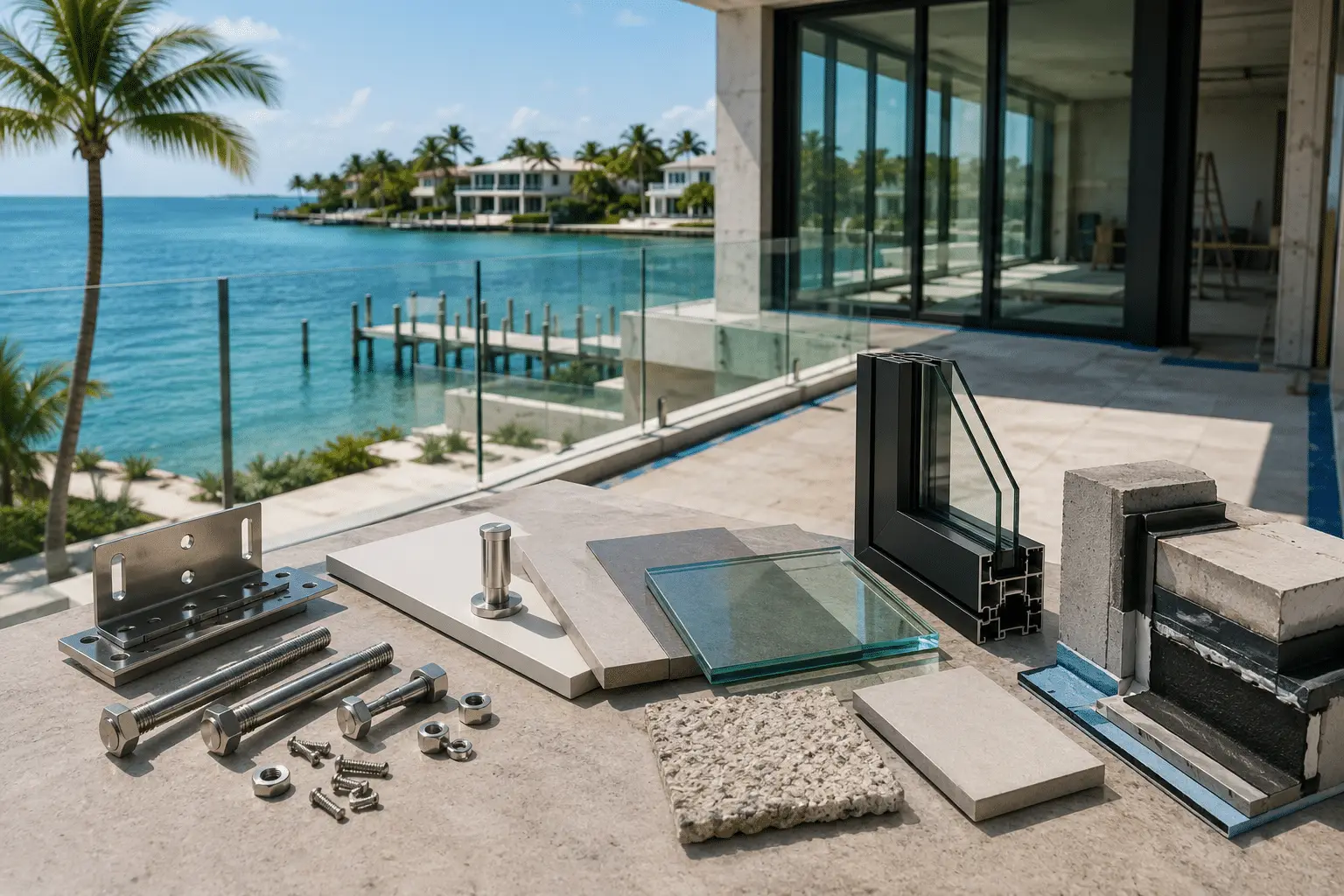
At the luxury level the metric behaves differently because cost concentrates in a few rooms rather than spreading evenly. Kitchens, primary baths, and specialty spaces carry a large share of the total, while bedrooms and corridors carry little. Adding plain area lowers the rate without lowering the cost, so cost per square foot actually falls as a house gets less efficient.
That inversion is why cost per square foot rewards exactly the wrong design decisions.
Efficient plans look expensive by the metric and are cheaper to build and run.
How does the site change the rate?
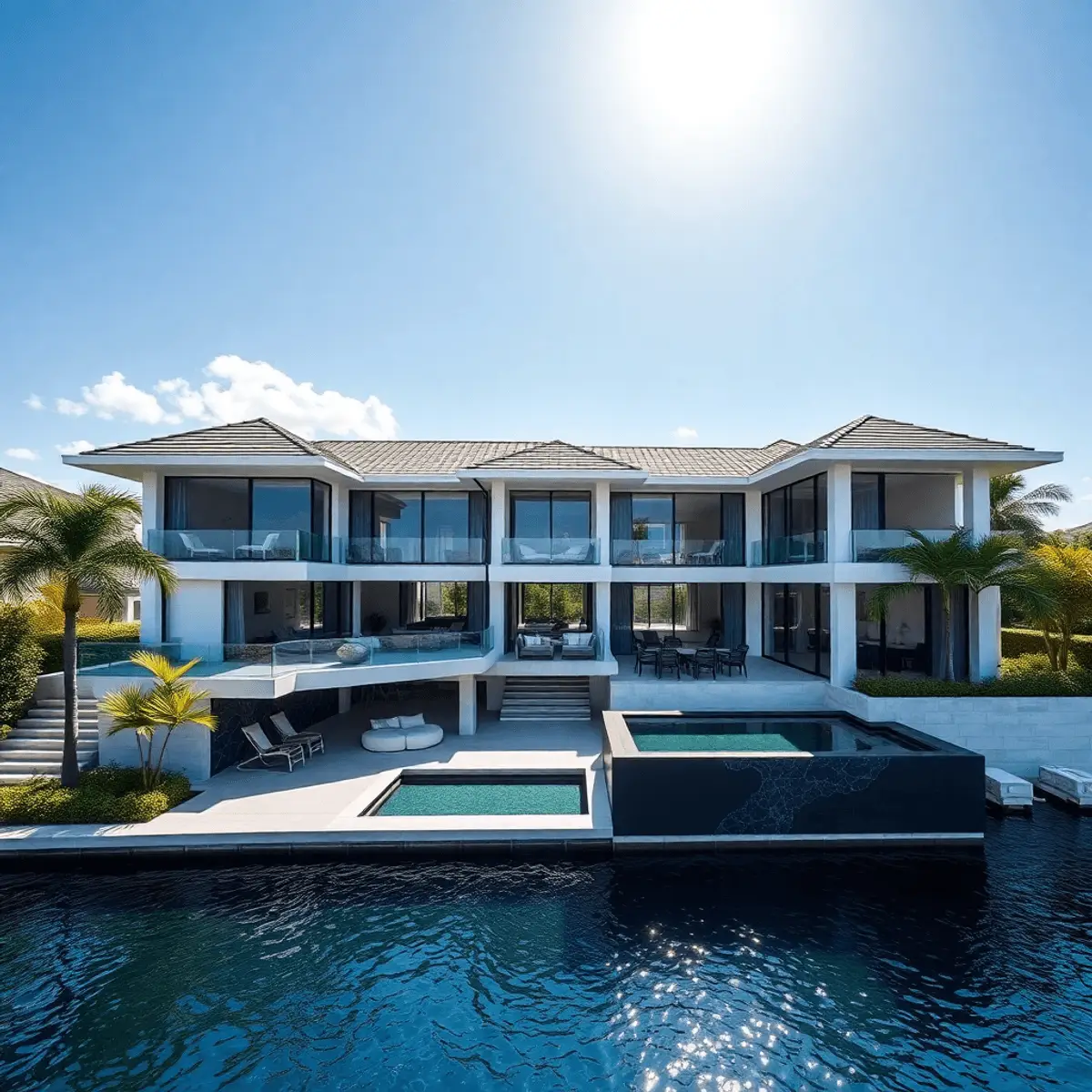
A South Florida site changes the rate dramatically and invisibly: seawall, flood elevation, pilings, and coastal permitting never show in a per-foot number. Deep foundations on coastal soils, elevated structure in a flood zone, seawall work, difficult access, and demolition all attach to the same building area. Two identical houses on adjacent lots can have materially different rates because of what sits under and around them.
Cost per square foot cannot see any of this, and the site variables are in what to know before building a waterfront home.
| Question | Why it changes the rate | What to ask |
|---|---|---|
| Which area was measured? | Including terraces and garages lowers the rate | Conditioned area only, or total? |
| What is excluded? | Land, site work, pool, and soft costs are often out | What is in the number? |
| What site conditions applied? | Deep foundations and elevation attach to the same area | Flood zone and soil conditions? |
| What finish level? | Cost concentrates in kitchens and baths | Comparable specification? |
| How efficient was the plan? | Plain area lowers the rate without lowering cost | Rooms and volumes, not just area |
Is the metric ever useful?
The metric is useful in two ways: as a sanity check against completed projects of genuinely similar type, site, and specification, and as a description of a finished build for record purposes. What it cannot do is originate a budget. Cost per square foot describes the past accurately and predicts the future badly.
National construction statistics are published by the US Census Bureau.
What should replace it for planning?
For planning a South Florida luxury home, a staged estimate should replace it: a feasibility number from the parcel and a written program, a design-development estimate once drawings exist, then a contract price from a complete specification with real subcontractor pricing. Each stage narrows the range using actual information rather than an average borrowed from someone else’s project.
The process is described in pre-construction planning.
How should an owner respond to a quoted rate?
An owner should respond to any quoted rate with four questions: what area definition was used, what is included and excluded, what site conditions applied, and at what finish specification. A builder who can answer all four is describing something real. A builder who cannot is repeating a number, and so is anyone comparing rates without asking.
Licenses and history can be verified at Florida DBPR.
Why do owners keep asking for it?
Owners keep asking for it because it is the only construction number that sounds comparable, and comparability is genuinely useful when making a large decision. The honest answer is that custom homes are not comparable in that way, and the substitute is not a better average but a real estimate built from the owner’s own parcel and program.
Budget structure is in how to budget a luxury home build.
How does Kass Construction & Development answer it?
Directly, and then with something better: Kass Construction & Development, a state-licensed (CGC1529472) boutique luxury builder led by Mitch Kass, a licensed general contractor and attorney, with 100+ luxury residences delivered by Mitchell Kass and the firms he has led across Broward, Palm Beach, and Miami-Dade, will explain what cost per square foot did and did not include on comparable work, then build a staged estimate from your parcel instead.
A custom build often runs 18 to 36 months. Contact Kass Construction & Development or call 954-607-4335.
What does a cost per square foot quote usually include and exclude?
Two builders can quote the same cost per square foot and be describing budgets that differ by a third, because the number has no agreed definition. Ask for the list, line by line:
| Item | Usually inside the rate | Usually outside the rate |
|---|---|---|
| Structure, envelope, roofing, interior finish | Yes | |
| Impact-rated windows and doors | Sometimes, at an allowance | Upgrades above the allowance |
| Kitchen, bath, and millwork allowances | At a stated allowance | The real selections |
| Site work, demolition, fill, and drainage | Yes | |
| Pool, outdoor kitchen, landscape, hardscape | Yes | |
| Seawall, dock, and marine permits | Yes | |
| Pile or elevated foundations for flood zones | Often priced separately | |
| Design, engineering, surveys, permits, impact fees | Yes (soft costs) | |
| Builder fee, general conditions, insurance, bonds | Sometimes | Sometimes |
| Contingency | Yes |
The items in the right-hand column are where South Florida budgets are made or broken, and they are the subject of soft costs in luxury home construction and seawall construction and permitting.
How do South Florida site conditions move the cost per square foot?
The same house drawn twice, once on an inland lot in Coral Springs and once on a canal lot in Fort Lauderdale, will not cost the same per square foot, and the difference has nothing to do with finishes. The site variables that move the rate:
- Flood zone and base flood elevation. An AE or VE zone can require an elevated or pile foundation, flood vents or breakaway walls below the living level, and a design that turns the height into architecture rather than a compliance penalty.
- High-velocity hurricane zone. Miami-Dade and Broward sit in the HVHZ, where every opening needs product approvals tested to the region’s stricter standard; Palm Beach County follows the standard Florida Building Code wind-borne debris provisions. The rules are summarized in building codes in Palm Beach, Broward, and Miami-Dade.
- Soils. Coastal fill and high groundwater push foundations from monolithic slabs to piles, and rule out basements.
- Shoreline. Seawall repair or replacement and dock permitting are separate projects with their own engineering and state review.
- Access and staging. Narrow lots with a water edge raise crane, barge, and logistics costs.
- Review layers. Historic, architectural, and environmental boards add time, and time is general conditions.
Flood-zone effects on the number are detailed in AE, VE, and X flood zones in Broward County; the official definitions are on FEMA’s flood zone glossary.
How do you build a real budget instead of multiplying by a rate?
A real luxury budget is assembled from the bottom up in seven steps, and cost per square foot is calculated at the end as a sanity check, never at the start as an input.
- Underwrite the site: survey, flood determination, geotechnical report, seawall assessment, zoning envelope.
- Write the program room by room, with ceiling heights, spans, and the way the family lives.
- Set allowances honestly, at the level you intend to buy at, and price three real selections against each.
- Have the builder price real assemblies from schematic drawings while the design can still move.
- List soft costs separately: design, engineering, surveys, permits, impact fees, insurance, financing.
- Hold contingency for unknowns and an owner reserve for upgrades, each reported monthly.
- Add general conditions for the real duration; a custom build often runs 18 to 36 months, and every extra month has a carrying cost.
This is the process behind how to budget a luxury home build and pre-construction planning. National averages published by the U.S. Census Bureau are useful for trend direction, not for pricing a coastal custom home.
What should you ask when a builder quotes a cost per square foot?
Five questions turn a meaningless rate into a usable one.
- Which area: air-conditioned only, or under roof including garages, porches, and terraces?
- Which of the table items above are inside the rate, and at what allowance?
- Which completed project produced this rate, on what kind of lot, finished when?
- Does the rate include the builder’s fee, general conditions, and insurance?
- What is excluded entirely, and what is the builder’s estimate for those exclusions on my lot?
The answers usually explain why the quoted number and the finished number diverge, which is the pattern documented in why luxury construction runs over budget.
Frequently Asked Questions
Why is cost per square foot unreliable?
Because area is only one cost driver. Structure, ceiling heights, glazing, wet-room count, site conditions, and finish level all move the total independently of area.
What area does the figure use?
It varies, which is the problem. Some rates use conditioned living area only, others include garages, terraces, and balconies, which lowers the apparent rate for the same house.
What is usually excluded?
Land, demolition, site work, seawall or dock, pool and hardscape, landscaping, and the entire soft cost stack. That is why a quoted rate feels achievable and then is not.
Why does the rate fall as a house gets bigger?
Because cost concentrates in kitchens, baths, and specialty spaces. Adding plain area raises total cost slightly while lowering the average, which rewards inefficient design.
Is the metric ever useful?
As a sanity check against genuinely comparable completed projects, and as a description of a finished build. It cannot originate a budget.
What should I use instead?
A staged estimate: feasibility from the parcel and program, design-development estimate from drawings, then a contract price from a complete specification with real subcontractor pricing.
What should I ask when given a rate?
What area definition, what inclusions and exclusions, what site conditions, and what finish specification. Four questions separate a real figure from a repeated one.