Native Florida plants are one of the most underutilized tools in South Florida luxury landscapes, and one of the most powerful when used with intention. The misconception is that native means untamed; in reality, natives compose like any other design material: tight palettes, strong forms, clean edges, and coordinated materials that read curated, resort-like, and architectural. This guide covers how top designers use native Florida plants at entries, courtyards, pool decks, waterfront edges, and even interior moments like atriums, plus the pitfalls that make expensive installs look cheap.
Key takeaways
- Why do native Florida plants look more luxurious than you think?
Because with native Florida plants, composition, not species, decides how a landscape reads. - What is the high-end case for native plants, beyond low maintenance?
Native Florida plants deliver four benefits that compound: resilience equals visual consistency (fewer brown patches, gaps, and emergency swaps near salt and reflected heat); water-smart hydrozoning that keeps lush areas lush without over-irrigating the tough edges; less chemical dependency around families, pets, and dining zones; and long-term value, because a well-composed native landscape looks better in year ten than year one, which matters for homes that get photographed and resold. - How do you start with architecture and match plant forms to the home?
Start a South Florida landscape architecture-first: read the home's geometry and facade rhythm, the view corridors from street to entry and interior to exterior, and the outdoor rooms, then map the site into zones (arrival, courtyard, pool terrace, waterfront edge, side yards) and compose the way you would inside a luxury home: repeated shapes, a limited palette, texture varied in a controlled way. - Which design principles make native Florida plants feel custom and expensive?
Five design rules make native Florida plants feel custom and expensive:
Why do native Florida plants look more luxurious than you think?
Because with native Florida plants, composition, not species, decides how a landscape reads. With restraint, repetition, and negative space, native Florida plants look elevated, and in this climate they deliver the most practical luxury outcome there is: a landscape that stays pristine year-round on coastal and waterfront properties, because the plants are built for the heat, humidity, salt air, and downpours.
Native planting is not a sustainability checkbox; it is a deliberate design choice based on texture (glossy vs. matte, fine vs. bold foliage), form (vertical accents, sculptural specimens, low massing), negative space (gravel, shell, stone mulch, clean ground planes), and architecture (planting aligned with the home’s lines and outdoor rooms). The authoritative species references are the Florida Native Plant Society and the UF/IFAS Florida-Friendly Landscaping program; the design context sits in biophilic design for luxury coastal homes and luxury home design trends.
What is the high-end case for native plants, beyond low maintenance?
Native Florida plants deliver four benefits that compound: resilience equals visual consistency (fewer brown patches, gaps, and emergency swaps near salt and reflected heat); water-smart hydrozoning that keeps lush areas lush without over-irrigating the tough edges; less chemical dependency around families, pets, and dining zones; and long-term value, because a well-composed native landscape looks better in year ten than year one, which matters for homes that get photographed and resold.
Irrigation strategy is regulated as well as smart: the South Florida Water Management District’s landscape irrigation guidance sets the framework for zoning and scheduling. The value connection is expanded in strategic design decisions for long-term property value.
How do you start with architecture and match plant forms to the home?
Start a South Florida landscape architecture-first: read the home’s geometry and facade rhythm, the view corridors from street to entry and interior to exterior, and the outdoor rooms, then map the site into zones (arrival, courtyard, pool terrace, waterfront edge, side yards) and compose the way you would inside a luxury home: repeated shapes, a limited palette, texture varied in a controlled way.
The mistakes that make expensive installs look cheap are consistent: too many species with no repetition, random bursts of color, oversized beds that swallow hardscape, and ignoring mature size, which forces constant hacking and messy silhouettes. The indoor-outdoor connection these landscapes serve is covered in indoor-outdoor living for Florida estates.
Which design principles make native Florida plants feel custom and expensive?
Five design rules make native Florida plants feel custom and expensive:
- Edit the palette to 5 to 9 core plants with accents only where they matter.
- Layer with control (canopy, understory, shrub massing, ground plane) with crisp spacing and clean bed lines.
- Use contrast and negative space so plant forms read sculptural.
- Plan seasonality without chaos, with a stable evergreen backbone.
- Light it like architecture, grazing texture and silhouetting specimens.
Repetition is what makes a landscape feel designed rather than collected. On oceanfront parcels, landscape lighting also has to respect the FWC’s sea turtle lighting guidelines: shielded, low, and long-wavelength fixtures near the beach.
Which native Florida plants consistently work in high-end landscapes?
Think in use-cases rather than shopping lists: sculptural specimens and vertical accents for entries (native palms such as Florida thatch and silver palm, sea grape trained as a specimen); tight, low massing for modern lines (coontie, dwarf Fakahatchee grass, sunshine mimosa as a groundcover); salt- and wind-tolerant structure at waterfront edges (sea grape, saw palmetto, cocoplum, muhly grass for seasonal softness); and shade-tolerant texture for courtyards (ferns, wild coffee, marlberry).
Confirm every selection against site conditions (salt exposure, sun, drainage) with the FNPS and UF/IFAS references above, and against mature size, because the second-most-common failure after over-planting is under-estimating growth. A landscape designer fluent in natives, coordinated early with the builder, keeps the plan buildable.
How do the signature zones come together?
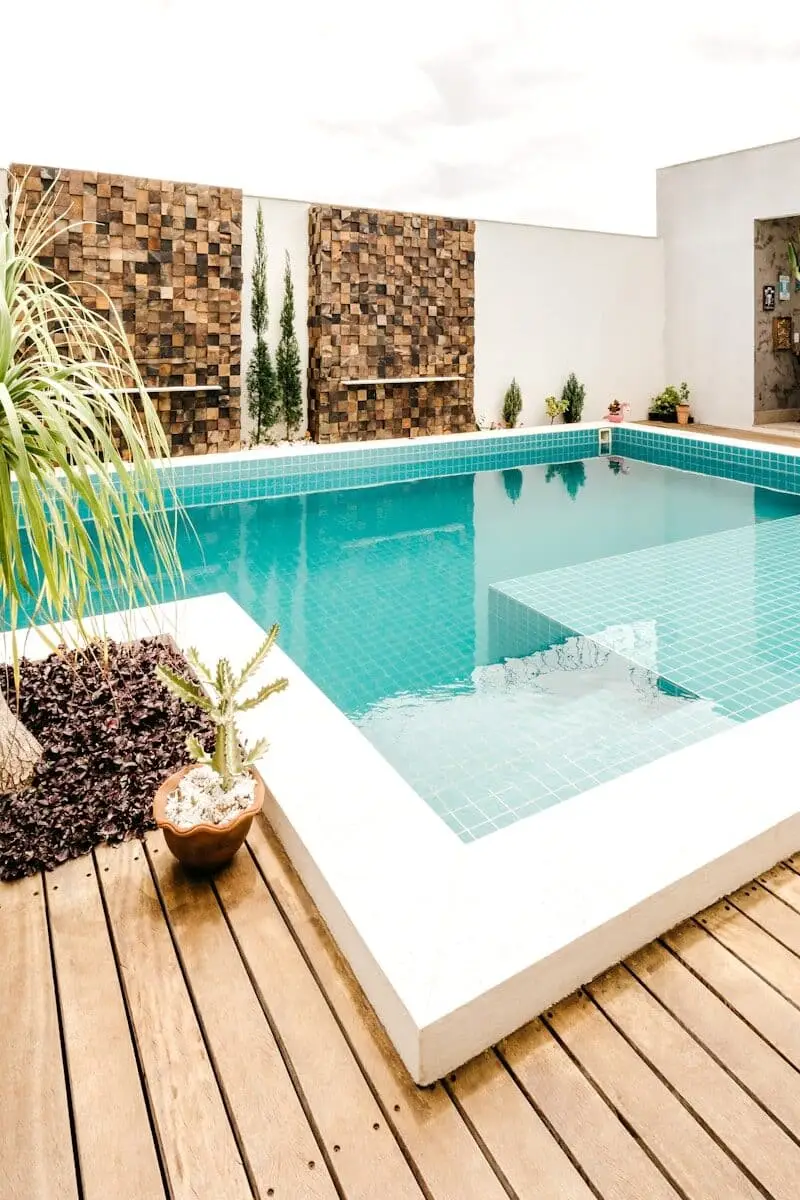
The signature zones of a South Florida estate come together as: Entry: a gallery-like arrival with one repeated specimen rhythm, clean ground plane, and concealed lighting. Pool decks: clean, comfortable, low-litter species set back from the water line, with no spiky forms at circulation. Waterfront edges: privacy, framed views, and storm resilience from salt-tolerant massing that also protects the bank. Interiors: atriums, double-height foyers, and covered lanais planted intentionally, with irrigation, drainage, and light planned as systems.
Waterfront planting is also a resilience decision: vegetation buffers slow wind-driven rain and stabilize edges, complementing the engineered systems covered in waterfront home construction and hurricane resilience design. Interior green moments follow the systems rules in biophilic design: waterproofing, drainage, grow light, and access.
Where is the luxury won or lost in a native Florida landscape?
The luxury of a native Florida landscape is won or lost in the coordination of materials and details: bed edges that align with hardscape joints, mulch and gravel selected as finishes rather than leftovers, irrigation heads and valve boxes concealed, lighting fixtures corrosion-rated, and planting held off the facade so the architecture breathes. The landscape should read as one composition with the hardscape, covered in the same drawings and mockups as the house.
Materials near salt need the same discipline as the building envelope; see coastal corrosion-resistant materials and premium sustainable materials.
What are the common pitfalls with native Florida plants, and how do you avoid them?
The common pitfalls with native Florida plants are over-collecting species instead of repeating a tight palette; treating natives as a budget shortcut and skipping soil preparation and establishment irrigation; ignoring mature sizes; letting beds swallow the hardscape; uncoordinated lighting and irrigation added late; and no maintenance specification, so a disciplined design decays into the untamed look owners feared. Every one is prevented by designing the landscape with the same rigor as the house.
How does Kass Construction & Development integrate landscape early?
Kass Construction & Development, a state-licensed (CGC1529472) boutique luxury builder in East Fort Lauderdale led by Mitch Kass, a licensed general contractor and attorney, with 100+ luxury residences delivered by Mitchell Kass and the firms he has led across Broward, Palm Beach, and Miami-Dade, brings the landscape designer into the project during design rather than after drywall, so grading, drainage, sleeves, irrigation, lighting circuits, and planted structure are coordinated with the architecture and permitting.
That early coordination is what makes courtyards, green walls, and waterfront edges land as designed; the process is described in pre-construction planning and how builders and architects collaborate. A custom build often runs 18 to 36 months and a high-end renovation 6 to 12 months; landscape belongs in the plan from the start. Contact Kass Construction & Development or call 954-607-4335.
What is the simple blueprint for a polished native-plant look?
The simple blueprint for a polished native Florida plant look is five steps:
- Map zones from the architecture (arrival, courtyard, pool, waterfront, service).
- Choose 5 to 9 core native species by form and texture, verified for salt, sun, and mature size.
- Design the ground plane and negative space as finishes.
- Engineer irrigation hydrozones, drainage, and lighting with the site utilities.
- Write the maintenance specification so the composition holds for a decade.
Which native Florida plants suit each zone of a luxury landscape?
Native Florida plants can be assigned by landscape zone, and the table below pairs the zones of a South Florida estate with species that read as designed rather than wild.
| Landscape zone | Native Florida plants that perform | Design note |
|---|---|---|
| Arrival and street frontage | Sabal palm, silver saw palmetto, coontie, Simpson’s stopper as clipped hedge | Repetition in odd-numbered groups; negative space between masses |
| Shade canopy | Live oak, gumbo limbo, pigeon plum, Jamaican dogwood | Placed for afternoon shade on the west elevation and terraces |
| Screening and privacy | Wild coffee, Simpson’s stopper, marlberry, Spanish stopper, cocoplum | Layered heights; evergreen; tolerant of shearing |
| Pool and terrace | Coontie, dune sunflower, muhly grass, blue porterweed, silver buttonwood | Low, salt-tolerant, no litter into the pool |
| Waterfront edge and seawall | Sea grape, silver buttonwood, sea oats on dunes, red and black mangrove where permitted | Salt and wind tolerant; mangrove work needs permits |
| Rain gardens and swales | Fakahatchee grass, swamp fern, blue flag iris, sand cordgrass | Handles heavy rain and short flooding |
| Courtyard and interior connection | Wild lime, firebush, necklace pod, native orchids and bromeliads on trees | Fragrance and pollinators near openings |
Plant selection and regional lists are maintained by the Florida Native Plant Society and the University of Florida’s Florida-Friendly Landscaping program; the design principles are developed in biophilic design for luxury coastal homes.
How are native Florida plants specified and installed on a custom home project?
Native Florida plants deliver the polished look only when they are specified, sourced and installed with the same discipline as the interior finishes, and the sequence below is how a luxury landscape is delivered.
- Landscape design starts with the architecture and the site survey, so canopy, screening and drainage are planned with the house rather than after it; see how builders and architects collaborate.
- Sun, wind, salt exposure and flood zone are mapped for each zone, using the parcel’s data from the FEMA Flood Map Service Center.
- Soil is amended for drainage where fill has been placed, and irrigation is designed for establishment then reduced, following water-management guidance from the South Florida Water Management District.
- Specimen trees and palms are tagged at the nursery and installed before hardscape where cranes need access.
- Shrubs and groundcovers are planted in masses at the specified spacing so the composition reads as designed on day one.
- Lighting, drainage and irrigation are coordinated with the automation and site systems described in energy management and sustainability systems.
- A maintenance specification is handed over: pruning form, fertilization limits and irrigation schedule, so the landscape keeps its intended shape.
Native planting also supports the storm and flood strategy in hurricane resilience design and the sustainable baseline in sustainable luxury home design in Florida; Kass Construction & Development brings the landscape designer into pre-construction on every Broward, Palm Beach and Miami-Dade project.
Frequently Asked Questions
Do native Florida plants really look high-end?
Yes, when composed with restraint: a tight repeated palette, strong forms, clean bed lines, and deliberate negative space read curated and architectural. The untamed look comes from over-collecting species and skipping structure, not from the plants being native.
What are the practical luxury benefits of native planting?
Visual consistency through heat, salt, and storms; water-smart irrigation without sparseness; less chemical dependency around living zones; and a landscape that matures gracefully, supporting curb appeal and resale photography for years.
Which native Florida plants work best near pools?
Low-litter, salt-tolerant, barefoot-friendly choices such as coontie, dwarf Fakahatchee grass, and cocoplum massing, set back from the water line, with no spiky forms at circulation paths. Verify each species against your site’s sun and drainage.
How many native Florida plants should a luxury landscape use?
A core palette of roughly five to nine species for the visible areas, repeated deliberately, with a few accents only where they matter. Repetition is what makes the landscape feel designed rather than collected.
Can native planting improve storm resilience on the waterfront?
Yes. Salt- and wind-tolerant massing such as sea grape, saw palmetto, and cocoplum buffers wind-driven rain, stabilizes edges, and recovers faster after storms, complementing the engineered seawall and drainage systems.
How do you bring native plants indoors without it looking like a garden center?
Intentionally: fewer, healthier, architectural placements in atriums, double-height foyers, and covered lanais, engineered as systems with waterproofing, drainage, grow lighting, and maintenance access designed in from day one.
When should the landscape designer join the project?
During design, not after construction. Grading, drainage, irrigation sleeves, lighting circuits, and planted structure all interact with the architecture and permitting, and late landscape design is how courtyards and waterfront edges get value-engineered away.