Sunrise Key waterfront homes sit in one of those Fort Lauderdale waterfront pockets where the details matter: not just the finishes you choose, but the seawall condition, the canal geometry, the flood strategy, and how the dock plan integrates with the architecture. This guide breaks down what to verify before you buy or design, how custom builds typically work here, what permitting and coastal compliance involve, how to coordinate the dock without delaying the house, why seawalls and drainage matter, realistic timelines, the new-build-versus-renovation call, and how Kass Construction & Development coordinates the home and the waterfront scope without surprises.
Key takeaways
- Where is Sunrise Key, and why are Sunrise Key waterfront homes so sought-after?
Sunrise Key sits just off Las Olas Boulevard in East Fort Lauderdale, close to everything yet reading as a quiet residential enclave with true canal-front living, quick Intracoastal access, privacy from through-traffic, and a high concentration of luxury estates. - What should you verify before you buy or design one of the Sunrise Key waterfront homes?
A Sunrise Key waterfront home is defined by its lot conditions: seawall type and condition, canal depth and width, bridge clearances, and dock eligibility. - Who is involved in a Sunrise Key custom build, and why does architect-driven, builder-led execution reduce rework?
Designing a custom Sunrise Key waterfront home means aligning architecture with coastal engineering: flood elevation strategy, hurricane-rated systems, long-span openings, and indoor-outdoor living, plus construction logistics on a tight waterfront site with dock or seawall constraints. - What permitting and coastal compliance do Sunrise Key waterfront homes typically require?
Sunrise Key waterfront projects commonly require layered approvals: building permits plus flood-zone and coastal resilience requirements, and separate coordination for seawall or dock work.
Where is Sunrise Key, and why are Sunrise Key waterfront homes so sought-after?
Sunrise Key sits just off Las Olas Boulevard in East Fort Lauderdale, close to everything yet reading as a quiet residential enclave with true canal-front living, quick Intracoastal access, privacy from through-traffic, and a high concentration of luxury estates. That combination makes it ideal for custom builds that prioritize views, boating convenience, and long-term property value.
How it differs from nearby Las Olas Isles or Seven Isles: Sunrise Key tends to feel more contained, with less pass-through traffic and a strong estate-home character. That has practical implications: access and staging need careful planning to reduce disruption; neighbor sensitivity is higher in luxury enclaves, so noise, truck routing, and jobsite cleanliness matter more; and waterfront expectations are elevated, including docks, outdoor living, and strong indoor-outdoor transitions. For the neighboring islands, see our Las Olas Isles and Las Olas waterfront homes guides.
What “waterfront” means on Sunrise Key: canal frontage connected into the wider Fort Lauderdale waterway network. What you can build and how you live on the water depends on lot orientation (where the home can open to water views), setbacks that shape the buildable envelope, seawall location and condition, and dock eligibility and layout constraints. A real waterfront plan starts with the lot, not the floor plan.
Why custom builds dominate among Sunrise Key waterfront homes: many properties include older housing stock, so owners choose either a significant modernization or a teardown to meet current expectations for coastal durability and hurricane-rated performance, larger openings and higher ceilings, updated flood and drainage strategies, and better indoor-outdoor waterfront entertaining.
Planning implications: discreet jobsite operations, tighter noise discipline, logistics planning for limited street and waterfront access, and neighbor protection (dust control, driveway and roadway protection, careful material storage). A waterfront build is as much about management as craftsmanship.
What should you verify before you buy or design one of the Sunrise Key waterfront homes?
A Sunrise Key waterfront home is defined by its lot conditions: seawall type and condition, canal depth and width, bridge clearances, and dock eligibility. Before design, verify the survey, flood zone, easements, seawall condition, and marine-use restrictions, because those facts control the footprint, the dock alignment, and the pool position.
Confirm first for Sunrise Key waterfront homes: a current boundary and topographic survey; the legal description and parcel configuration; recorded easements and right-of-way conditions; utility corridors and any constraints near the waterfront edge; and pool and waterfront hardscape feasibility within the buildable envelope. Check the parcel’s flood zone at the FEMA Flood Map Service Center and read our explainer on AE, VE, and X flood zones in Broward County.
Boating realities that shape design: no-wake and neighborhood boating etiquette; space for turning and maneuvering near the dock; how canal geometry affects the docking approach; and how dock placement interacts with outdoor living. Your architect can design a beautiful waterside facade, but the home lives better if the boating plan is equally deliberate.
Title and legal review: waterfront parcels can carry recorded restrictions or use limitations that get expensive if discovered late, including neighborhood rules where applicable, restrictions tied to waterfront features, and utility, drainage, or access rights at the waterfront edge. Because principal Mitchell P. Kass is both a licensed Florida general contractor (CGC1529472) and an attorney, Kass brings that transaction awareness to projects where the waterfront scope is tied to recorded constraints.
Due-diligence checklist, owner’s-rep style: survey review and buildable-envelope confirmation; seawall condition evaluation and waterfront-edge planning; flood strategy and elevation-intent discussion; preliminary budgeting that includes dock and marine allowances; and early feasibility for generators, service upgrades, and site access. Our feasibility study guide shows how the checklist becomes a decision.

Who is involved in a Sunrise Key custom build, and why does architect-driven, builder-led execution reduce rework?
Designing a custom Sunrise Key waterfront home means aligning architecture with coastal engineering: flood elevation strategy, hurricane-rated systems, long-span openings, and indoor-outdoor living, plus construction logistics on a tight waterfront site with dock or seawall constraints. The projects that run smoothly define responsibilities early and document handoffs clearly.
Who is typically involved on Sunrise Key waterfront homes: architect and interior designer; structural engineer; MEP engineering; surveyor and civil support as needed; marine contractor for dock, seawall, and waterfront scope; builder and specialty trades; and specialty glazing and door-system providers. Where coastal factors show up: corrosion resistance in fasteners, connectors, and hardware; waterproofing assemblies and detailing at transitions; exterior material durability and maintenance planning; window and door performance under wind-driven rain; and mechanical placement and resilience planning. Coastal building is about correct systems and detailing, not just “better materials”.
Why architect-driven plus builder-led execution reduces rework: a high-design waterfront home can fail on budget or timeline if the plans are not continuously aligned with buildability on tight sites, long-lead procurement realities, permit sequencing and inspection paths, and the waterfront interfaces where pools, seawalls, and docks converge. How Kass supports Sunrise Key builds: architecture and design partnerships; integrated project management and documentation; waterfront scope coordination alongside the vertical build; permitting support and sequencing; and owner’s representation for budget, schedule, and risk. Our luxury custom home building insights cover the model in depth.
What permitting and coastal compliance do Sunrise Key waterfront homes typically require?
Sunrise Key waterfront projects commonly require layered approvals: building permits plus flood-zone and coastal resilience requirements, and separate coordination for seawall or dock work. A builder with strong project management sequences surveys, engineering, and reviews so timelines stay predictable.
Typical permitting tracks: new build, renovation with major structural and systems upgrades, or teardown and redevelopment. Each brings different documentation and review needs, so define early whether the scope triggers additional engineering, elevation changes, or waterfront infrastructure work. Environmental and marine considerations: dock and seawall work often follows its own pathway, with separate drawings and engineering, review timelines and sequencing constraints, and inspections and site-access planning. Plan the marine scope in parallel with house design so neither becomes the other’s bottleneck; our guides on seawall construction and permitting and expediting seawall and flood-zone permits cover the details.
Utility coordination owners underestimate: electrical service modifications and panel strategy; generator planning and placement; plumbing tie-ins and routing; and stormwater approach and site drainage improvements. Designed late, these force redesigns to finished plans and landscaping. How Kass mitigates risk: state-licensed general contracting leadership, disciplined documentation and submittal tracking, clear schedules tied to milestones, and transparent communication on review cycles and dependencies. See our permitting and project management insights and hurricane-resistant construction guide.
How do you coordinate a dock on Sunrise Key without delaying the house?
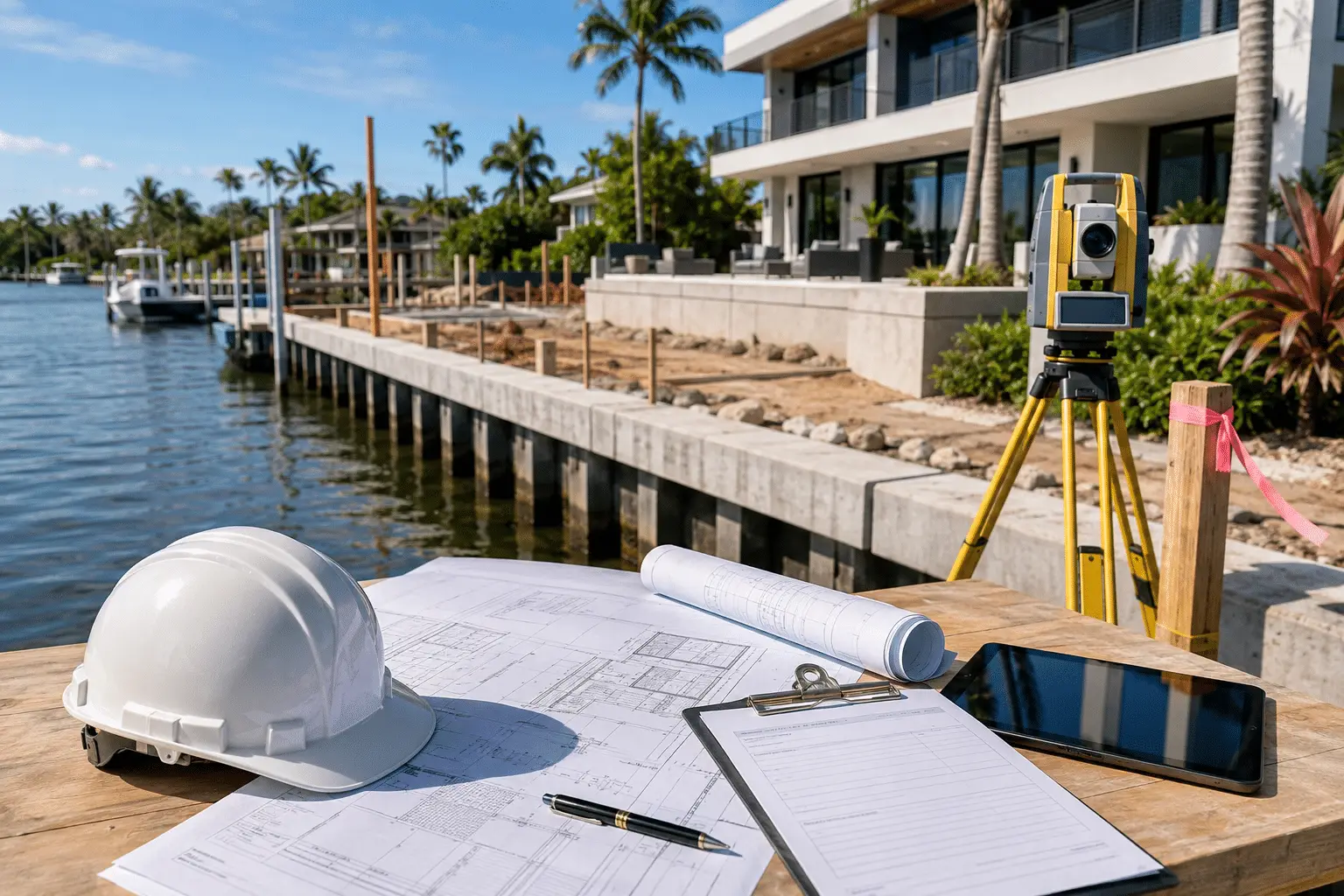
Dock coordination in Fort Lauderdale works best when planned in parallel with home design: confirm dock feasibility early, align the dock layout with the home’s outdoor living areas, and sequence permitting and marine construction so the dock, seawall, and site work do not conflict with foundations, pools, or final landscaping.
What dock coordination includes for Sunrise Key waterfront homes: dock layout planning based on waterfront-edge conditions; utilities to the dock (power, water, lighting, controls); lift planning where applicable and equipment placement; setback awareness and access points from the home; and integration with outdoor kitchens, patios, pools, and landscape. A dock should feel like part of the architecture, not an afterthought.
Builder versus marine contractor roles: the marine contractor typically owns dock and seawall execution; the builder coordinates interfaces, scheduling, and site logistics and makes sure the dock plan integrates with the home’s outdoor living design and utilities. The handoff points are where delays occur if they are not mapped early, so Kass emphasizes coordination so marine work does not collide with foundations, sitework, or final hardscape.
Owner priorities to decide early: lift versus no lift; entertaining space versus maximum slip utility; storage solutions and access points; and lighting, safety, and maintenance tolerance. Those decisions influence the entire backyard layout and even the rear elevation. Quality and durability planning: saltwater-rated hardware; composite versus wood and long-term maintenance expectations; and electrical and lighting systems that are robust and serviceable.
Why do seawalls and drainage matter so much for Sunrise Key waterfront homes?
Seawalls and site drainage are the critical invisible infrastructure on a Fort Lauderdale canal lot. A strong plan assesses seawall condition early, designs drainage and grading to manage heavy rains, and uses durable coastal materials, protecting the home, landscape, and dock from long-term water damage.
Why seawall condition matters before design: the seawall influences the waterfront-edge elevation and repair strategy, backyard usability and hardscape transitions, the scope and timing of marine work, and the budget, especially if replacement is necessary. Design the rear yard, pool, or dock without understanding seawall realities and you may redesign the whole site plan midstream; our seawall maintenance and cost guide covers what to expect. Drainage strategy for Sunrise Key waterfront homes: grading and collection routes; hardscape slopes and water management at patios; pumps where site conditions require; and landscape planning that does not trap water against the structure. This is where coastal builds either feel effortless or become maintenance-heavy.
Material selection in coastal builds: corrosion-resistant fasteners and connectors; concrete and reinforcing strategies appropriate for exposure; and waterproofing membranes with correct detailing. Kass’s integrated project management helps ensure these systems are not value-engineered into future problems. Our waterfront and coastal construction insights go deeper on each system.
How long does a Sunrise Key custom waterfront build take?
Most Sunrise Key custom builds move through design and engineering, permitting, and construction. Timelines depend on scope, complexity, approvals, procurement, and dock or seawall scope: construction of a custom home often runs 18 to 36 months, with design and permitting adding time in front of it, and a high-end waterfront renovation often runs 6 to 12 months. A builder-led, milestone-based plan with early procurement and parallel permitting keeps progress steady.
Phase 1, preconstruction and feasibility: survey confirmation and feasibility planning; early waterfront and seawall assessment; budget-range development and scope definition; and team selection and responsibility mapping. This phase reduces the unknowns that cause change orders later. Phases 2 and 3, design, engineering, and permitting as one system: engineering aligned with architectural intent early; permit submittals sequenced strategically; and dock and seawall pathways started in parallel where possible.
Phase 4, construction of Sunrise Key waterfront homes: waterfront sites need more logistics planning than a typical lot: material staging and deliveries, protecting neighboring properties, scheduling specialty trades and inspections, and coordinating exterior completion with marine work and landscaping. Long-lead items to plan early: specialty glazing and large-format doors; generators and switchgear; custom stone and tile; and custom millwork and metalwork. Kass ties proactive procurement to a transparent schedule so the job does not stall waiting on critical items.
New build or high-end renovation on Sunrise Key: how do you choose the right path?
The right choice between new build and renovation depends on the home’s structural condition, elevation and flood requirements, desired layout, and waterfront infrastructure. Renovations can be smart when the bones and elevation work; teardowns often win when you need a modern plan, higher resilience, or major seawall and dock reconfiguration.
When renovation makes sense for Sunrise Key waterfront homes: the structure is strong and adaptable; the layout can be modernized without fighting the building; the elevation and flood approach can be addressed responsibly; and the waterfront infrastructure is usable without major reconfiguration. Cost drivers unique to waterfront renovations: corrosion and aged systems behind finishes; unknown conditions at the waterfront edge; phased-construction complexity if the home is occupied; and updating mechanical systems for long-term reliability. Our teardown vs. renovation guide walks through the test.
Resale and long-term value: luxury buyers increasingly value design relevance and modern layouts, mechanical longevity and energy resilience, and insurance practicality tied to systems and mitigation. Kass supports both high-end remodeling and luxury new builds, helping owners choose the path that fits the property and their goals.
What should you look for in a builder for Sunrise Key waterfront homes, and what does working with Kass look like?
Choose a Fort Lauderdale builder who can manage both the house and the waterfront scope, including permitting, flood compliance, hurricane-rated systems, and dock or seawall coordination, with disciplined project management. Kass Construction & Development is a boutique, state-licensed luxury builder based in East Fort Lauderdale, serving Broward, Palm Beach, and Miami-Dade, known for architect-driven custom homes, precision execution, and transparent project management.
Who should be on the bench: coastal-experienced engineers and trades; marine contractors with consistent execution; specialty glazing and envelope expertise; and reliable MEP partners who understand resilience planning. How to evaluate the process: ask how they handle budget clarity and allowance structure, change-order policy and documentation, schedule reporting cadence, meeting rhythm and decision deadlines, and jobsite protection, cleanliness, and neighbor considerations. Confirm licensing through the Florida DBPR portal; our Fort Lauderdale builders guide has a fuller checklist. Kass positioning: owner’s representation, general contracting, and construction management under one roof, with a principal who is both licensed GC and attorney, structured to reduce risk and protect long-term value on waterfront projects; see what an owner’s representative does.
A practical preconstruction checklist for Sunrise Key waterfront homes: property and legal (current survey and buildable envelope, title and restriction review, easements and utility locations, seawall condition and waterfront-edge plan); permitting plan (submission order and dependencies, parallel marine track where feasible, expected reviews and inspection milestones); budget controls (clear allowances and finish standards, a contingency appropriate for waterfront scope, change-order rules and approval workflow); and execution readiness (a long-lead procurement list tied to the schedule, a site logistics and staging plan, and a neighbor-protection plan and jobsite rules).
What working with Kass looks like: a builder-led, architect-aligned process of feasibility, budgeting, permitting coordination, and high-precision construction while managing dock and seawall interfaces and coastal compliance. Communication runs on milestone-based updates, transparent schedules and dependency tracking, clear decision deadlines for finishes, systems, and long-leads, and written documentation that protects scope and quality. Closeout supports long-term ownership: documentation, warranties, and operating guidance, maintenance planning for coastal materials and systems, and a practical handoff that keeps the home performing. Explore our services, projects, and about page, or contact us to validate feasibility early, including the dock and seawall interfaces that so often drive waterfront complexity.
| Item | What to settle | Why it has to happen early |
|---|---|---|
| Vessel | The boat the owner actually intends to keep | Everything about the dock follows from it |
| Water depth | Controlling depth at low tide along the frontage | Determines whether the vessel can berth at all |
| Air draft | Fixed bridge clearance on the route out | A limit no dock design can overcome |
| Dock permits | What is approved on file against what exists | Unpermitted structures must be resolved first |
| Lift capacity | Rated capacity against the loaded vessel weight | Undersized lifts are replaced, not upgraded |
| Utilities | Power, water, and lighting to the dock | Trenching is far cheaper before the yard is finished |
How is dock coordination in Fort Lauderdale sequenced against the house on Sunrise Key?
Dock coordination in Fort Lauderdale is a scheduling problem as much as a permitting one, and the table below shows how the dock, lift and seawall work on Sunrise Key line up against the phases of the house.
| House phase | Dock and seawall work | Approval in play | Why the order matters |
|---|---|---|---|
| Feasibility | Seawall inspection, water depth, canal width, bridge clearance, lift capacity for the boat | None yet | Decides whether the lot supports the vessel and the budget for the wall |
| Design | Marine engineer designs seawall, dock, pilings and lift with the house drawings | County environmental application prepared | Dock position sets the terrace, pool and view lines |
| Permitting | County license, state authorization where on submerged land, federal general permit | Filed first, before the city building permit | These run on their own calendars and set the start date |
| Site work | Seawall repair or replacement; pilings driven | Inspections at embedment and cap | Wall must be sound before the foundation goes in behind it |
| Structure and envelope | Dock deck and lift installed once heavy equipment is off the waterfront | Final marine inspections | Protects the new dock from construction damage |
| Close-out | Utilities to the dock, lighting, lift commissioning, as-built survey | State and federal completion certifications | Handover file for insurance and resale |
Flood elevation for the lot is at the FEMA Flood Map Service Center, manatee conditions are published by the Florida Fish and Wildlife Conservation Commission, and marine contractors are verified at myfloridalicense.com. The permit path is in seawall construction and permitting.
What is the sequence for Sunrise Key custom builds?
Sunrise Key custom builds follow an order in which the water is settled before the architecture, and the steps below are that order on this deepwater isle.
- Survey with the mean high water line, seawall cap and flood datum; zone and freeboard per AE, VE and X flood zones in Broward County.
- Renovate-or-rebuild study per feasibility studies for luxury home builds.
- Architect-driven design with builder-led pricing, per luxury home architecture and design in South Florida.
- Marine engineering and shoreline permits first, then the city permit.
- Seawall and pilings, then the house to hurricane-resistant construction with coastal corrosion-resistant materials.
- Dock deck and lift installed late; commissioning and handover; the neighboring markets are in Las Olas Isles and Las Olas waterfront homes.
Frequently asked questions about Sunrise Key waterfront homes
Why are Sunrise Key waterfront homes so sought-after in Fort Lauderdale?
Sunrise Key offers true canal-front living with quick Intracoastal access, privacy from through-traffic, and a high concentration of luxury estates just off Las Olas Boulevard. It suits custom builds that prioritize views, boating convenience, and long-term property value.
How does Sunrise Key differ from Las Olas Isles or Seven Isles?
Sunrise Key reads as a more contained, quiet enclave with less pass-through traffic and a strong estate-home character. During construction that means tighter planning for access and staging, more neighbor sensitivity around noise and cleanliness, and elevated expectations for docks, outdoor living, and indoor-outdoor transitions.
What should I verify before buying or designing a Sunrise Key waterfront home?
A current boundary and topographic survey, the legal description and easements, utility corridors near the waterfront edge, flood zone and elevation intent, seawall type and condition, canal geometry and bridge clearances, dock eligibility, and any recorded marine-use restrictions. Those facts control the footprint, dock alignment, and pool position.
What does dock coordination involve for Sunrise Key waterfront homes?
Dock layout based on waterfront-edge conditions, utilities to the dock, lift planning and equipment placement, setbacks and access from the home, and integration with outdoor kitchens, patios, pools, and landscape. The marine contractor executes the dock and seawall; the builder coordinates interfaces, scheduling, and logistics so marine work never collides with foundations or hardscape.
Why does the seawall matter before design starts?
The seawall sets the waterfront-edge elevation and repair strategy, backyard usability and hardscape transitions, the scope and timing of marine work, and a potentially large budget line if replacement is needed. Designing the rear yard, pool, or dock without knowing seawall condition risks redesigning the whole site plan midstream.
How long does a Sunrise Key custom waterfront build take?
Construction of a custom home often runs 18 to 36 months, with design, engineering, and permitting adding time in front of it; a high-end waterfront renovation often runs 6 to 12 months. Dock and seawall scope, permitting sequencing, and long-lead items such as specialty glazing and generators drive the schedule most.
Should I renovate or rebuild on Sunrise Key?
Renovate when the structure is strong and adaptable, the layout can be modernized without fighting the building, the elevation and flood approach can be addressed responsibly, and the waterfront infrastructure is usable. Rebuild when you need a modern plan, higher resilience, or major seawall and dock reconfiguration.
How does Kass Construction & Development approach Sunrise Key waterfront homes?
Through a builder-led, architect-aligned process covering feasibility, budgeting, permitting coordination, and precision construction, with the dock and seawall interfaces managed alongside the vertical build. Kass is a state-licensed boutique luxury builder in East Fort Lauderdale serving Broward, Palm Beach, and Miami-Dade, with owner’s representation available.
Sunrise Key waterfront homes reward owners who lock in the property facts first, align the full team, including the marine contractor, and plan permitting and procurement before drawings harden. If you are evaluating a Sunrise Key lot, considering a teardown, or weighing a high-end renovation, contact Kass Construction & Development to discuss your property, goals, and the right path to a high-performing waterfront home.