South Florida canal waterfront homes sit on the dense residential canal network that threads through Broward, Palm Beach, and Miami-Dade. The water is calmer than the Intracoastal or the ocean, but the engineering is not simpler, because the seawall, the drainage, and the elevation strategy carry the property.
Key takeaways
- What counts as one of the South Florida canal waterfront homes?
A South Florida canal waterfront home is a property fronting the residential canal system rather than open water. - What are the signs a canal seawall is failing?
The signs a South Florida canal seawall is failing are leaning or displacement, cracking and spalling in the cap, corrosion of structural members, and sinkholes or settling pavers behind the wall. - Who regulates work on canal waterfront homes?
Work on canal waterfront homes in Broward, Palm Beach, and Miami-Dade is regulated by local building and zoning review, floodplain compliance with elevation documentation, wind-load and product approvals, and separate marine approvals for seawall or dock work. - When does the substantial improvement rule apply to canal waterfront homes?
The substantial improvement rule applies to South Florida canal homes when a renovation grows large enough to trigger full floodplain compliance.
This guide covers what actually changes on a canal lot: how to read a seawall before it fails, who regulates work at the waterline, when a renovation crosses into a rebuild, which upgrades are worth bundling with seawall work, and the timelines and cost drivers to plan around. Kass Construction has built and renovated luxury residences across South Florida under Mitchell Kass and the firms he has led.
What counts as one of the South Florida canal waterfront homes?
A South Florida canal waterfront home is a property fronting the residential canal system rather than open water. South Florida canal waterfront homes are generally more protected from wind and wave energy than Intracoastal or oceanfront sites, but they carry their own constraints: narrower water, tighter lots, a high water table, and a seawall that is often decades old.
What changes on canal waterfront homes relative to open water. Wave and wake energy are lower, which reduces some structural demand, but canal frontage concentrates other risks. Water depth and canal width govern the vessel you can keep and how it turns. Bridge clearances between the property and open water cap air draft, and cannot be changed later. Lot geometry is often tighter, and construction access is constrained on both the street side and the water side, which affects barge access and marine equipment as much as deliveries.
The high water table is the condition owners underestimate. It affects excavation, dewatering, pool construction, and stormwater design, and it can add real cost to work that looks routine on a drawing. That is why the geotechnical report belongs early rather than after budgeting. See our companion guides to Intracoastal Waterway homes and Atlantic Ocean waterfront homes for how the other waterway types compare.
What are the signs a canal seawall is failing?
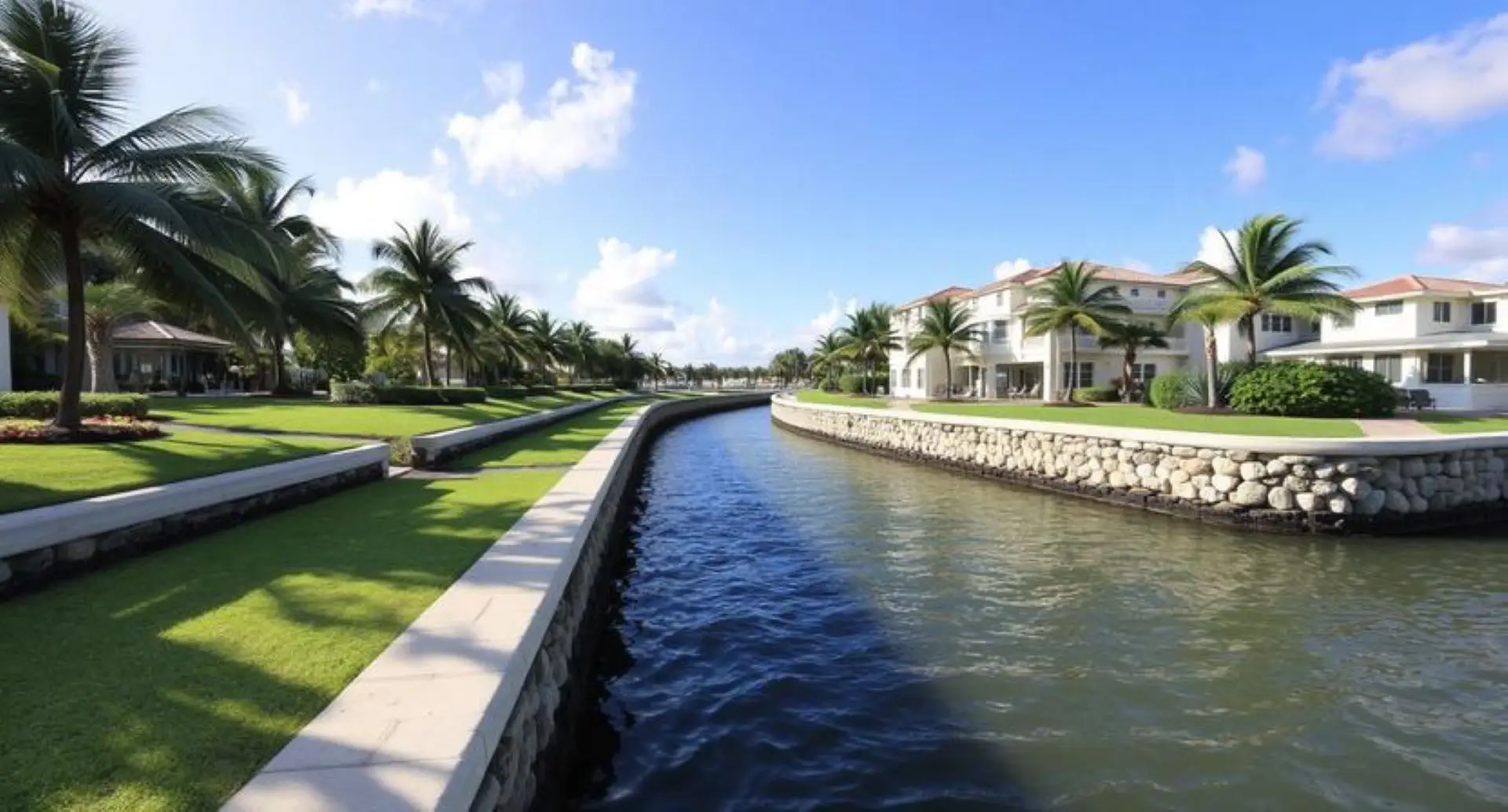
The signs a South Florida canal seawall is failing are leaning or displacement, cracking and spalling in the cap, corrosion of structural members, and sinkholes or settling pavers behind the wall. On South Florida canal waterfront homes those symptoms usually point to failed drainage rather than a single defect, which makes them structural rather than cosmetic.
Why seawalls actually fail. Rarely from one cause. They fail because several small issues were left alone. A long-lasting wall depends on an engineered system, corrosion-resistant reinforcement, properly designed tiebacks or anchors, and drainage that relieves hydrostatic pressure through weep holes, filter fabric, and correct gravel backfill. When drainage is wrong, water accumulates behind the wall and you see voids, settlement, and moving pavers long before the wall visibly leans.
What to inspect on canal waterfront homes, and when to act. Cap condition and cracking; the ground behind the wall for voids and sinkholes; tieback condition where visible; and cap height relative to your intended finished grades, since a cap set too low limits what the yard and pool deck can ever do. Repair is reasonable when the structure is sound and the drainage can be corrected. Replacement becomes the realistic path when there is displacement, chronic washout, compromised structural members, or a planned dock or lift upgrade that needs stronger support. Our seawall construction and permitting guide, maintenance and cost guide, and costs and ROI analysis go deeper, and seawall versus elevated foundation covers the strategic choice.
Who regulates work on canal waterfront homes?
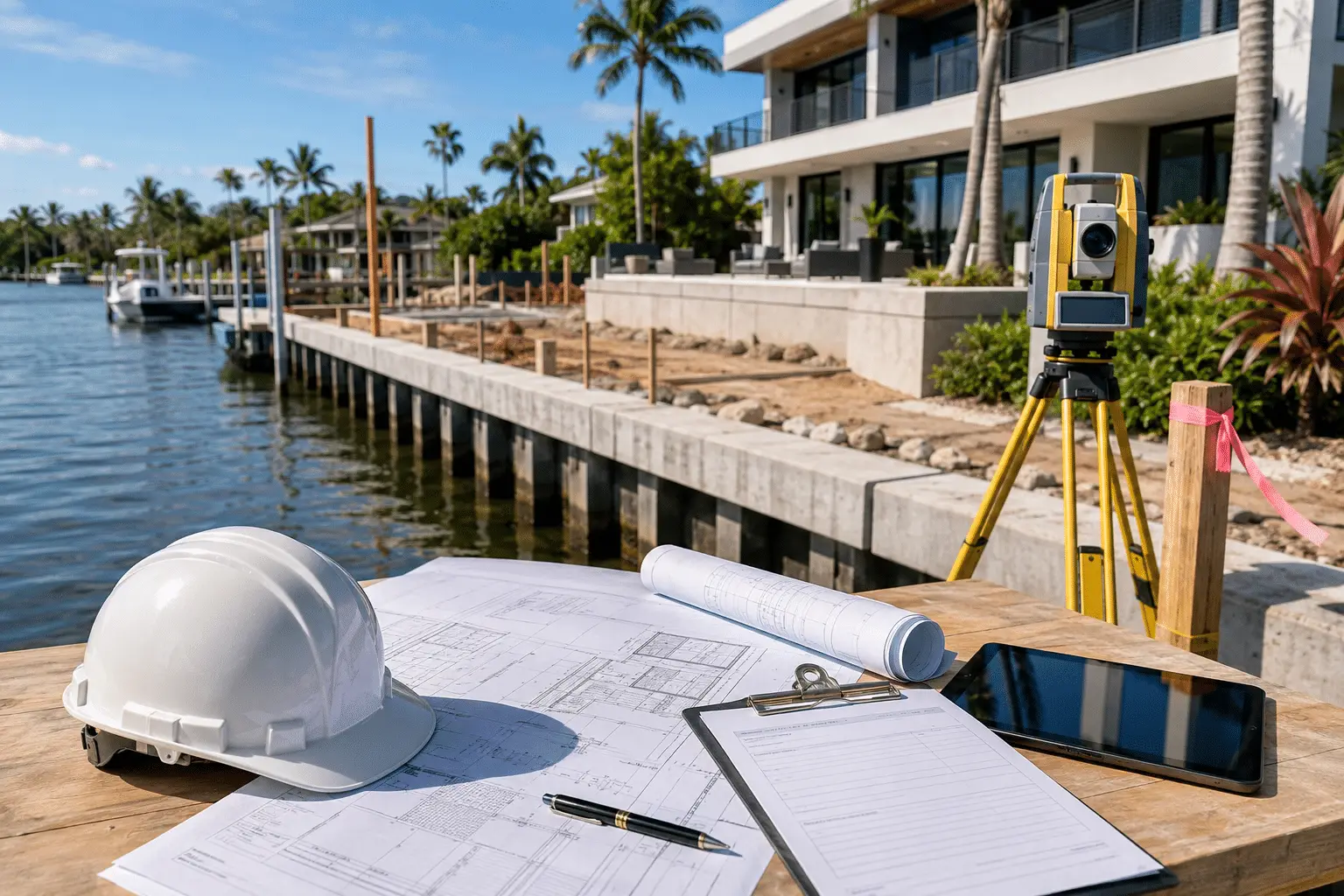
Work on canal waterfront homes in Broward, Palm Beach, and Miami-Dade is regulated by local building and zoning review, floodplain compliance with elevation documentation, wind-load and product approvals, and separate marine approvals for seawall or dock work. On South Florida canal waterfront homes the marine track runs on its own timeline and should start early.
The two authorities most often missing from the plan. Shoreline and submerged-lands work falls under the Florida DEP submerged lands program, and work affecting navigable water can additionally require authorization from the Army Corps of Engineers, whose Florida regulatory program explains how those applications are handled. Both run independently of the building permit, which is why a seawall treated as a late add-on becomes the item that stalls everything behind it.
What the submittal usually needs: a current survey with clear boundaries, an engineered design for the wall and any attachments, seawall condition assessment, elevation documentation, product approvals for impact-rated openings and roofing on the building side, and as-builts at closeout. Environmental review can also apply where seagrass, manatee protection, or turbidity control are in play. Verify any contractor’s license through the Florida DBPR license search, and see our guides to expediting seawall and flood zone permits, why permits get delayed, and permitting timelines.
When does the substantial improvement rule apply to canal waterfront homes?
The substantial improvement rule applies to South Florida canal homes when a renovation grows large enough to trigger full floodplain compliance. Under National Flood Insurance Program rules, once improvement costs reach roughly half the structure’s market value, the building is generally treated as substantially improved and must be brought into current floodplain requirements, which can include elevating it.
Why it decides canal projects specifically. Much of the canal network was developed decades ago, so many homes sit at older finished floor elevations. An ambitious remodel can cross the threshold and trigger a requirement to raise the structure, which changes the economics of the whole project and frequently tips the decision toward rebuilding. The threshold is administered locally and valuation varies, so confirm the treatment with your municipality before committing to a budget rather than after demolition.
Where to confirm the numbers. FEMA’s Map Service Center is where the mapped designation is confirmed, an elevation certificate documents what was built and at what height, and FEMA’s floodplain management resources explain the framework. See our guides to flood-zone retrofitting, FEMA elevation certificates, AE, VE, and X flood zones, and flood zone requirements in Broward County.
New build or renovation on canal waterfront homes?
On a South Florida canal lot, renovate when the structure and elevation already support your goals, and build new when they cannot without over-investing in a compromised base. On South Florida canal waterfront homes the finished floor elevation and the seawall usually settle it before the floor plan does.
What the comparison turns on: the age and original construction quality of the home; existing elevation against current requirements; roof-to-wall connections and the wind-load path; whether existing openings can accept impact-rated units without structural change; the age of plumbing, electrical, and mechanical systems; evidence of prior water intrusion; seawall condition, which can be a major scope on its own; and permit history, since unpermitted work by prior owners complicates future approvals. Compare the paths in our teardown versus renovation guide, financial and timeline comparison, and whole-home renovation guide.
What are the non-negotiables on canal waterfront homes?
The non-negotiables on South Florida canal waterfront homes are an elevation strategy, a hardened envelope, corrosion-resistant specification, and water management designed as a system. On South Florida canal waterfront homes these are requirements rather than upgrades, because the environment finds weak specification quickly.
The envelope and structure: impact-rated windows and doors with correctly engineered door packages, roof assemblies and fastening schedules matched to current standards, a continuous load path from foundation to roof, and corrosion-resistant hardware and exterior metals. Glazing requirements sit in Chapter 24 of the Florida Building Code, and FEMA’s coastal construction guide explains how design elevations are established. See our hurricane-resistant construction guide and corrosion-resistant materials guide.
The site and the systems: grading and routing that move water away from the structure without pushing it onto neighbors, pool deck elevations that do not send runoff back toward openings, drainage sized for the rainfall these storms actually deliver, and mechanical and electrical equipment raised or protected. That last item is consistently the highest-value and most-skipped upgrade, because it decides whether a flood event is an inconvenience or a gut renovation. See our elevated foundation guide.
Which upgrades are worth bundling with a seawall project?
Bundle with a South Florida seawall project anything that lives behind, above, or attached to the wall. On South Florida canal waterfront homes the access, excavation, and permitting are already open during seawall work, so bundling adjacent scope avoids paying twice to disturb the same ground.
The scopes that pair naturally: dock rebuild or modernization and boat lift installation, since both tie into the wall; electrical and water pedestals and shore-power planning; drainage improvements behind the wall, which is the work that protects the new wall; hardscape, pool deck, and landscaping that would otherwise be torn up later; and cap height adjustments coordinated with finished grades. Monitoring and automatic water shutoff systems are worth considering at the same time for owners who travel. Our dock coordination guide and smart flood mitigation technologies cover the options, and how flood zones affect insurance premiums explains the documentation side.
How long do canal waterfront homes take, and what drives cost?
A custom South Florida waterfront build often runs 18 to 36 months from design through closeout, and a high-end waterfront renovation often runs 6 to 12 months. On South Florida canal waterfront homes, marine approvals and long-lead glazing set the pace rather than construction speed.
The cost drivers worth pricing early: seawall repair or replacement, which can be a substantial scope on its own; dock, lift, and marine utility work; foundation and any elevation the site requires; dewatering and excavation driven by the water table, which also affects pool construction; impact-rated glazing packages, which are expensive and long-lead; corrosion-resistant materials and hardware; drainage and site work; and the productivity cost of a narrow canal lot with limited staging on both the street and the water side.
Sequencing is what protects the schedule. Marine scope should be resolved early because it controls access, staging, and critical-path permitting, and replacing a wall after the pool and hardscape are finished means paying to rebuild work you already bought. Our cost to build guide, cost per square foot analysis, soft costs breakdown, and guide to avoiding cost overruns break these down, alongside our realistic construction timeline and contract structure comparison.
How do you choose a builder for canal waterfront homes?
Choose a builder for canal waterfront homes by looking for completed canal and waterfront work in Broward, Palm Beach, or Miami-Dade, direct experience with seawall permitting, established marine and engineering relationships, and transparent contract and reporting practices. On South Florida canal waterfront homes, seawall and marine experience is the qualification that matters most.
What to ask before you sign. How many seawall and waterfront projects the builder has completed locally; who prepares and files the marine applications, and when; how the contract handles allowances, change orders, and contingency; what the weekly reporting delivers; and how concealed work such as backfill, drainage, and tiebacks is documented before it is covered. Our guides to choosing the right luxury builder, the risks of hiring an unqualified builder, and our client stories cover the evaluation.
| Factor | What to verify | What it decides |
|---|---|---|
| Canal width | Width at your frontage and at the turns | Whether a larger vessel can maneuver at all |
| Controlling depth | Depth at low tide along the route to open water | The draft the property can serve |
| Bridge clearance | Fixed spans anywhere on the route out | A permanent ceiling on air draft |
| Seawall | Cap condition, height, tie-backs, and permit history | Usually the largest single waterfront line item |
| Neighboring walls | Height and condition either side of you | Overtopping risk and the order of works |
| Dead end or through canal | Flow, flushing, and traffic past the dock | Water quality, wake, and privacy |
Which upgrades are worth bundling with a seawall project on canal waterfront homes?
On South Florida canal waterfront homes the seawall job opens the yard, brings marine equipment to the site and triggers environmental review once, so several other upgrades cost less when they ride along with it.
| Upgrade | Why it pairs with the seawall | Typical added review |
|---|---|---|
| Cap raise to the county minimum elevation | Done in the same pour as the new cap; impossible to add cheaply later | Included in the seawall permit |
| Dock, pilings and boat lift | Same barge, same pile driver, same environmental application | City dock permit plus the county and state authorizations already in hand |
| Yard drainage and tie-back replacement | The yard is open behind the wall; the deadman system is exposed | Usually included; drainage to the canal may need a separate outfall detail |
| Pool and terrace re-leveling | The pool deck must meet the new cap height; settlement behind the old wall is fixed at the same time | Pool and building permits |
| Shore power, lighting and water at the dock | Conduit runs before backfill and paving | Electrical permit under the dock scope |
| Rip-rap or living shoreline | Can improve the environmental permit outcome and reduce wave loading on the new wall | Reviewed with the seawall application |
Cap elevation minimums are set by county code, and structures over state-owned submerged land are authorized by the Florida Department of Environmental Protection; the flood zone that governs the house behind the wall is on the FEMA Flood Map Service Center. Costs and returns are covered in seawall construction costs and ROI and the seawall maintenance cost guide, and the dock side in dock coordination on Sunrise Key.
What is the order of a seawall upgrade on canal waterfront homes?
Seawall upgrades on canal waterfront homes are sequenced the same way whether the house is being renovated or rebuilt behind them:
- Have a marine engineer inspect the wall, record the existing cap elevation against the county minimum, and recommend repair, cap raise or replacement.
- Obtain a survey with the property line at mean high water and soundings in front of the wall.
- Decide the dock and lift program now, so pilings and the lift’s electrical are included in the same application.
- File the county environmental and state applications, and the city building permit for the wall and dock, before any house permit; see expediting CCCL, seawall and flood zone permits.
- Specify corrosion-resistant reinforcement, sheet piles and hardware for the wall, per coastal corrosion-resistant materials.
- Confirm whether the seawall cost counts toward the substantial improvement calculation for the house, using retrofitting homes under flood zone regulations.
- Build the wall, dock and drainage first, then re-level the pool deck and terraces to the new cap, then start the house work.
- Close the permits with an as-built survey and keep the engineer’s report and warranties with the property file.
What the delays cost if the water side is filed late is quantified in permit delays on South Florida luxury homes, and the elevation decision that follows the new cap in seawall vs elevated foundation. City-specific versions of the same work are covered in Oakland Park waterfront homes, Wilton Manors waterfront homes and Lighthouse Point waterfront homes.
Frequently asked questions about South Florida canal waterfront homes
How do I know if my seawall needs replacing rather than repair?
Repair is reasonable when the structure is sound and drainage can be corrected. Replacement becomes realistic with visible leaning or displacement, chronic washout, compromised structural members, or a planned dock or lift upgrade that requires stronger support. A marine engineer should make the call.
Why does drainage behind the wall matter so much?
Because hydrostatic pressure is what pushes a seawall over. Weep holes, filter fabric, and correct gravel backfill relieve that pressure. When they are missing or clogged, water builds up behind the wall and produces voids, settlement, and eventually structural failure.
Who approves seawall work?
More than one authority. Local building and zoning review applies, shoreline and submerged-lands work falls under Florida DEP, and work affecting navigable water can require Army Corps authorization. Each runs on its own timeline, so start the marine track early.
Will a large renovation force me to elevate the house?
It can. If improvement costs approach roughly half the structure’s market value, the project may be treated as a substantial improvement and required to meet current floodplain rules. Much of the canal network is older, so this comes up frequently.
How does the high water table affect a canal project?
It affects excavation, dewatering, pool construction, and stormwater design. Work that looks routine on a drawing can carry real cost once dewatering is required, which is why the geotechnical report belongs early rather than after the budget is set.
Should I do the dock at the same time as the seawall?
Usually yes. The access, excavation, and permitting are already open, and the dock ties structurally into the wall. Doing them separately means disturbing the same ground twice and paying for it twice.
How do I compare two canal waterfront homes on different canals?
Compare the water before the house when shopping canal waterfront homes. Two canal waterfront homes with similar interiors can differ enormously in canal width, depth at the dock, bridge clearance to open water, and seawall condition. The house can be changed. The canal cannot.
Do canal waterfront homes need different landscaping choices?
Near the water edge, yes. Roots, irrigation runoff, and hardscape loads all interact with the seawall, so planting plans for canal waterfront homes keep heavy trees and structures back from the cap. It is a small discipline that protects a very expensive wall.
Are canal waterfront homes quieter than Intracoastal properties?
Generally, and buyers feel it. Canal waterfront homes sit off the main navigation channels, so wake, traffic, and noise are lighter than on the Intracoastal itself. The tradeoff is a longer idle to open water, which is exactly the tradeoff worth weighing consciously.
How do you start planning a South Florida canal waterfront project?
Kass Construction builds and renovates luxury waterfront residences across Broward, Palm Beach, and Miami-Dade counties, coordinating the house, the seawall, and the dock as one project rather than three. With four decades in Florida real estate, law and construction and 100+ luxury residences delivered by Mitchell Kass and the firms he has led, and with Mitch Kass serving as both a licensed general contractor, license CGC1529472, and an attorney, contracts, permitting, and risk get unusual attention. To discuss a canal property, get in touch or call 954-607-4335.
Related waterfront guidance. See our companion guides to New River waterfront homes, Middle River waterfront homes, and Tarpon River waterfront homes, along with Lauderdale Isles and Oakland Park.